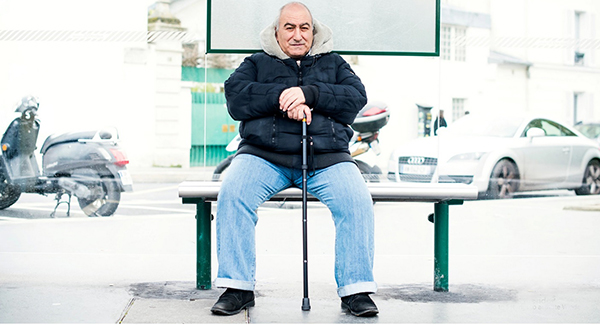
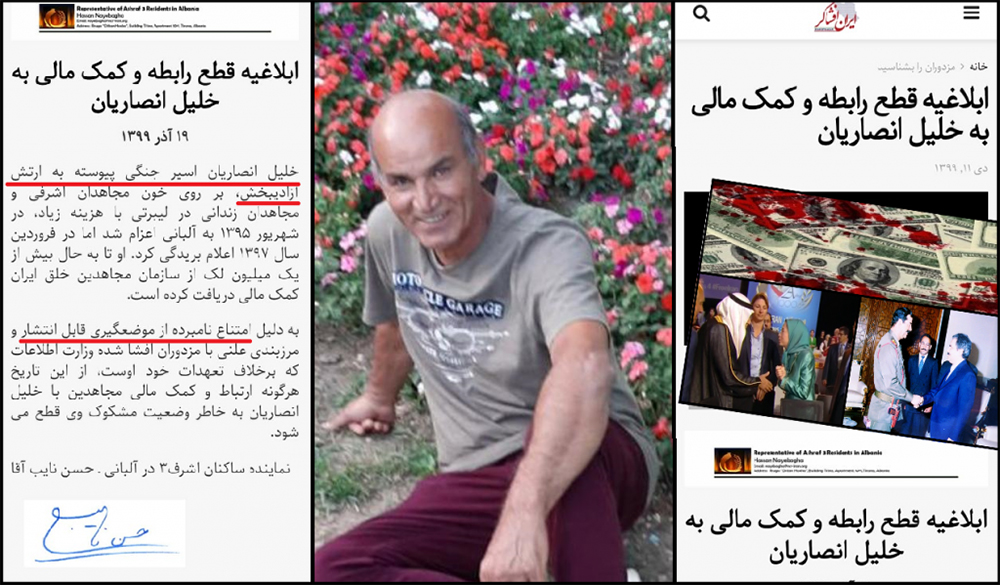
Mr. Gholam Ali Narimi from Khoozestan Province is presently in the MEK paramilitary camp of Manza in Albania.
He was born 1960. He joined MEK in 1976 when he was 16 years old. Today he is 60 years old.
His family in Khoozestan in Iran want to meet him. However the Albanian government does not allow his family to come to Albania since Maryam Rajavi, the leader of MEK cult claims that these Iranian families are terrorist and want to kill their family member.
In this video the aged mother and the sister of Ali Narimi appeal the Albanian government to let them travel to Albania and visit their beloved Ali:
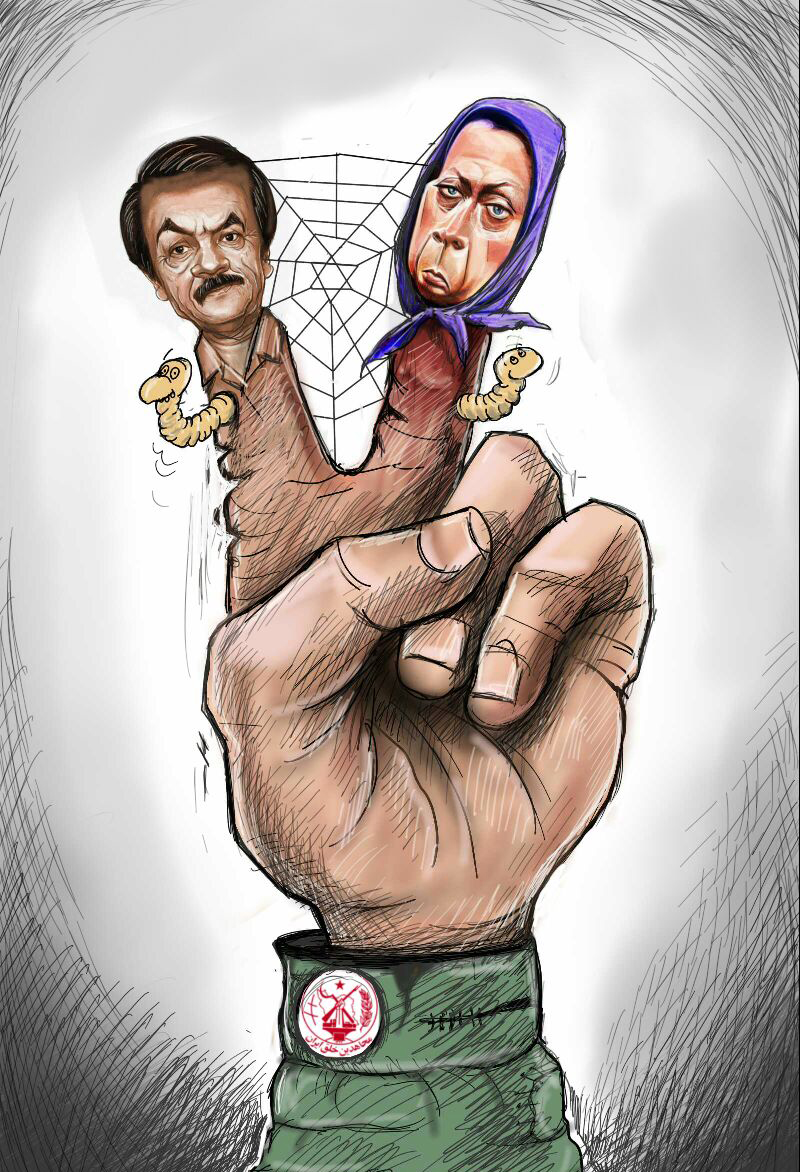
Rajavis and Cult Leadership
Following the publication of the news of Shahin Qasemi’s death by the news media of the Mujahedin Khalq Organization (the MKO/ MEK/ PMOI/ Cult of Rajavi), her brother Siavash Qasemi contacted the office of Nejat Society in Ahvaz, Khuzestan and asked to publish the message of his family’s grief for the loss of his sister:
It is necessary to make our voices heard by the public

My family and I have not had any news about my sister for 40 years. During the past years, my brother died and Shahin did not call to offer condolences. At first, I was not familiar with the atmosphere ruling the MEK and I did not know that the leaders of the group do not allow the members to contact their families. Hence, I thought that my sister had lost her feelings and emotions for her family.
When I got to know about the relations inside the MEK, I found out that she was not allowed to contact the outside world. I got assured that Massoud Rajavi is the main culprit for the ruined relationship between Shahin and us. He did not even let her know about the death of our brother. My family and I consider Rajavi as the main criminal to be charged for the death of my sister.
Why didn’t Maryam Rajavi –who weeps crocodile tears for Shahin’s passing—think of us as her family during those 40 years? Why didn’t she inform Shahin of the death of her brother? Is it humanitarian that the group leaders just gave us the news of her death after 40 years of separation and unawareness of her conditions? Why didn’t they tell us that she was sick, maybe we could help her with her treatment?
Therefore, I announce that Rajavi is the main culprit for the death of my sister. I regard her death as a murder. God damn Rajavi who victimized my sister and other people like her, and broke the hearts of their families.
This is the fate of some sincere and naïve youth who were abused by the Rajavis and were finally buries under the soil with their wasted wished to see their loved ones.
Siavash Qasemi
Nejat Society Khuzestan office
News of the deaths of at least two MEK members from COVID-19 last week was troubling. In April, Albania was warned that the MEK’s refusal to allow public health officials to access the closed camp in Manez could put the lives of the residents and local citizens at risk. Families of MEK members have petitioned Edi Rama and his government to take steps to prevent a tragedy. Unfortunately, the state of Albania appears to be in thrall to the Rajavi cult and has failed to challenge, change or contain it. Health officials are still denied access to the MEK’s closed camp, which has no registered doctors among its residents, and deaths there are not subject to a Coroner’s report. It is hard to imagine worse conditions in the fight against the coronavirus pandemic.
Instead of putting the lives of her followers at the forefront of her concerns, MEK leader Maryam Rajavi gleefully claimed these newly dead as “martyrs” and heaped praise on them simply for dying. Two things are significant in this callous declaration. First, the cause of death was missing, unlike all previously announced deaths for which some explanation – true or not – has been forthcoming. Such an omission will be interpreted as an admission; these individuals really did die from COVID-19.
Second, Rajavi has found a new way to exploit the concept of ‘martyrdom’ which her husband so skilfully manipulated for years. Not only did MEK websites proclaimed the dead as martyrs, but now Rajavi heaped praise on them for dying without abandoning “the struggle”. In doing so, Rajavi has redefined what martyrdom means for the members. To achieve martyrdom now, all one has to do is to die while obedient to Rajavi.
In 1965, the MEK founders adopted the Shia culture of venerating martyrdom along with lessons learned from Marxist revolutionary struggles. The MEK celebrated its first suicide bombing on 9/11: a young MEK activist stepped forward to clasp Ayatollah Sayyid Asad Allah Madani after the Friday Prayer on September 11, 1981, exploding a bomb that killed them both. Revolutionary struggle before and after the 1979 Revolution produced its share of martyrs; mostly helped by the zealous purges of opposition to Ayatollah Khomeini’s newly formed Islamic Republic.
When Massoud Rajavi seized leadership of the MEK, the organization’s fate was sealed. The self-appointed guru instigated a programme of coercive mind control (aka brainwashing) which resulted in a membership fearfully and mindlessly obedient to his whims and demands. In re-purposing the MEK from revolutionary group to personality cult used to pursue a terrorism campaign against Iran, Rajavi very quickly realised that martyrdom was a commodity which he could bank like gold or dollars. It became known in the MEK as a blood bank – the more blood the better. For Rajavi, the ‘book of martyrs’ acted like the share prospectus of a big company, advertising its success.
And so it continued, through the disastrous Eternal Light operation of 1988 (which Rajavi exploited by attacking his followers for not believing in him enough), the deployment of suicide squads into Iran in the next decade, to putting in harm’s way various clusters of members – such as the battles over Camp Ashraf. Over the past four decades, Rajavi has accrued a rich harvest of martyrs through suicide bombings, self-immolations and swallowing cyanide capsules in the name of “the struggle” against the “mullah’s regime”. As the deaths from these tactics added to Rajavi’s blood bank, the blood bank itself garnered him political capital from other bloodthirsty warmongers. John McCain, Rudi Giuliani, John Bolton all showed willing to risk their reputations to make lucrative speeches praising and advocating the MEK based on this blood bank; ‘the MEK will get results’ they claim.
But since the MEK were deported to Albania, Maryam Rajavi has been deprived of opportunities for creating martyrs. Her claims that agents of the Iranian regime want to come to the MEK camp to kill the members have no basis in fact and are only used to frighten the members into continued submission. Instead, she has had to rely on the baseline of attrition through death which has underpinned the MEK’s membership numbers for at least two decades: that is, deaths by natural causes – old age and sickness – deaths by suicide and deaths by murder – often disguised as suicides. Whatever the causes of these deaths, their numbers are highly disproportionate in comparison with a cohort of the same demographic of population living in normal society. In other words, deaths in the MEK are not natural nor inevitable; only desirable. They add to the blood bank of martyrs.
These deaths, however, are not only mundane – elderly and sick people dying in bed – they are not enough. Previously, Massoud Rajavi commanded the 3800 members that in May 2003, coalition officers consolidated in Camp Ashraf, Iraq. According to a 2017 UNHCR report, a total of 2,901 individuals were relocated to Albania in the course of 2016. The Albanian police reported at the end of 2016 that “There are about 2745 MEK members in our country: 11 members have died; 80 have left our country with regular papers; 65 were illegally removed; Mojahedin who continue to be full members of MEK and follow their rules for living as members are 2621; Mojahedin dissociated from MEK are 124 people”.
We see from this that one of the biggest problems for Rajavi is not the untimely and disproportionate number of deaths among her followers, but the even greater attrition through desertion. Since arriving in Albania, the members have become disillusioned. In spite of relentless brainwashing, coercion and harsh punishments for disobedience, many members took advantage of their new location to escape the group. Currently, just over 2,000 remain. To prevent more people leaving, Rajavi created a closed, isolated camp to incarcerate the enslaved members, where cynically they are worked to death for “the cause”. Time has exhausted the once vigorous fighters who pledged to fight to overthrow the Iranian regime. The members are now old and sick and in danger of giving up. According to Rajavi, their only task now is to die in her service and be banked as martyrs. The definition of MEK martyrdom has been truly hollowed out
Special Rapporteur Mr. Javaid Rehman ,
To begin with, Gafour Fatahian, a longtime member of the Mojahedin, was one of the best young people in the organization’s camps in Iraq for more than twenty years. Fortunately, I had been rescued and I am currently living in France.

Now I consider it my human and legal duty to disclose everything that happened to me and my friends during these two decades, because I know very well that the Mojahedin Organization, contrary to what its leaders, especially Maryam Rajavi , claims in Europe, they pretend to follow a path of democracy and human rights, and in fact they not at all. Their claims are not true at all because they themselves are violating the most basic human rights in Iraq and still in Albania till right now.
I vowed to convey to the world the oppressed voice of my friends who are currently trapped in Albania. by the way,
I wrote you a letter before about this subject.
Mr. Javaid Rehman I want just to expose to you that many former friends who have been dating for nearly thirty years now have no connection to the outside world.
No one in this organization, whether male or female, knows the meaning of life, because any marriage, love, and family formation, and any contact with family members and the outside world, is forbidden and trafficked. Even thinking about family and women and life is forbidden and an unforgivable crime.
And when an Iranian or European member of a family of these imprisoned people wants to visit them, the officials of this organization do not allow them to do so they even do not have permission to demand such a thing.
In addition, the Albanian government does not issue visas to Iranian people to travel to Albania in order to visit their families.
Mr. Javaid Rehman I am writing to you this letter; first, in order to expose this problem again, and second so as to demand your intervention to save these people and to find a solution to this dilemma.
I confirm Mr. Javaid Rehman that your contribution in this problem and your reaction to save these people will be memorable for these families.
With the warmest regards,
Gafour Fatahian – Paris
They fought for the Iranian revolution – and then for Saddam Hussein. The US and UK once condemned them. But now their opposition to Tehran has made them favorites of Trump White House hardliners.
Mostafa and Robabe Mohammadi came to Albania to rescue their daughter. But in Tirana, the capital, the middle-aged couple have been followed everywhere by two Albanian intelligence agents. Men in sunglasses trailed them from their hotel on George W Bush Road to their lawyer’s office; from the lawyer’s office to the ministry of internal affairs; and from the ministry back to the hotel.
The Mohammadi’s say their daughter, Somayeh, is being held against her will by a fringe Iranian revolutionary group that has been exiled to Albania, known as the People’s Mujahedin of Iran, or MEK (Mujahedin-e Khalq). Widely regarded as a cult, the MEK was once designated as a terrorist organization by the US and UK, but its opposition to the Iranian government has now earned it the support of powerful hawks in the Trump administration, including national security adviser John Bolton and the secretary of state, Mike Pompeo.
Somayeh Mohammadi is one of about 2,300 members of the MEK living inside a heavily fortified base that has been built on 34 hectares of farmland in north-west Albania. Her parents, who were once supporters of the group, say that 21 years ago, Somayeh flew to Iraq to attend a summer camp and to visit her maternal aunt’s grave. She never came back.

The couple have spent the past two decades trying to get their daughter out of the MEK, travelling from their home in Canada to Paris, Jordan, Iraq and now Albania. “We are not against any group or any country,” Mostafa said, sitting outside a meatball restaurant in central Tirana. “We just want to see our daughter outside the camp and without her commanders. She can choose to stay or she can choose to come home with us.” The MEK insists Somayeh does not wish to leave the camp, and has released a letter in which she accuses her father of working for Iranian intelligence.

Mostafa Mohammadi: MEK holds my daughter hostage, assaulted and terrorized me in Tirana
“Somayeh is a shy girl,” her mother said. “They threaten people like her. She wants to leave but she is scared that they will kill her.”
Since its exile from Iran in the early 1980s, the MEK has been committed to the overthrow of the Islamic republic. But it began in the 1960s as an Islamist-Marxist student militia, which played a decisive role in helping to topple the Shah during the 1979 Iranian revolution.
Anti-capitalist, anti-imperialist and anti-American, MEK fighters killed scores of the Shah’s police in often suicidal street battles during the 1970s. The group targeted US-owned hotels, airlines and oil companies, and was responsible for the deaths of six Americans in Iran. “Death to America by blood and bonfire on the lips of every Muslim is the cry of the Iranian people,” went one of its most famous songs. “May America be annihilated?”
Such attacks helped pave the way for the return of the exiled Ayatollah Ruhollah Khomeini, who quickly identified the MEK as a serious threat to his plan to turn Iran into an Islamic republic under the control of the clergy.
Following the revolution, Khomeini used the security services, the courts and the media to choke off the MEK’s political support and then crush it entirely. After it fought back, killing more than 70 senior leaders of the Islamic republic – including the president and Iran’s chief justice – in audacious bomb attacks, Khomeini ordered a violent crackdown on MEK members and sympathizers. The survivors fled the country.
Saddam Hussein, who was fighting a bloody war against Iran with the backing of the UK and the US, saw an opportunity to deploy the exiled MEK fighters against the Islamic republic. In 1986, he offered the group weapons, cash and a vast military base named Camp Ashraf, only 50 miles from the border with Iran.
For almost two decades, under their embittered leader Massoud Rajavi, the MEK staged attacks against civilian and military targets across the border in Iran and helped Saddam suppress his own domestic enemies. But after siding with Saddam – who indiscriminately bombed Iranian cities and routinely used chemical weapons in a war that cost a million lives – the MEK lost nearly all the support it had retained inside Iran. Members were now widely regarded as traitors.
Isolated inside its Iraqi base, under Rajavi’s tightening grip, the MEK became cult-like. A report commissioned by the US government, based on interviews within Camp Ashraf, later concluded that the MEK had “many of the typical characteristics of a cult, such as authoritarian control, confiscation of assets, sexual control (including mandatory divorce and celibacy), emotional isolation, forced labor, sleep deprivation, physical abuse and limited exit options”.
After the US invasion of Iraq, the MEK launched a lavish lobbying campaign to reverse its designation as a terrorist organization – despite reports implicating the group in assassinations of Iranian nuclear scientists as recently as 2012. Rajavi has not been seen since 2003 – most analysts assume he is dead – but under the leadership of his wife, Maryam Rajavi, the MEK has won considerable support from sections of the US and European right, eager for allies in the fight against Tehran.
In 2009, the UK delisted the MEK as a terror group. The Obama administration removed the group from the US terror list in 2012, and later helped negotiate its relocation to Albania.
At the annual “Free Iran” conference that the group stages in Paris each summer, dozens of elected US and UK representatives – along with retired politicians and military officials – openly call for the overthrow of the Islamic republic and the installation of Maryam Rajavi as the leader of Iran. At last year’s Paris rally, the Conservative MP David Ames announced that “regime change … is at long last within our grasp”. At the same event, Bolton – who championed war with Iran long before he joined the Trump administration – announced that he expected the MEK to be in power in Tehran before 2019. “The behavior and the objectives of the regime are not going to change and, therefore, the only solution is to change the regime itself,” he declared.
The main attraction at this year’s Paris conference was another longtime MEK supporter, former New York mayor Rudy Giuliani, now Donald Trump’s lawyer. “The mullahs must go. The ayatollah must go,” he told the crowd. “And they must be replaced by a democratic government which Madam Rajavi represents.” Giuliani also praised the work of MEK “resistance units” inside Iran, that he credited with stoking a recent wave of protests over the struggling economy. “These protests are not happening by accident,” he said. “They’re being coordinated by many of our people in Albania.” (Giuliani, Bolton and the late John McCain are among the US politicians who have travelled to Albania to show support for the MEK.)
Meanwhile, back in Albania, the MEK is struggling to hold on to its own members, who have begun to defect. The group is also facing increased scrutiny from local media and opposition parties, who question the terms of the deal that brought the MEK fighters to Tirana.
It would be hard to find a serious observer who believes the MEK has the capacity or support within Iran to overthrow the Islamic republic. But the US and UK politicians loudly supporting a tiny revolutionary group stranded in Albania are playing a simpler game: backing the MEK is the easiest way to irritate Tehran. And the MEK, in turn, is only one small part of a wider Trump administration strategy for the Middle East, which aims to isolate and economically strangle Iran.
The Intercept published a news article recently about the cult-like Iranian militant group the Mojahedin-e Khalq. The article is based on interviews with high-ranking defectors.
The following is an excerpt of the article:
On a blisteringly hot summer afternoon in 2006, Reza Sadeghi ran into an old friend at the Iraqi headquarters of the Mojahedin-e Khalq, an exiled Iranian militant group better known as the MEK. The two men had not seen each other in over a decade. Sadeghi guided his friend, who had just arrived from Canada, on a stroll through the desert compound known as Camp Ashraf. He was glad to catch up with an old comrade. But he also had a burning question.
Sadeghi had effectively given his life to the MEK, which means “People’s Mujahideen of Iran.” A 26-year veteran of the group, he had not left Camp Ashraf for over a decade. During that time, he’d had no contact with his family or news of them. The MEK leadership had forced him and most of the other cadres living at Camp Ashraf to abandon even their closest relationships. Most painful for Sadeghi were thoughts of his son, Paul, his only child, now 16 years old. Sadeghi hadn’t seen or spoken to Paul since he’d arrived in Iraq.
As Sadeghi and his old friend strolled through the compound, two MEK minders followed at a distance. Sadeghi walked a bit faster, signaling to his friend that he needed to talk out of earshot of their escorts. Turning a corner between buildings, he whispered: “How is Paul?”
In 1996, Sadeghi traveled to Camp Ashraf, the group’s sprawling compound in northeast Iraq, for a mandatory six-month military training. While the MEK did propaganda and intelligence work, the group’s core skills were military. Membership required extensive training, including everything from weapons skills and bomb-making to operating a T-55 tank.
While he was in Iraq, Sadeghi decided to leave Paul, who was then almost 5 years old and had been born in Canada, with Sadeghi’s parents in Iran. At the time, Paul had never met his grandparents or been to Iran. Sadeghi planned to train for six months, retrieve Paul, and return to the U.S., where he’d spent several years raising money for the MEK’s leadership, which is based in Europe.
But when his training was over, the group asked Sadeghi to stay for another six months. He had been selected to train for assassination missions inside Iran and would fine-tune the fighting and sabotage skills that his commanders told him would soon help liberate his country. His MEK commander told Sadeghi that Paul would be sent back to Toronto to live with his mother, a Canadian woman whom Sadeghi had divorced not long after their son was born. Sadeghi agreed to stay.
Sadeghi got only rare updates about Paul during the 10 years he spent in Ashraf. Members were forbidden from discussing family or friends who were not MEK members. When he did ask about his son, they always told him that the boy was well, living in Toronto with Sadeghi’s ex-wife and receiving hundreds of dollars in support every month from the group.
Now, his old friend from Toronto told Sadeghi something that seemed impossible. His son, the friend said, was not in Canada at all. He had never left Iran and was being raised by Sadeghi’s parents there. Sadeghi’s Canadian ex-wife had filed a report with Canadian authorities, believing that Sadeghi had kidnapped the boy. Paul was declared a missing child by the Royal Mounted Canadian Police.
His picture had even been printed on milk cartons in Canada in the hope that someone might find him and return him to his mother.
“No, he’s in Canada,” Sadeghi declared in disbelief. The friend insisted that wasn’t true. Canadian authorities had even interviewed him about Sadeghi and his son, the man said.
Sadeghi abruptly left his friend and marched to his commander’s office. He told her that he was leaving the organization to retrieve his son. He planned to join the U.S. soldiers at the spartan desert encampment they’d built to house those who managed to escape, Sadeghi said.
His commander called a group of other MEK members to detain him. Suddenly, about a dozen of Sadeghi’s comrades were grabbing him, trying to push and lift him into the back seat of a nearby Toyota pickup. As he resisted, he felt one of his fingers snap.
The MEK members shoved him into the back of the truck, pinning him to the floor with their bodies. The truck started driving. “You’re dead,” one of Sadeghi’s captors told him. “We are going to put you in the ground, and no one will ever know what happened to you.” Forced disappearances and solitary confinement were not uncommon at Camp Ashraf, and Sadeghi was sure he would be executed.
His only chance, he thought, was to try to kick out the window of the truck hoping the commotion would attract attention. He slammed his foot against the glass as the others fought to restrain him. The windows didn’t break, but as the truck slowed to turn onto the camp’s main road, it approached two American soldiers patrolling the road in a Humvee.
The soldiers stopped the truck and ordered everyone out. The men in the back got off Sadeghi and he raised himself up. “I want to leave the MEK,” he told the Americans in English. “I need your help.” The Americans took Sadeghi past the razor wire and armed Humvees and into their own makeshift military compound next door.
“He (Reza Sadeghi) had been selected to train for assassination missions inside Iran and would fine-tune the fighting and sabotage skills that his commanders told him would soon help liberate his country.”
Once inside, Sadeghi asked to make a phone call. He still had the phone number of his brother who lived in Canada. He called him and asked for their parents’ number in Iran. After so much time without a word, they didn’t even know whether Sadeghi was alive or dead.
“When my mother picked up the phone, all I could say was hello. I didn’t know what else to say to her.” he recalled recently. “She recognized my voice and just started crying.”
Issa Azadeh, a senior operative who left the group in 2014 after 34 years, told The Intercept about his experience inside the MEK.
“I couldn’t feel whether I was alive or dead,” said Azadeh. “I was thinking, ‘Did I make a mistake?’ But the first time when I got into the internet, I saw the truth. I searched about cults. I realized we were robots.”
“I loved the MEK very much. I saw all my dreams in this organization, everything,” Azadeh said when we met in Cologne, Germany, last fall. “But when I got involved in detail with things that no one else knew, I realized that there was no difference between [Joseph] Stalin and Massoud Rajavi.”
For MEK members, he said, “Rajavi was right after God. This is something that they put in our minds. Over the years, minute by minute, month by month, year by year, they put that in our minds. If you doubt Rajavi, it means that you doubt God.”
“Rajavi told us that you have to divorce your family completely,” Azadeh said. The leader told his acolytes that “family are the main poison for you guys” and counseled them that if their siblings or other relatives showed up at Camp Ashraf, the MEK members would be required to kill them. Azadeh was shocked. “At one time, family for MEK was honor,” he said. “Then Rajavi announced that family is poison or shame.”
“[Rajavi] said: ‘Don’t think about women. That’s not your life,’” Azadeh recalled. “You have only one aim and one target: to obey everything I say and to overthrow the Iranian government.”
Batool Sultani was also an MEK commander and a member of the High Council. Soft-spoken with brown hair and glasses, Sultani easily blended into the crowd when we met in Cologne. The High Council governed the conduct of everyone living at Camp Ashraf. They could order the isolation, ostracization, and imprisonment of members who ran afoul of Rajavi. But when it came to major decisions, the council had “no real power,” Sultani said. “It was just for show and a means of using the women to keep control over the men who might become Massoud Rajavi’s rivals in the Mojahedin.”
“Maryam Rajavi came to us as female members of the group many times and asked us why we haven’t demanded to see our leader in his bedroom,”
Sultani said. “There was a strong pressure” on MEK women to initiate sexual relationships with Rajavi, she said, “to show your commitment to the leader and the group.”
Another female member of the High Council at Camp Ashraf, whom The Intercept agreed to identify only as Sima, said she joined the MEK in the 1980s and left it in 2014. Unlike other former members, Sima asked that her real name not be used because she feared retaliation from current MEK members.
She now lives in hiding in a European country and agreed to meet privately in a place where other local supporters of the group were unlikely to see her.
“You must know the organization and the psychological warfare that they start against you,” she told us in an effort to explain her fear.
“They assassinate your personality and you will lose your closest friends; even your family wouldn’t trust you. This is the reason that these people are scared.”
As the years dragged on, she began to clash with other members. In response, they placed her under surveillance and forced her to engage in grueling self-criticism sessions that she described as psychologically tortuous. Around 2000, Sima was nearing a breaking point. She made a plan with another woman to escape from Camp Ashraf. They plotted their exit in meticulous detail, but the other woman turned her in to MEK leaders. As punishment, Sima was subjected to even more intense ostracization and psychological torture.
For most of the next 14 years, Sima was confined to one section of Camp Ashraf, unable to move freely on her own. Like Batool Sultani, Sima described an intense form of psychosexual manipulation by Rajavi that she said became an integral tool for controlling female cadres. Years earlier, in 1995, “Rajavi gave every single woman in the organization a pendant and told us that we are all connected to him and to no other man,” Sima said. She was forced to divorce her husband and, like Sultani, eventually became sexually involved with Rajavi.
Around 1998, an even more chilling directive came down from Rajavi to the female members of the organization. “I see some obstacles which have prevented us from reaching our goals and achieving victory,” Rajavi told members of the group, Sultani recalled.
“That obstacle is hope for the future. We want to eliminate any kind of hope for the future from your mind. You are either with us or not!”
Sterilization would be a means of focusing the women’s minds. “They said that this organ of the body, the womb, has made women want to be mothers someday and return to domestic life,” Sultani said. “And so, visits with women began, to get them to go in groups of 20 or 30 to have a hysterectomy.”
Women were scheduled for appointments at an MEK hospital in Camp Ashraf. The procedures would be carried out by a female MEK member who had been trained as a doctor, assisted by a local Iraqi physician. At first, Sultani resisted. But finally “the pressure was so great that it broke my resistance, and I agreed that I, too, should make an appointment,” she said. “In other words, they gave so many and varied arguments for me to go to the hospital that I had no choice.”
Sultani said she finally defected from the MEK in 2006, after she was scheduled for the surgery but before it could be carried out.
“How many women have reached the castle?” Rajavi later asked in a meeting Sultani attended, referring to what she called the “women who had abandoned the last vestiges of their sexual world and were operated on.” The doctor answered that there had been 50 so far.
After much urging from MEK leaders, Sima said she finally agreed to have her ovaries surgically removed in 2011. “When you are under brainwashing, you would do anything and everything,” she told The Intercept. “You would do any military operation, you would go and have sexual relations with your leader, you would sell information and intelligence. We were under constant control by the leader.”
When Sima finally left the group, she said, “I was like a lost person.” The United Nations set up a meeting between her and her brother, whom she hadn’t seen for 30 years. At first, she was reluctant to hug or kiss him, so deeply alienated had she become from her closest kin. He showed her how to shop and use money. “We’ve never seen anything like this for about 30 years,” Sima said. “I completely forgot about real life outside MEK.”
When she first spoke out against the group, current members requested a meeting. They offered her several thousand euros not to criticize the group, which Sima says she declined. “I told them, ‘You cannot return what I lost, my family, my husband. You cannot return that.’”
“We joined the MEK for freedom and democracy and independence,” Sadeghi said. “But if we knew that Masoud Rajavi was spying on the Iranian government during the [Iran-Iraq] war, I would never accept that. If I knew that [we received] money from Saddam Hussein to give information, I would never accept that.”
“I remember we were attending a rally at Camp Ashraf where everyone from the movement was supposed to be gathered together,” he said. “They had told us that we had hundreds of thousands of members and maybe millions more supporters in Iran. At the rally, there were only a few thousand people at most. I remember at the time a few of us were wondering. If this is really a movement like Rajavi says it is, where is everyone?”
His reunion with Paul was bittersweet. “My son was supposed to be away from me for six months. It was 10 years,” he said. “The first question was, ‘Dad, where were you? I cannot believe that in the 20th century, you were in some place that you couldn’t be able to send me a postcard or call me for my birthday.’”
Sadeghi had no answer. He was ashamed. He could not articulate how being a member of the MEK had made him feel bereft of individual agency.
In the meantime, Sadeghi, like the other defectors, has many regrets and struggles in his new life. What’s left of his family is scattered between Iran and the West.
“I would never [again] leave Iran, because all these years I left my family and my parents died,” he said. “I miss them very much.”
Every night, he dreams some version of the nightmare he’s lived. “Either I am in prison [in Iran], or I am in Camp Ashraf trying to escape. When I wake up, I’m sweating.”
The following is an interview I conducted via email with Osli Jazexhi, an Albanian-based, Canadian-Albanian historian who specializes in the history of Islam, nationalism and religious reformation in Southeastern Europe. His interest covers nationalism, radicalism, religious and ethnic identities in the Balkans. The interview was conducted between December 17 and 19.

How popular is MEK in Albania?
MEK is a terrorist cult that resides in Albania, and which struggles to overthrow the government of a country that has done nothing wrong against Albania. As a result, the majority of the Albanians have no sympathy for this organization whose job is to wage war and terrorism against a foreign country. What MEK does is criminal and punishable according to the Albanian Penal Code and the Constitution of Albania.
MEK was brought to Albania by deception. Albanian politicians like Pandeli Majko, Fatmir Mediu, Sali Berisha etc., asked the Americans to host them in Albania without asking the Albanian people first. This is like as if German politicians were to take into Germany the ISIS army and command, and host them in their country without asking their citizens first.
The first members of MEK came to Albania in 2013. However, the bulk of them were brought in 2016, when the then US Secretary of State John Kerry announced their massive landing in Tirana. The coming of MEK created big fears in the country where many media, security analysts, journalists and the public opinion condemned the deception through which MEK was brought. From 2016 to 2018 the media in Albania has written and produced many debates against the MEK and ISIS fighters. Even the office responsible for fighting extremism classified them as an extremist organization in January 2018. The weird nature of MEK which operates as a messianic jihadi cult, whose members are mujahedeens, live isolated from the world, refuse civilian life and make continuous calls for jihad against Iran, and create fear among the peace-loving Albanians in the same way ISIS does for many people in the world. For this reason in the past years many journalists and activists have criticized the government of Prime Minister Edi Rama by blaming it for turning Albania into a safe heaven for terrorists.
In the past three years MEK has gained notoriety in Albania for its attacks against journalists, the media and any person who questions their activities. MEK defectors and their revelations have appalled the Albanians who hate the Stalinist past of their country, when they were indoctrinated and isolated like MEK does at present with its members.
When MEK first came to Albania they were housed in Tirana. Many of their members, who for many years had been kept in isolation in Iraq, started to defect en masse. Some were caught by the border police for trying to smuggle themselves into Western Europe. The stories that defectors presented to the Albanian public, which showed the brainwashing and radicalizing tactics of MEK against their members, shocked the Albanians. 2016 and 2018 have been critical for MEK, since it faced many defections and scandals from many family members of MEK jihadis who came to Albania trying to rescue their relatives from the organization. To stop this, the MEK leadership took the following steps:
1. They removed their members from Tirana and housed them in the paramilitary camp of Manza known as Ashraf 3, where they are kept locked in and not allowed to walk out of the camp.
2. They asked American and British politicians to intervene in Albania and ask the Albanian authorities to not allow any family member of MEK jihadis to come to Albania and meet their relatives. Their family members were branded as agents of Iran and the Albanian government was ordered to stop their entry in the country.
3. They spread fake news in Albania and Europe by claiming that Iran is sending terrorists to kill them and for this reason forced the Albanian government to keep them in total isolation from the outside world and discourage the media from investigating them.
4. They have asked from all the local media to never interview and investigate them, not to reveal their names and activities, by claiming that if interviewed the media will send out facts which will be used by Iran to kill them. While they succeeded in silencing the Albanian media, they failed with the Western media who have exposed them a lot.
5. They secured the shameful collaboration of the UNHCR office in Albania and Albanian government agencies through which any MEK member who escaped from the jihadi camp and wanted to de-radicalize himself was to be punished by the UNHCR and the Albanian authorities by having his / her social assistance cut, their political asylum rejected, and left without working and traveling documents. In few words, if the mojahedens abandon the jihadi organization, they were to be starved to death.
6. They co-opted some Albanian media like News 24 TV and Vizion + and paid their journalists to support their cause and propagate the fake MEK claims that Iran is a terrorist state which wants to kill them. The owners of News 24 and Vizion + did not allow any debate in their TV stations about what MEK does, how it spreads fake news and attacks their opponents without facts. Journalists like Sokol Balla who covered their events, even produced a documentary showing the jihadis as freedom fighters.
7. They demanded the Albanian authorities to close all Shia religious institutions of the country connected to Iran, block their bank accounts and expel all the Iranians from Albania. The Albanian authorities complied. A Quran foundation, a private High School and Rumi philosophical foundation that were cooperating with religious institutions and universities in Iran were all closed down. Hundreds of Albanians lost their jobs, students lost their education, many Iranians were deported back to Iran and many research projects and book publications were canceled. The Bektashi Community of Albania and other Sufi Tariqas who historically had very close relations with Iran have all been forced to severe their ties with Iran and not invite Shia religious scholars in the country anymore.
How much in the public are Maryam Rajavi and Massoud Rajavi? Do they have much support in Albania?
Massoud Rajavi, the founder of MEK is nowhere to be seen. People who study MEK believe that he is dead, probably because of an injury that the Americans inflicted on him in Iraq when MEK was on the side of Saddam Hussein and was considered a terrorist organization by the United States.
Maryam Rajavi the widow of Massoud, who leads the cult-organization, does not make public appearances. She never comes out in streets and few Albanians know where she hides. It is believed that most of the time she stays with her cult commanders who run the everyday life of the mojahedins and their subversive activities against Iran and probably Iraq.
Maryam Rajavi works mainly behind the curtains. Time after time she releases pictures of meetings with Albanian politicians, where she asks for favors and pushes them to stop the media from reporting on human rights violations that MEK does against her members. The story that MEK and Maryam Rajavi conveys to those Albanian media who have agreed to spread their fake stories is that MEK is ‘the democratic opposition of Iran’, that people in Iran live in a dictatorship and are being killed by the ‘regime’ and they are all waiting for Maryam Rajavi to go and save them from the Mullahs. MEK tries to play the victim in Albania and the West by spreading fake news against Iran and claiming that Iran is ready to conduct a major terrorist attack and kill the ‘democracy loving’ mojahedins. On the other hand, as the Albanian Deputy Minister of Interior Besfort Lamallari have accepted in a TV show, MEK, contrary to Albanian laws, runs its own secret service agency in Albania and serves as a major tool to direct Albanian policies towards Iran. In a few words, MEK has taken over Albanian foreign affairs in regard to Iran in the country, and apart from its foreign fight against Iran, conducts espionage activities inside Albania against Albanian and foreign citizens.
Even thought they spend a lot of money to counter their negative image, the Albanian public opinion and almost all the journalists and security analysts do consider MEK, at least privately, a violent terrorist organization which is hosted in Albania because the Americans have ordered it to be.
MEK has been trying hard to buy a number of Albanian politicians and NGO activists on their side by inviting them to their events in Albania and in France, and connecting them with American and European politicians. They spend a lot of money even with peasants who live in the vicinity of their village of Manza in order to recruit them on their side. There are reports that MEK is teaching its jihadi ideology to young children in the village of Manza; however, the Albanian government has done nothing to stop this dangerous indoctrination.
Nevertheless, the Albanian public opinion including the politicians do not take MEK seriously for what they do and say. MEK’s desire to do jihad and establish a utopian Rajavi cult-like regime in Iran does not make any sense for the Albanians who for 50 years lived under a MEK-like Stalinist regime of Enver Hoxha. No Albanian would ever want to live even for a day in the paramilitary camp of MEK or under the totalitarian ‘Utopia’ of Maryam Rajavi. I do not believe that any Albanian will be cheated to join the jihad of MEK against Iran as many did when they joined DAESH in Syria.
The only use that Albanian politicians have with MEK is the connections that MEK has with high neo-con politicians in the United States. Since the US Embassy has the absolute say about many things that happen in our country, having good connections with MEK for the corrupt Albanian politicians means that they will have access to the Americans and probably save themselves from being sent to jail for their crimes. For this reason, many Albanian politicians, including our president, participate in MEK meetings.
One Albanian deputy who used to seat in Albania’s Security Council in 2018 told me that ‘We know that MEK is a terrorist organization. But the Americans brought them here, and they and our British friends told us to keep them, and we are keeping them because we are told so.’
Is MEK growing in numbers and influence, or diminishing? Why do you think that is?
When the Obama administration brought MEK to Albania, the idea was that they will build an asylum where MEK terrorists will retire and die by escaping justice for their past crimes against Iran and Iraq. MEK was brought to Albania, probably as part of the Iran Nuclear Deal. Iran and Iraq did not want them in their region and the Americans had to do something in order to save them from justice. As a result of their past terrorism, no country wanted to host them. Even the Americans did not want them in the United States.
The only country which accepted them was Albania. Albania was a good choice since our country is run by criminal groups and does not have a functioning legal system like the United Kingdom, Italy or many countries in the West have. By being a lawless country with very weak legal institutions, a corrupt leadership and where the US Embassy has the final say on everything, the Americans made the right decision to bring them to Albania. The other option for MEK would have been the Guantanamo Bay. Many American senators who have visited Albania during the past years have told Prime Minister Edi Rama to protect MEK at any cost and do not allow them to be charged for the murder and crimes they have committed in the past. If MEK was to be located in the United States, United Kingdom, France or Italy, many of its members would have gone to court by now.
After coming to Albania, many MEK members have changed their names and ID-s. Last year, when a Canadian family of Mostafa Mohammady wanted to save their daughter, Sommayeh Mohammady, who is being held in the MEK camp – Mostafa revealed to the media that many MEK commanders who appeared in the media parading his daughter in Iraq had other names. Mostafa and other defectors have revealed that some of the commanders who are today in Albania, in the past have committed crimes and even killed people. This fact has shocked the journalists and the public, but no investigation has been opened by the office of the general prosecutor. The only court case that is ongoing at present against MEK in Albania is the case of Gjergji Thanasi, an Albanian journalist who has been accused for being an Iranian spy by commander Behzad Safari. Thanasi has sued Behzad Safari for slander, libel and defamation and is asking compensation for the damage that MEK fake accusations have made against him.
While during the days of Obama administration MEK kept a low profile, their influence and profile has changed during the beginning of the Trump administration. John Bolton, the National Security Adviser to president Trump, has been instrumental on radicalizing and promoting them as ‘the democratic opposition of Iran’ and promoting them as the ISIS or Free Syrian Army version of a future war against Iran – which would bring regime change in Tehran. In the last three years MEK has transformed its profile in Albania – from an asylum seeking organization who begged Albania to host and ‘save them from Iran and Iraq’ into a militant organization which together with the US administration has pushed Albania to undertake hostile actions against Iran; like the expulsion of the Iranian Ambassador in December 2018. In the past two years MEK and Maryam Rajavi have aggressively demanded from the Albanian government to cut all ties with Iran, expel Iranian diplomats, and has been involved in a huge campaign of spreading fake news against Iran.
The Edi Rama government, who at first was surprised by their demands and was hesitant to please them, in the past year has been forced to give them support on the fake news that they spread and in their attacks against MEK defectors.
However, after the sacking of John Bolton and the investigations that have started against President Trump and Rudy Giuliani in the US, MEK seems to have gone mute. In the past months they have been less aggressive in the Albanian media, and have launched only sporadic attacks against some foreign media outlets like the BBC, Der Spiegel or Albanian journalists like me and Gjergji Thanasi who have reported on their weird activities and organization.
MEK is very vicious against the media. Unlike ISIS or the Taliban who kill the journalists, MEK who cannot do such killings; in Albania, the attacks against them are through character assassination by accusing them of being agents of Iran and working for the Mullahs. This is how they have attacked the BBC, Channel 4, the Guardian, Al Jazeera and many journalists who dare to speak and investigate them. When they attack the media, they do not use their names. They post their attacks in anonymous websites who cannot be traced where they are located. As a result, journalists like me have difficulty to sue them in courts. But the case is different with Gjergji Thanasi, who was attacked by Behzad Safari, a notorious commander of MEK who has to justify his lies in court.
The hate that MEK has against the media is partly because Maryam Rajavi and her commanders live in a totalitarian utopia. They brainwash their soldiers with fake hopes about the imminent victory of their utopian regime change in Iran. Albanian politicians like Pandeli Majko have also fallen pray to MEK radicalization. Two years ago, Majko believed that before 2019 he and Maryam Rajavi would eat ice cream in Tehran after overthrowing the democratically-elected government of Iran. However, while the people of Iran hate MEK and their regime change has never materialized, MEK hates the media and perceives them as its greatest enemy. MEK behaves like the Communist Party of China. Their camps are not much different from the Xinjiang Concentration Camps where Uyghur Muslims are brainwashed to believe that chairman Xi Jinping is the leader of the great Chinese revolution. Like the CCP, which hates the media and have placed Xinjiang in a total lockdown, MEK does the same. Journalists are not allowed to enter in their camps to investigate their members, and the only time when ‘friendly’ journalists and guests are invited they are allowed to film MEK jihadis singing and praising Maryam Rajavi. Exactly what CCP does with its imprisoned Uyghurs in the concentration camps, who when presented to the media are told to sing and dance.
However, after the sacking of John Bolton and Donald Trump’s declaration of retreat from Syria and his abandonment of the Kurds, the MEK leadership seems to be having a very hard psychological time in Albania. Some defectors have told me that MEK fears that Trump will abandoned them like he did the Kurds and this will mean the end of MEK. The Saudi money which is believed to be funding MEK’s existence will cease, and without money its members who now stay in the Manza camp or Ashraf 3 will escape and defect en mass towards Western Europe. Maryam Rajavi will be forced to close her 50-year old jihadi organization and Albania and Europe will have to deal with MEK at the same way as they are dealing with the returning ISIS fighters. Albania will be in the position of Turkey with its 3 million Syrian refugees, while the Americans will discharge the MEK problem to Europe as they are doing with ISIS returnees at present.
How strong is the international support for MEK in your estimation?
MEK had a lot of support when John McCain was alive and John Bolton was advising the White House. MEK was perceived as the Iranian version of ISIS and Free Syrian Army by American neo-cons. However, with the death of McCain and dismissal of Bolton and troubles for Rudy Giuliani, MEK seems to have lost some very important supporters in the United States. MEK is not a military asset for the United States against Iran. They are a bunch of old terrorists, many suffering severe illnesses, who no longer have tanks and cannons like they had under Saddam Hussein. From Albania they cannot easily conduct terrorist attacks against Iran like they were doing from Iraq. The best that they can do in the great regional war between Iran and the Axis of Resistance on one side and Israel and the United States on the other, is to spread lies and disinformation against Iran or to stage false flag attacks in Europe.
MEK has been quite successful on that. Many ‘terrorist’ attacks that the media attributed to Iran in 2018, have in fact been faked by MEK and its members. To date not a single Iranian or Iranian-linked individual or organization has been found guilty in Europe during the past years, even though MEK and Israeli media keep on repeating that Iran is about to mass-terrorize the Europeans.
MEK is being used by Israel and certain elements of the American deep state to serve as a poisoning tool in the relations between Iran and Europe.
Their organization, which is believed to have around 3000 members, needs a huge budget to run. Each MEK member used to take around 500 EURO / month to survive in Albania from UNHCR. The minimum budget that MEK takes to sustain its members and camp is around 1.5 million EURO per month. It is believed that this budget comes from Saudi Arabia. In a year they need at list 18 million Euros, without counting here the money that they spend for building their facilities and hosting periodic events where they invite retired and second-class politicians from the West who get free hotel, food, airplane tickets and some stipends for their attendance.
Coming back to your question how strong is MEK’s international support I could say that they have the support of some countries that are hostile to Iran, like the United States, Israel and Saudi Arabia. But no European government loves them, and the European Union despises them since they perceive them as a security threat. The Italians, the Greeks, the Macedonians, the Turks, the Russians etc., all observe MEK with great concern.
MEK tries very hard to create the impression that it has mass international support. In its periodic conferences it invites retired Europeans and Americans, students, workers etc. who, in exchange for their free holiday trip to Albania, are required to go into their gatherings and spend a few hours in photographic meetings that Maryam Rajavi does with them. MEK stages shows in its camp like the CCP does in its concentration camps in Xinjiang with foreign journalists and diplomats. China invites foreigners who receive first-class treatment and in return are expected to lie about Xinjiang and not to investigate what is going on with the Muslim detainees. MEK’s invitees do the same. They do not interrogate MEK members who do not want to do jihad and want to escape from the camp. The invitees in most of the cases are happy to sell to the world a fake story by declaring that MEK is not a terrorist cult which wants to do jihad against Iran, but it is the ‘Iranian opposition’ who ‘wants to bring democracy to Iran’. However, some brave journalist like the brave Alice Taylor who have visited the MEK camp, have revealed to the world how MEK tries to fake its image and use the paid journalists for this fake make up.
When MEK came to Albania, their presence was rejected overwhelmingly by many civil society groups, the media and the public. There were many calls for their immediate expulsion from the country. However, in the past two years MEK, with the support of many American and Western politicians, has been able to buy many individuals and silence the media criticism on them. They do this by blackmailing the media who report on them, by character assassination of journalists, or when they cannot silence the media they try to buy them by offering money. Many journalists are paid when they go to MEK camp and produce fake stories on them. MEK never accepts open debates about what they do. They do not know how to act in an open society.
Since MEK is seen as an organization which the United States supports, no politician or religious personality in Albania dares to talk about them in public. Many journalists who have opposed them in the past have been told not to do so anymore. Many media have chosen to ignore them since they know that by speaking against MEK they put themselves into trouble, and as MEK commanders say to many journalists – they will ruin their career.
Do you think MEK is a well-organized group, or is it in disarray?
MEK has three types of members. Some who are fully indoctrinated and follow the ideology of Maryam Rajavi blindly and believe that she is some kind of Holy Person who will establish an utopian Marxist – Rajavist regime in Iran. Some who know that her totalitarian ideology is non-sense, but keep quiet because they know that if they leave the cult, now that they are too old they will not be able to survive and will die in poverty. The third type of their members, who are mainly youths, hate the organization and wait for their moment to escape and live in freedom. MEK does anything in its power to keep its members isolated and scared from the outside world. The majority of its members, especially the youth, are not allowed contact with their families, the media and the outside world since this will give them the connections to escape into freedom.
MEK runs as a paramilitary organization. It has a well-organized command structure, while the rest of its members are treated as simple jihadi soldiers. Some MEK defectors who live in Tirana have told me that there is an open mutiny among the soldiers and when foreign delegations visit the camp, many members are kept locked indoors and are not allowed to attend the mass events. They want to abandon the camp where they live isolated like in prison. MEK members undergo psychological brainwashing very much like the Uyghurs in China’s concentration camps. Camp members are forced to undergo indoctrination classes every day. They do not have access to telephones, the internet and are not allowed to communicate with their families. They are kept under constant supervision, radicalized with ideas of violent jihad and monitored by surveillance cameras. Defectors have told me that Maryam Rajavi rules over them with fear. She and her command scare the mojahedins by claiming that if they leave the camp they will die of hunger or Iran will kill them with its agents.
For as long as MEK receives a budget of millions of dollars and is protected and allowed to isolate its members and abuse their human rights, it will manage to survive for a few more years as an anti-Iran warmongering organization and center of espionage. If Washington or Tel Aviv would need, some of its still-able members will be also used to commit terrorist attacks in the Middle East and Europe. However, if the organization will be left without money, Maryam Rajavi will not be able to pay ‘international supporters’ like Bolton and Giuliani for her cause and its members who will be hungry will riot and abandon the cult like many of their comrades have done in the past.
If Iran reaches a new comprehensive and long-lasting deal with the United States, MEK will very likely lose its sponsors and the organization will either be sent back to Iran or it will dismantle by itself. But even if these things do not happen, in the coming 10 to 20 years the organization will cease to exist since many of its members will be dead by that time and Maryam Rajavi, if she is still alive, will not have the chance to abduct and brainwash new jihadis against Iran.
Robert Fantina, Counter Punch
Cults make the news when there is a large number of deaths of their victims. Terrorism is also in the news when there is violence or catastrophe, such as numerous acts of terror all over the world by alQaeda, ISIS and other terrorist groups. Not all cults are dangerous but there is a risk and likelihood of violence from cult members. As their name implies, terrorists intentionally use violence to achieve their goals, but cult members are always potentially expected to turn into terrorists.

The same person can be identified as a”cult member”or”terrorist”in one society and at the same time welcomed as a”freedom fighter”or”hero”in her or his own group. In case of members of the Mujahedin Khalq Organization (the MKO/ MEK/ PMOI/the Cult of Rajavi),”terrorist”can simply fit the group based on its evident undisputed background of violent acts although it not listed as a terrorist organization by western states.
The group leaders claim that they are”freedom fighters for people”which is the equivalent of the term”Mujahedin_e Khalq”. However, the group is considered as a cult by experts and based on many evidences. Leaders of the Cult of Rajavi have used manipulative techniques to run their cult.
Herd mentality is a behavior pattern in human beings that helps leaders to program the crowd. Once the crowd is programmed, cult leaders indoctrinate them. Members of the MEK have been enduring the state of being programmed for over 40 years –at least since Massoud Rajavi became the leader of the group.
In the late 1979, following the Iranian revolution and the MEK’s breakdown with the newly established Iranian government, the MEK formed its militia. The semi military MEK members included ambitious youth who were recruited by the MEK agents; they were excited and influenced by their leaders and peers to commit certain acts of violence. They were terribly influenced by the leaders of the MEK. The consequence was the loss of thousands of innocent civilians, the arrest and the execution of a large number of the group members by the Iranian government.
This was how herd mentality functioned. When a crowd is led under herd mentality, it adopts some characteristics:
*They lose fear of the consequences so they commit any violent act that they are ordered or indoctrinated to do even if their victims are children and women. The documents on MEK’s homicide or suicide attacks against civilians is the proof.
*They lose moral responsibility; they are no more sensitive to violation of moral, religious or social norms. They are told to boycott their family, to divorce their spouses, to leave their children, to insult them all and they are coerced to accept.
*They enjoy a feeling of invincibility. Thus they are courageous enough to act unethically, immorally and violently. They are ready to set themselves on fire for the release of their leader Maryam Rajavi.
*The act of the crowd is contagious. This is empowered by peer pressure in the cults. In the Cult of Rajavi peer pressure is a tool to keep members under control. Self-criticism sessions are regularly held inside Camp Ashraf 3 in which members have to confess their thoughts in front of their peers and eventually get verbal and physical abused by them.
*The crowd interests are preferred over personal interests. This turns out to be a jargon in the cults that every cult member should follow. In the MEK, the consequences of such a jargon have been a range of human rights abuses including forced labor, sleep deprivation, mandatory celibacy, separation of children from parents and etc.
Even irrational acts become contagious. Self-immolations of a dozen of MEK members in June 2003 to protest the arrest of Maryam Rajavi by the French Police is an example of irrational acts. Agitated by the group’s propaganda and manipulative meetings, certain members were not able to decide over their lives. Herd mentality and eventually cult-like indoctrinations made them choose that catastrophic death.
*Human herding is usually led by a Demagogue. In case of the MEK, Maryam Rajavi tries her best to play the part of a demagogue. Despite the huge violation of human rights that are taking place in her establishment, she always vows for democracy, women rights and freedom in Iran. Although she hardly ever enjoys Iranians’ public support, her claims can be taken as serious by the isolated members inside the cult or at least she wishes to influence them.
Being in a cult, under the rule of a Demagogue, individuals enter a hypnotic-like state mesmerized by the leader. So the leader can influence the crowd. Glorified as”unique gems”who are”freedom fighters”for the Iranian Khalq (people), the MEK member became more and more suggestible. They started to turn Rajavi’s thoughts to acts. This has had a lot of disastrous outcomes in the MEK. To mention one, you can refer to the marriage of Massoud Rajavi with a large number of female members of the group’s Elite Council.
In human societies, herding often involves people using the actions of others as a guide to sensible behavior, instead of independently seeking out high-quality information about the likely outcomes of these actions. It seems that destructive cults such as the MEK go much further misusing this behavior pattern in human beings. The outcome has been numerous acts of violence against the Iranian civilians, Iraqi Kurds and even their own members.
Those who could manage to leave the MEK, before their departure they definitely could take some time and look at what they were following for decades, who they were following and why. They might be surprised by what they found. That was the time they could make a decision by their own. However, most of these people were not lucky enough to find a way to escape the group.
The human rights bodies including the UNHCR must take proper action to help those MEK members who are under the rule of Rajavi’s cult of personality. The threat of a cult herding some thousand rank and file should not be neglected.
Mazda Parsi
A recent report by BBC once more revealed facts on the world inside the Mujahedin Khalq Organization (the MKO/ MEK/ PMOI/ Cult of Rajavi). The investigated report describes members of the MEK as those”who mustn’t think about sex“. Although the BBC correspondents were not allowed to enter the group’s headquarters in Tirana’s countryside, they could interview former members of the group. Not surprisingly former members are accused by the MEK of being agents of the Iranian regime.
Meanwhile, the report quotes the group’s longtime sponsor Rudy Guilliani as saying:”If you think this is a cult, then there’s something wrong with you”
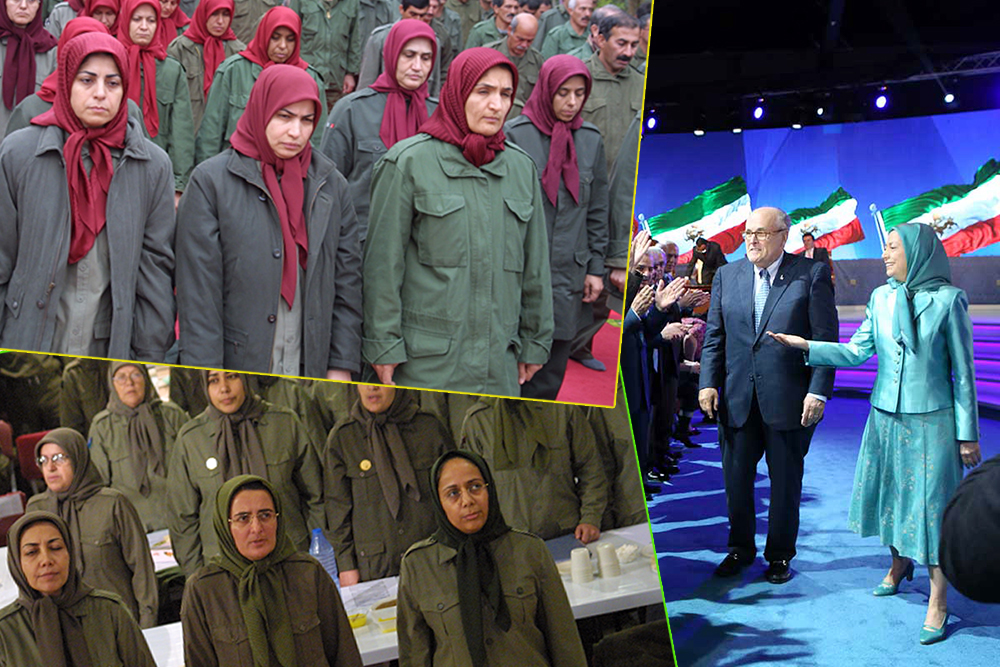
“These are people who are dedicated to freedom,”he said, referring to the uniformly dressed and gender-segregated MEK members present in the hall. [1]
However, testimonies of the former members including Hassan Heyrani and Gholam Mirzai interviewed by BBC, confirms numerous testimonies made by other ex-members of the group. The entire evidences prove that the Mujahedin Khalq is a cult-like group if not a cult. However, many cult experts argue that the MEK is a cult in which lives of members are under daily threat and the cult itself is a threat for the outside world. Rick Alan Ross an American deprogrammer, founder and executive director of the nonprofit Cult Education Institute asserts:”The MEK fits well into the definition of cult”. [2] Here are reasons why the MEK should be considered a destructive cult listed by Rick Ross and confirmed by the testimonies of former members and journalists’ accounts of the group of which just a few examples are stated:
Mind Control (undue Influence): Manipulation by use of coercive persuasion or behavior modification techniques without informed consent. Hassan Heyrany told BBC of the leadership’s oppressive control of his private life inside the MEK.
The nadir of Heyrany’s life with the MEK an evening meeting he was obliged to attend, according to BBC. [3]
“We had a little notebook, and if we had any sexual moments we should write them down. For example, ‘Today, in the morning, I had an erection.'”[4]
Romantic relationships and marriage are prohibited by the MEK. It was not always like that – parents and their children used to join the Mujahideen. But after the bloody defeat of one MEK offensive by the Iranians, the leadership argued it had happened because the Mujahideen were distracted by personal relationships. Mass divorce followed. Children were sent away – often to foster homes in Europe – and single MEK members pledged to stay that way. [5]
Charismatic Leadership: Claiming divinity or special knowledge and demanding un-questioning obedience with power and privilege. Leadership may consist of one individual or a small core of leaders. In the MEK, the couple Masoud and Maryam Rajavi are the core of MEK’s cult of personality. Their leadership is so undisputed that no one dares to ask about the whereabouts of Massoud Rajavi who has been disappeared since 2003 and even his death was declared by Saudi prince Turkie Faisal in the group’s gathering in Paris.
“Rajavi and his wife are the defining role of authoritarian charismatic leadership that has become the focus, defining element and driving force of MEK,”Rick Ross says.”There are no checks and balances to their power, meaningful accountability or transparency.”[6]
Deception: Recruiting and fundraising with hidden objectives and without full disclosure of the use of mind controlling techniques; and the use of”front groups.”
MEK recruiters had their fraudulent techniques to recruit young Iranians looking for a better life outside Iran. They were promised to be granted European passports but their own ID cards were confiscated by the MEK as soon as they entered the group.
Once they are in the group, members are bombarded with fake news and propaganda about the outside world particularly Iran. They are constantly promised by the group leaders that the overthrow of the Iranian government is close. They are so isolated from the reality that cannot believe their eyes when they see an Albanian child talking on a mobile phone. According to the BBC report, Gholam Mirzai was astonished that even children had mobile phones. [6]
Moreover, several charity associations that in fact were front group of the MEK have been delegitimized by European states.
Exclusivity: Secretiveness or vagueness by followers regarding activities and beliefs. The MEK’s internal relations were secret to the outside world until the early 2000s when a large number of members started defecting the group. The increasing process of defection resulted in huge revelations on the mysterious issues inside the MEK. Elizabeth Rubin of the New York Times Magazine, described the group’s Camp Ashraf in Iraq as “fictional world of female worker bees.” [7]
Alienation: Separation from family, friends and society, including a change in values and substitution of the cult as the new”family;”evidence of the subtle or abrupt personality changes. The latest example of an alienated member who was interviewed by BBC is Gholam Mirzai who has not seen his family for almost 40 years.”When Mirzai left to go to war against Iraq in 1980, he had a one-month-old son,”BBC reports.”After the Iran/Iraq war ended, his wife and other members of his family came to the MEK camp in Iraq to look for Mirzai. But the MEK sent them away, and told him nothing about their visit. This 60-year-old man never knew he was a much-missed father and husband until he made that first call home after 37 years.”[8]
“They didn’t tell me that my family came searching for me in Iraq,”he told BBC.”They didn’t tell me anything about my wife and son. All of these years I thought about my wife and son. Maybe they died in the war… I just didn’t know.”[9]
Exploitation: Can be financial, physical, or psychological; pressure to give money, to spend a great deal on courses or give excessively to special projects and to engage in inappropriate sexual activities, even child abuse. According to RAND report sponsored by the US Defense Department, members of the MEK are subjected to forced labor, sleep deprivation, mandatory celibacy. [10]
BBC’s account on the exploitation in the MEK states:
“Romantic relationships and marriage are prohibited by the MEK. It was not always like that – parents and their children used to join the Mujahideen. But after the bloody defeat of one MEK offensive by the Iranians, the leadership argued it had happened because the Mujahideen were distracted by personal relationships. Mass divorce followed. Children were sent away – often to foster homes in Europe – and single MEK members pledged to stay that way.”[11]
However, the most shocking issue on human rights abuses in the MEK is polygamy. Massoud Rajavi married dozens of female members of what is called the Elite Council in the MEK. He had sex with a large number of these women. The Guardian reported the horrible story of female victims of the MEK. Batul Soltani was sexually abused by Massoud Rajavi before she left the group. [12]
Besides, Female defectors Zahra Mirbagheri, Batul Soltani and Nasrin Ebrahimi revealed the list of a hundred women who underwent forced hysterectomy surgeries. They became barren under the order of the Rajavis. [13]
Totalitarian Worldview (we/they syndrome): Effecting dependence, promoting goals of the group over the individual and approving unethical behavior while claiming goodness. That’s why all defectors of the MEK are labeled as traitors and agents of the Islamic Republic. The group leaders indoctrinate the rank and file that”anyone who is not with us is against us”.
Hassan Heyrani, Gholam Mirzai and other defectors of the MEK –who live in Albania or any other side of the world speaking to the media about what they underwent in the cult-like system of the group—are accused of being spies of the Iranian Intelligence. [14]
“Now he scrapes by in the city, full of regrets and accused by his former Mujahideen comrades of spying for their sworn enemy, the government of the Islamic Republic of Iran,”BBC write about Gholam Mirzai, the 60 year old former cult member. [15]
Rajavi’s totalitarian character allows him to have sex with dozens of female members of the group but members mustn’t even think about it.
By Mazda Parsi
References:
[1] Pressly, Linda & Kasapi, Albana, The Iranian opposition fighters who mustn’t think about sex, BBC News, November 11th, 2019.
[2] MEK fits well into definition of cult, Mehr News Agency, February 8th, 2017
[3] Pressly, Linda & Kasapi, Albana, The Iranian opposition fighters who mustn’t think about sex, BBC News, November 11th, 2019.
[4]ibid
[5] MEK fits well into definition of cult, Mehr News Agency, February 8th, 2017
[6] Pressly, Linda & Kasapi, Albana, The Iranian opposition fighters who mustn’t think about sex, BBC News, November 11th, 2019.
[7] Rubin, Elizabeth, The Cult of Rajavi, The New York Times Magazine, July 13th, 2003.
[8] Pressly, Linda & Kasapi, Albana, The Iranian opposition fighters who mustn’t think about sex, BBC News, November 11th, 2019.
[9] ibid
[10] Goulka, Jeremiah & Hansell, Lydia & Wilke, Elizabeth & Larson, Judith, The Mujahedin-e Khalq in Iraq, A Policy Conundrum, National Defense Research Institute, August 4th, 2009.
[11] Pressly, Linda & Kasapi, Albana, The Iranian opposition fighters who mustn’t think about sex, BBC News, November 11th, 2019.
[12] Merat, Aron, Terrorists, cultists – or champions of Iranian democracy? The wild wild story of the MEK, The Guardian, November 9th, 2018.
[13] ibid
[14] Pressly, Linda & Kasapi, Albana, The Iranian opposition fighters who mustn’t think about sex, BBC News, November 11th, 2019.
[15] ibid