Nejat Society
  • Home
  • Articles
  • Media
    • Cartoons
    • NewsPics
    • Photo Gallery
    • Videos
  • Publications
    • Books
    • Nejat NewsLetter
    • Pars Brief
  • About Us
  • Contact us
  • Editions
    • عربي
    • فارسی
    • Shqip
Nejat Society
Nejat Society
  • Home
  • Articles
  • Media
    • Cartoons
    • NewsPics
    • Photo Gallery
    • Videos
  • Publications
    • Books
    • Nejat NewsLetter
    • Pars Brief
  • About Us
  • Contact us
  • Editions
    • عربي
    • فارسی
    • Shqip
© 2003 - 2024 NEJAT Society. nejatngo.org
Maryam Rajavi
Mujahedin Khalq; A proxy force

Congress Boosts cultish MEK exile group

Members of Congress from both sides of the aisle are backing a bill that endorses Maryam Rajavi, an Iranian opposition figure who leads the Mojahedin-e Khalq.

AS IRANIANS BOTH inside Iran and in the diaspora organize against the Islamic Republic, a bipartisan collection of over 160 members of the U.S. Congress this week put forward a resolution endorsing an exiled opposition group with a past of hard-line militancy that has been credibly accused of cult-like behavior.

On Thursday, Rep. Tom McClintock, R-Calif., held a congressional briefing to introduce House Resolution 100, with the expressed aim of lending support to Iranians protesting for “a democratic, secular, and nonnuclear Republic of Iran.” The introductory speaker at the session was Maryam Rajavi, the head of the Mojahedin-e Khalq, or MEK, an Iranian exile group previously listed as a terrorist organization that has been accused of brainwashing and sexual abuse of its members.

“It is no exaggeration to say that perhaps nothing unites Iranians of today than opposition to the MEK and their agenda.”
“It is no exaggeration to say that perhaps nothing unites Iranians of today than opposition to the MEK and their agenda,” said Arash Azizi, an Iranian historian and political commentator, who described the group as a “brutal cult.” “Not only are they not popular amongst Iranians, they are despised and hated by Iranians across the political spectrum.”

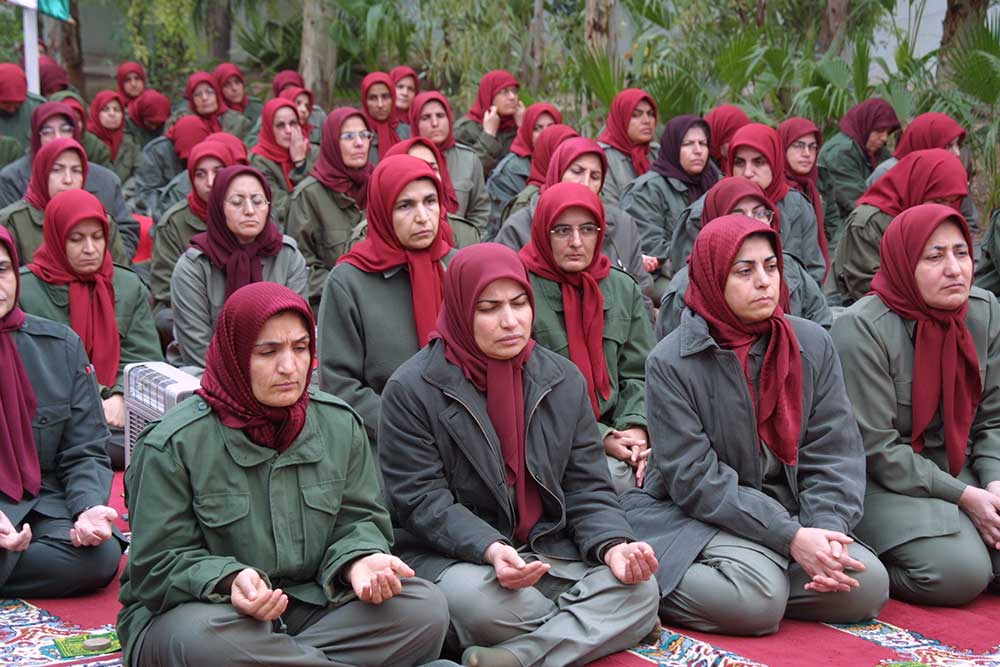
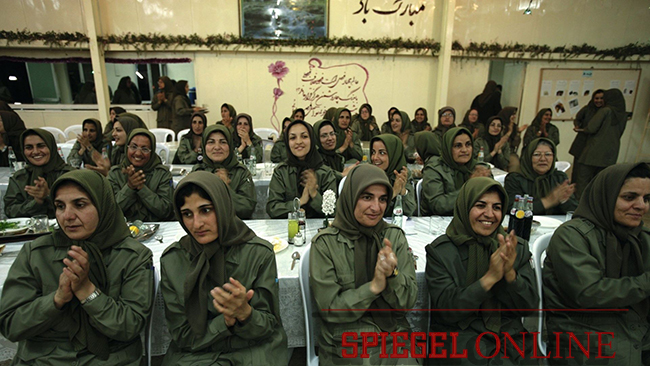
MEK women in Ashraf 3

Leaked photo of MEK’s Albanian headquarters

This perception of the MEK among Iranians has not stopped many U.S. politicians who claim to support democracy in Iran from providing consistent support to the group. Congress has long been a stronghold of support for the MEK. The group boasted a robust lobbying operation before it was listed in the late 1990s as a terror group, and then spent years lobbying through cutouts to be removed from the terror rolls. The group has long appealed to hawks in Washington who advocate for war with Iran and a U.S. policy of regime change.
The text of the new bill is pegged to the recent wave of protests and repression in Iran, noting with favor a 2018 rally held by the MEK in Paris calling for regime change in Iran. While the bill does not name the group specifically, it points to “opposition leader Mrs. Maryam Rajavi’s 10-point plan for the future of Iran” as a starting point for change. In her remarks at the briefing, Rajavi thanked the supporters of the measure for “this very important bi-partisan congressional initiative in support of the people of Iran and the Iranian Resistance.”

SPONSORED BY MCCLINTOCK, a Republican, the resolution boasts the support of 60 Democratic politicians, including several members of the House Foreign Affairs Committee and the Congressional Progressive Caucus. (McClintock’s office did not immediately respond to a request for comment.)

”For over 26 years as a senior member of the House Foreign affairs committee, I have co-sponsored many resolutions and bills regarding democracy and human rights in Iran,” Rep. Brad Sherman, D-Calif., who led minority support for the bill, said in a statement to The Intercept. Sherman pointed to an array of other bills he supported in recent years that condemned human rights abuses in Iran, called for sanctions, and expressed support for protesters.

While Sherman did not respond to The Intercept’s follow up questions about the MEK, he has in the past been a stalwart congressional backer of the group, vocally supporting Rajavi, whom he video chatted with last year, and signing on to past McClintock pro-MEK resolutions.

Rep. John Garamendi, D-Calif., said he supported the resolution after receiving “significant outreach” from constituents. “I cosponsored H.Res. 100 because I stand with the Iranian people in their fight for human rights and a secular and nonnuclear state,” Garamendi said in a statement. Acknowledging McClintock’s explicit linking of the bill to the MEK, Garamendi said, “I don’t control what other members say in their press releases about the bill, but let me be clear, the point of H.Res. 100 is to call for investigations into extrajudicial killings and the prevention of other human rights abuses, which I support.”

Rep. Brendan Boyle, D-Pa., told The Intercept he co-sponsored the resolution to show “support for the brave protesters in Iran who are risking their lives to protest an oppressive regime.” Boyle said he did not see MEK mentioned in the bill text but that he was glad there was bipartisan support for standing with protesters.

https://dlb.nejatngo.org/Media/Interview/Intercept-Defectors-MEK.mp4

To Download the video file click here

The MEK continues to receive backing from Western politicians, including many American leaders, despite its abysmal reputation among Iranians. Former Trump administration officials like John Bolton have been longtime supporters of the group, which successfully won its removal from the State Department’s list of designated terrorist organizations in 2012 after a yearslong lobbying campaign targeting senior politicians in both parties.

Despite its popularity on Capitol Hill, Iranians themselves tend to be overwhelmingly opposed to the MEK, due to its support of Saddam Hussein’s invasion of the country in the 1980s, its involvement in terrorist attacks inside Iran, and its own authoritarian ideology.

The sources of the MEK’s funding remain opaque, but the group periodically organizes rallies and public events attended by foreign dignitaries. Many attendees at the events have written about “rent-a-crowds” of non-Iranians who have been hired to show up and provide a simulacrum of popular support for the organization.

The group is also believed to run covert operations and information campaigns from its foreign bases in Albania and France.

Akela Lacy, Murtaza Hussain – The Intercept

February 14, 2023 0 comments
FacebookTwitterPinterestWhatsappTelegramSkypeEmail
Albania Unrests
Albania

Albanian opposition protests against corruption, poverty

Thousands of opposition supporters rallied in front of the Albanian prime minister’s office on Saturday accusing the government of Edi Rama of corruption and protesting against the high cost of living which is forcing people to leave the country.

Protesters, led by opposition leader Sali Berisha, hurled firecrackers at the entrance of government offices where hundreds of police officers in anti-riot gear blocked protesters from entering the building.

“(Edi Rama) resign, go where you belong, to the pillar of shame, the traitors’ house,” Sali Berisha, head of the opposition Democratic Party said, adding that a new protest will be called in front of the parliament on Monday.

Albania Unrests

People take part in the Albanian opposition anti-government protest in Tirana, Albania, February 11, 2023. REUTERS/Florion Goga

Berisha, a former president and prime minister, is banned from entering the United States over alleged corruption. He denies the charges.

During the protest Berisha accused Prime Minister Rama of corrupting U.S. officials to lobby against him and against opposition parties. Such accusations are rejected by both Rama and the U.S. government.

Rama, who is in his third term as prime minister, has denied all accusations of corruption.

“How will I live with 7,000 Albanian leke ($64.64) as a pension. I have to pay rent, electricity, water and everything else. Our lives have become poisonous,” protester Mino Xhindi, a pensioner in his late 60s, told Reuters.

Reuters

February 14, 2023 0 comments
FacebookTwitterPinterestWhatsappTelegramSkypeEmail
Ali Hajari
Former members of the MEK

Ali Hajari to visit his new-born daughter after a month

Ali Hajari could visit his wife and his new-born daughter a month after she was born. Hajari who has his first child, Alisa, at the age of 59 is a former member of the Mujahedin-e Khalq MEK) and a current member of the Association for the Support of Iranians Living in Albania (ASILA). He has been detained in the refugee detention center Karrec for five months.

In the first visit with his baby, Hajari addresses his former friends inside the MEK’s camp in Manez, Albania. He tells them, “I built a new life after I left the MEK. Although I am in detention now, I have a calm life and I hope that I will soon get back to my family to enjoy a peaceful life with them.”

Marriage is forbidden for members of the MEK. The entire members of the group are deprived from the right to get married and to have children. A large number of defectors of the Cult of Rajavi got married and have children after they left the group. Ali Hajari was deprived from these rights until his fifties. He just was able to enjoy his basic human rights after he left the group five years ago.

https://dlb.nejatngo.org/Media/Interview/Hajari-Alisa-202302-en.mp4

to download the video file click here

February 13, 2023 0 comments
FacebookTwitterPinterestWhatsappTelegramSkypeEmail
The Iranian foreign minister; Hossein Amirabdollahian
Iran

Iran FM: Backing MEK Reveals American Use of Terrorism against Iran

The Iranian foreign minister slammed a resolution that the US House of Representatives has passed in support of the terrorist Mujahedin-e-Khalq Organization (MKO) as an indication of Washington’s insatiable appetite for employing terrorism for the purpose of destroying Iran.

“The US Congress’ worthless resolution in support of Monafeghin (MKO) terror cult demonstrates, just once more, their insatiable appetite for instrumentalizing terrorism and DAESH modeled scenarios -that wrecked Syria and Iraq- for destroying Iran,” Hossein Amirabdollahian said in a post on his Twitter account on Saturday.

The Iranian foreign minister; Hossein Amirabdollahian

The Iranian foreign minister; Hossein Amirabdollahian

His comments came after the US House introduced a resolution on February 7, expressing support for what it called the Iranian people’s desire for a democratic and secular country.

The head of the MKO terrorist group also joined a congressional press briefing at the US House after the announcement of the resolution.

More than 17,000 Iranians, many of them civilians, have been killed at the hands of the terrorist Mojahedin-e Khalq Organization (MKO or MEK) in different acts of terrorism including bombings in public places, and targeted killings.

The MKO – listed as a terrorist organization by much of the international community – fled Iran in 1986 for Iraq and was given a camp by former Iraqi dictator Saddam Hussein.

They fought on the side of Saddam during the Iraqi-imposed war on Iran (1980-88). They were also involved in the bloody repression of Shiite Muslims in southern Iraq in 1991 and the massacre of Iraqi Kurds.

February 12, 2023 0 comments
FacebookTwitterPinterestWhatsappTelegramSkypeEmail
Albania Flag
Albania

Albania awaits unrest

Reports from Albania indicate that the opposition (a coalition of parties of former Albanian leaders Sali Berisha and Ilir Meta) has planned a massive demonstration for Saturday, February 11, 2023, which is expected to be similar to the one that was well received a few months ago,
The relevant report adds that “there is a possibility – which is not a small possibility – that the demonstration will not only meet with public favor, but will subsequently cause civil unrest and a rapid and serious deterioration of public order not only in Tirana but throughout Albania”.

It has also been reported that several foreign embassies of NATO member countries are updating the list and contact phone numbers of their citizens residing in Albania. Such an open act is a clear sign that they are preparing to evacuate their nationals from Albania.

The report states: “A 1997-style collapse of public order may only be a possibility. But if the police disappear from the streets and the central authority is reduced, perhaps even some of the prisoners of the Mojahedin-e Khalq camp will be able to take advantage of this opportunity and escape. I believe that the evacuation of the Iranian hostages who are living in the camp of illegal immigrants is not far off.”

It should be noted that the Albanian opposition leaders, who are included in the US and UK sanctions list, are constantly accused by Prime Minister Edi Rama and the Albanian state media, as well as Israel and the Israeli media, of having connections with Iran.

“Sot”, Israel’s media organ in Albania titled “Voice of Israel”, which has a very close relationship with the MEK, always attacks the Albanian opposition leaders.

On the other hand, “Home Justice” has made new revelations against the government, police and the security apparatus of Albania by presenting documents which the public prosecutor’s office deems the publication of such documents to be punishable.

The significant closeness of Edi Rama’s government to Saudi Arabia and Israel and their material, promotional and political support in recent months has attracted the attention of many international observers and they consider it as a sign of the weakening of the foundations of the current government of Albania

February 7, 2023 0 comments
FacebookTwitterPinterestWhatsappTelegramSkypeEmail
Torture in the MEK Cult
Former members of the MEK

Farhad Javaher Yar speaks of torture and solitary confinement in the MEK

Farhad Javaheri Yar, former member of the Mujahedin-e Khalq wrote his autobiography in 2003 after he defected the group. His book titled “From Evin to Abu Ghraib” covers some extents of the MEK’s crimes against its own members who had once joined the group trustfully. His Autobiography indicates how shallow the MEK’s slogans for freedom and democracy are.

According to Javaheri’s account, the MEK is a one-way path; a blocked path with no exit door. The rank and file of the group must be robots or modern slaves who have no idea of their own. Once they enter the MEK, they have to leave all their believes, interests, plans and in general their whole life behind.

MEK Cult

In the beginning of his book, Javaheri explains why he decided to leave the MEK and how his decision was reacted by the group leaders:

When in 1994, hundreds of the group members were tortured and, in some cases, killed by the group commanders, I declared my demand to leave the group.

The group’s strategy of armed struggle in the streets had been defeated so Massoud Rajavi and his partners had to explain about their failure. But, instead of giving a logical and precise answer to the rank and file, they took action to eliminate dissident members and as always, their pretext was that dissident members were agents of the Islamic Republic who had penetrated the MEK.

A large number of members were imprisoned and tortured to sign forced confessions admitting that they were agents of the Iranian Intelligence Ministry while they were professional members of the group whose lifetime of membership in the MEK was longer than the lifetime of the Ministry of Intelligence of the Islamic Republic.

It was a trick used by Massoud Rajavi to cope with his problems at the time. The internal elimination process was a classified secret of the group. No one dared to talk about it.

I got to know about it by one of my friends who had been tortured. Eventually I asked to leave the group. There were a lot of other members of the group who had declared their defection. The group leaders launched an organizational suppressive and intimidating project to stop us from defection. A large number of those who wanted to leave gave up and stayed in the group but I had made my mind. The authorities knew that I had realized about the prisons and tortures so they tried to convince me to stay but they did not succeed. I insisted.

Thus, they decided to destroy me. The other night, all of the rank and file were supposed to be in a meeting where Maryam Rajavi was going to give them a bunch of watches as gifts. “Someone called Mahmoud Mahdavieh wants to talk to you about an important issue,” I was told. “You should stay and wait for him.”

I was aware of the tactics used by the MEK to eliminate dissident members. Therefor, I broke through the barbed wires around Ashraf and the Iraqi military stations and reached the road to Baghdad. I was got near Baghdad but the forces of the Iraqi Security Service had taken control of the road with the help of high-ranking members of the MEK. I had to cross the marshes around the city to reach the road to Tikrit.

Unfortunately, the driver of the car that I got on was a security agent. He knew that the MEK and the Iraqi Security Service were looking for an Iranian man who had escaped Camp Ashraf.
He immediately delivered me to the security forces who consequently arrested me, put handcuffs on me and blindfolded me. They jailed me in a dark cell.

In response to their interrogations, I told them that I wanted to leave Iraq and asked them to submit me to the Red Cross or at least to call my family. I gave them their phone number but the Iraq officers replied that this could be possible only under the order of the higher authorities.

The higher authorities in their turn ordered to deliver me back to Camp Ashraf, to the torturers of the MEK, Nader Rafieenezhad, Farhad Olfat and Mahmoud Mahdavieh. I was under torture from 5 to 20 hours a day.

I was in solitary confinement for 5 years. During those years, I saw Massoud Rajavi 3 times. In the meeting room, in addition to me and Massoud Rajavi, Mahmoud Mahdavieh and Mahboobeh Jamshidi were there.

Rajavi had a lot of unfulfilled promises. He signed an agreement with me and asked me to write a letter to my family. I wrote the letter but immediately after he received my letter, he handed me back to his torturers.

I was jailed in Ashraf prison until I was delivered to Iraqi forces who imprisoned me in Abu Ghraib. After a year they handed me to Iranian Intelligence agents.

February 6, 2023 0 comments
FacebookTwitterPinterestWhatsappTelegramSkypeEmail
Michael Rubin
Mujahedin Khalq Organization as a terrorist group

Michael Rubin: Why Do Iranians Hate the Mujahedin-e-Khalq So Much?

The senior fellow of the Washington Examiner, has found it vital to warn the US politicians who advocate the MEK despite its violent history and its cult-like nature. This is the third piece written by Rubin in order to inform paid politicians that the MEK is hated by the Iranian people:

I once asked a senior American official about why he accepted honoraria from the Mujahedin-e-Khalq, or the MKO, given the group’s cultlike nature and its lack of popularity inside Iran. His response: Even if the group lied about its support, they said the right things about democracy and regime change, and so he saw no harm in collecting the cash. The regime’s fall, he said, would be a moment of truth: Either the MKO would prove itself right, or its political Ponzi scheme would collapse.

Michael Rubin

Michael Rubin

Rubin gives a comprehensive record of how he is so well-informed about the aspirations of the Iranian public in response to critics including the MEK agents who label him as the agent of the Iranian intelligence:

The problem with engaging in the MKO’s endorsement-for-cash scheme is the impact it has on ordinary Iranians. I spent seven months in Iran during the 1990s, during both the administrations of the late President Ali Akbar Hashemi Rafsanjani and his successor Mohammad Khatami.

MKO representatives have rejected my calls that they open their books and suggested I must do so first, suggesting that this Jewish neoconservative ex-Bush administration Iran hawk must be, if not a Manchurian candidate, then a “Mashhadian” one supporting the ayatollahs’ regime. This is silly but reflective of MKO diversion. There is no secret about my time in Iran: First Yale University and then the American Institute of Iranian Studies funded my work, which focused on language study and archival research in pursuit of a Ph.D. dissertation about telegraphy in 19th-century Iran. So too was my participation in a Tabriz conference marking the 90th anniversary of the 1909 Constitutional Revolution. I spoke on the telegraph system at the time. It was not riveting. After leaving Iran for the last time, I penned this short monograph on the history of secret societies and vigilante groups in the country.

Over the course of those seven months in the country, I engaged with hundreds if not thousands of ordinary Iranians: shopkeepers, bus drivers and passengers, grocery store clerks, doctors and lawyers; Jews, Christians, Baha’is, and Muslims; and residents from the Azeri northwest to the Baluchi southeast.

His knowledge about the Iranian public opinion is not actually restricted to his trip to Iran:

While the regime banned me from Iran more than two decades ago, I have continued my conversations. I regularly meet Iranian religious pilgrims in Iraq; it is not hard to strike up a conversation in the lounge of Baghdad or Najaf International airports. Whether in 1996 or today, there are commonalities: Iranians do not hesitate talking about their hope for change. Some were curious about the exiled shah’s son. Many just wanted a parliamentary democracy absent the ayatollahs, and to be a normal country.

There were two items, however, on which all Iranians agreed:
First, change must be internal. Iran has suffered its share of foreign interventions over the centuries, and the country has suffered because of them. No Iranian wants to be bombed or invaded. To do so would be counterproductive and, as after the 1980 Iraqi invasion, allow the regime to rally Iranians around the nationalist flag.
Second, Iranians despised the MKO. The group was an early ally of Ayatollah Ruhollah Khomeini. After Khomeini purged them as rivals, many died in his prisons, but the group’s leadership fled to Iraq.
Rubin gives a brief but accurate answer to the main question of his article, “Why Do Iranians Hate the Mujahedin-e-Khalq So Much?”
There they made two mistakes that few Iranians will forgive: They allied themselves to Iraqi dictator Saddam Hussein as he was lobbing missiles into Iranian cities and killing their conscripted fathers, sons, and brothers. They also launched a wave of terror to destabilize the regime, killing hundreds of innocent bystanders in the process. Put another way, Iranians look at the MKO as Americans see American Taliban John Walker Lindh or deserter Bowe Bergdahl.

And he concludes why US politicians should not advocate the MEK with its entire history of violence, treason and cult-like attitude:

The point is this: Paying lip service to the MKO has a price. It endorses a group Iranians believe worse than the current regime. If John Walker Lindh gave money to aspiring American politicians, it would disqualify them in American eyes. For Iran’s leaders, those five-figure MKO honoraria are a godsend that deflates and delegitimizes the grassroots opposition. Americans should stand with the Iranian people, not sell them out for cash.

February 5, 2023 0 comments
FacebookTwitterPinterestWhatsappTelegramSkypeEmail
Mujahedin Khalq Organization's Propaganda System

The Rajavi cult is interested in movies and cinema!

A report received from a reliable source from Albania indicates that the Mojahedin-e Khalq Orgnization (MEK, MKO, Rajavi Cult) has contacted several television channels in this country and has entered into negotiations with them to broadcast the two films “ARGO” and “September of Shiraz” with Albanian subtitles, offering to pay a huge amount of money.

This report adds: “The MEK is also trying to show the espionage series “Tehran” on one of our televisions jointly with the Israeli non-governmental organization “Sot” (Izraeli Sot – Voice of Israel) in Albania.

“The MEK, in cooperation with pro-Israel organizations in Albania, is trying to screen the two mentioned films between January 31 and February 11,” the report states. “I see that the MEK pays special attention to films and cinema in our country”.

“ARGO” produced in 2012 and “September of Shiraz” in 2015 are political dramas that are based on the events after the 1979 Islamic Revolution in Iran.

The television series “Tehran” produced in 2020 in Israel tells the story of a Mossad agent who enters his hometown Tehran to carry out espionage and sabotage missions.

Recently, there were reports that the political activities of the MEK were limited in Albania, and even Edi Rama said in a talk with the New York Times reporter that the condition of accepting the MEK in Albania with the agreement of the UNHCR was that they do not have political activities.

Apparently, the MEK want to fill the void of their political activities in Albania by showing anti-Iranian films with sensitive subjects, which have not received much attention at the international level.

February 5, 2023 0 comments
FacebookTwitterPinterestWhatsappTelegramSkypeEmail
Malek Beit Mashaal
The cult of Rajavi

MEK Commander: Why didn’t you throw rock at families?

According to the ruling of Massoud Rajavi, the leader of the Mujahedin-e Khalq , family is an enemy who should be subdued. Every member of the MEK has to fight against his or her family because based on Rajavi’s indoctrinations, family is an obstacle in the path toward the cause of the group.

Malek Beitmashal, a defector of the MEK who left the group after it was relocated in Albania, writes about his own experience on the MEK’s hostile approach towards families. Families of the MEK members have not been allowed by the group leaders to contact or meet their loved ones in the MEK for over long years.
“The MEK leaders argued that family is our enemy,” Malek writes, “They used to show us movies in which partisans would betray their group because of their families.”

Malek Beit Mashaal

Malek Beit Mashaal; former MEK member in Albania

This way Malek was brainwashed as well as his other comrades in the group. “During those years I never missed my family. Under the influence of their indoctrinations, we were prepared to fight our families.” However, Malek is grateful to God that he never took action against families while they were picketing in front of the gates of Camp Ashraf, Iraq.

He recalls those days, when the MEK commanders had ordered them to attack the families who were on strike at Ashraf gates. “I saw families who came over and said hello. ‘Do you know my brother?’ A woman asked tearfully. ‘For god’s sake tell him just to wave to me!’”

Malek was moved by the heartbroken sister. He stepped back to a car. “A superior member ordered us to throw rocks at families,” he recounts. “Everyone began throwing rocks but I started smoking behind the car.”

His disobedience led to punishment. He writes, “When we got back to the unit, interrogation was started. From the Commander of our unit to my direct higher rank were asking me why I did not throw rocks at families.”

The interrogations lasted for two weeks. Malek was under suppression of the Cult of Rajavi because he had refused to do an inhuman act.

February 1, 2023 0 comments
FacebookTwitterPinterestWhatsappTelegramSkypeEmail
Camp Ashraf 3 in Albania
The cult of Rajavi

Inside the MEK: Cellphone Forbidden

Using cellphone can be a distracter to accomplish your tasks but who denies that cellphones have opened the door to be able to communicate in different ways (text message, social media messaging, photos, etc.) However, there are still some people out there who are banned from having cellphones: Members of the Mujahedin-e Khalq .

While even kids across the world are allowed to have cellphones these days, the rank and file of the MEK who are taken as hostages in a barred camp called Ashraf 3, north of Tirana, Albania, are banned from having cellphones. Defectors of the group have bizarre experiences of forbidden cellphones inside the MEK’s cult-like group.

In the United States no law prohibits the employer from banning phone use or possession during actual work time or in a regular active working area but MEK members are not employed by the group leaders. They are not paid for the routine difficult tasks they have to accomplish every day, in Camp Ashraf. Instead, as all cult members, they are supposed to dedicate their whole life to the leaders of the cult.

Former members of the MEK who are residing in Albania have recently published their memoirs of “cellphone ban” in the MEK. Khalil Ansarian who defected the MEK in 2020 after 28 years of forced membership, writes his memoirs of the efforts made by him and his friends to find a cellphone to call their family from inside the MEK. Sarfaraz Rahimi also writes how a cellphone rescued him from the group.

Camp Ashraf in Albania

Camp Ashraf 3 in Albania

According to Ansarian, after the MEK was relocated in Albania and since the group was under the scrutiny of a democratic society, Massoud Rajavi decided to pay his rank and file for the first time. “Each member was paid 8 dollars per month,” he writes. “After three decades we had 8 dollars in our pockets.”

One of his friends suggests Khalil buying one cellphone by sharing their money. As they had no idea of mobile technology, the first cellphone that they secretly bought was so old that no application could be installed on it. So, they did not succeed to contact their families after long years of separation. They planned to buy another one.

“This time we bought a used cellphone for 40 dollars,” he recounts. “The other day, my friend and I went to the hills around the camp. We tried to contact his family via Telegram by the only phone number my friend had from his family.”
They could finally get connected to his friend’s family. “We were connected!” he writes. “At first, his family could not believe him. They could not believe that their son was alive after so many years.”

Nevertheless, it was not easy to contact your family even if you had a cellphone. “We had to change the place of contact every day, “Khalil Ansarian states. “The suppressive agents of Rajavi would constantly patrol around the camp watching the rank and file.”

Sarfaraz Rahimi the MEK defector who left the MEK six years ago and married an Albanian girl, writes, “The leaders of the MEK know well that if members have cellphones, they will immediately call their families. Having been connected to the outside world, they will realize the reality of the world. Thus, the MEK does not allow members to have cellphones.”
Sarfaraz writes about his personal experience after he found a cellphone to call his family. “It was because of the cellphone that I learned that I was a hostage of the MEK,” he states. “When I started having daily contacts with my family and I surfed the Internet, I got to know that the truth was not what the MEK gave us. Every day, the truth became clearer. I realized why the MEK was against cellphone. Because it would open connections with the world outside the walls of Ashraf.”

January 30, 2023 0 comments
FacebookTwitterPinterestWhatsappTelegramSkypeEmail
Newer Posts
Older Posts

Recent Posts

  • Nejat Society Albania’s Conference on June 20th

    June 22, 2026
  • Maryam Rajavi’s Stance, Peace or Survival Tactic?

    June 22, 2026
  • France’s foreign ministry denies asking for ban of MEK’s rally

    June 20, 2026
  • The MEK did not allow them to visit their father

    June 20, 2026
  • June 17th, 2003, a Counterproductive Event for the MEK

    June 17, 2026
  • Facebook
  • Twitter
  • Instagram
  • Youtube

© 2003 - 2025 NEJAT Society . All Rights Reserved. NejatNGO.org


Back To Top
Nejat Society
  • Home
  • Articles
  • Media
    • Cartoons
    • NewsPics
    • Photo Gallery
    • Videos
  • Publications
    • Books
    • Nejat NewsLetter
    • Pars Brief
  • About Us
  • Contact us
  • Editions
    • عربي
    • فارسی
    • Shqip