
On Friday, April 16, 2010 the news published on the MKO websites mentioned prior clashes in Camp Ashraf. Once again, the MKO is using a propaganda campaign to spread an expired pretext—that MKO residents are "Protected Persons" under the Fourth Geneva Convention. Previously the MKO used this argument following the 2009 clash in which the MKO clearly exhibited their deep rooted terrorist tactics by using Molotov cocktails and rocks to execute hostilities against the Iraqi forces led by the legitimate Iraqi government.
The claim made by the MKO about their "Protected Persons" status and whether or not the status applies to Camp Ashraf residents is up for debate. Article Four of the Fourth Geneva Convention defines "Protected Person" as “those who, at a given moment and in any manner whatsoever, find themselves, in case of a conflict or occupation, in the hands of a Party to the conflict or Occupying Power of which they are not nationals.” Article Four furthers that, “Nationals of a State which is not bound by the Convention are not protected by it.
Nationals of a neutral State who find themselves in the territory of a belligerent State, and nationals of a co-belligerent State, shall not be regarded as protected persons while the State of which they are nationals has normal diplomatic representation in the State in whose hands they are.” [1]
Earlier in the decade, in July 2004, In July 2004, the MKO forces in Ashraf were declared by the US to be ‘protected persons’ under the Fourth Geneva Convention of 1949 (rather than military personnel under the Third Geneva Convention), because they had not been belligerents during the Iraq War. The Fourth Geneva Convention protects civilians who, as the result of an international armed conflict or of occupation, find themselves in the hands of a country of which they are not nationals. It states that in no circumstances shall a protected person be transferred to a country where he or she may have reason to fear persecution for his or her political opinions or religious beliefs. In the case of occupied territory, the Convention continues to apply for a year after the general close of military operations, and partially thereafter if the occupying power continues to exercise the functions of government. The occupation of Iraq formally ended on 30 June 2004. [2]
In addition, the ICRC noted that, due to UNSCR 1546, the conflict in Iraq would no longer be a war between states; hence, the Geneva Conventions would no longer apply. It argued that customary international humanitarian law govern non-international conflicts; hence, continuing to apply the Geneva Conventions to the MKO would be legally incorrect.[3]
On February 9th, 2010 in a debate in the House of Lords of the UK Parliament on the case of Camp Ashraf, Iraq, Barroness Falkoner of Margavine asked her colleague if the Minister will confirm that these people are not non-protected persons under the Geneva Convention. Baroness Kinnock of Holyhead responded [to] the question by insisting that "any claim to protected persons status by Camp Ashraf residents under the Fourth Geneva Convention has ceased to apply. That view is shared by the United Nations. The Camp leadership have been given that information. [4]
Notwithstanding, the MKO still tries to deceive public opinion by the fake claim that Ashraf residents are “Protected Persons” under the Geneva Convention, and yet all significant international bodies believe that the rule does not apply to MEK members anymore.
[1] "International Humanitarian Law – Treaties & Documents." International Committee of the Red Cross. ICRC, 2005. Web. 29 Apr 2010. <http://www.icrc.org/ihl.nsf/full/380?opendocument>.
[2] Thorp, Arabella. " In Brief: Camp Ashraf and the Geneva Conventions”. LIBRARY HOUSE OF COMMONS: Standard Note 20 MAR 2009, page 2. Web. 29 Apr 2010.
[3] Goulka, Jeremiah, Lydia Hansell, Elizabeth Wilke, and Judith Larson. "The Mujahedin-e Khalq in Iraq: A Policy Conundrum." RAND NATIONAL DEFENCE RESEARCH INSTITUTE (2009): P.21. Web. 29 Apr 2010.
[4] Baroness Kinnock of Holyhead, Baroness Falkner of Margravine. "United Kingdom Parliament.” Parliamentary Business. UK Parliament, Tuesday, 9 February 2010. Web. 29 Apr 2010. <http://www.publications.parliament.uk/pa/ld200910/ldhansrd/text/100209-0001.htm>.
By: Mazda Parsi
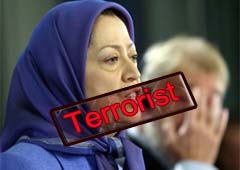 the most horrifying violent groups, traveling in Europe, visiting politic men of the so-called developed democratic countries, defending the activities and violent strategy of her cult of personality.
 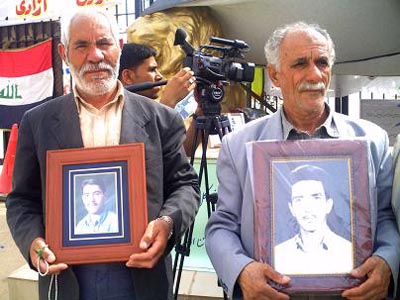 our entry into the camp to meet sons and daughters who came here twenty years ago. We have picketed here for thirty days”.