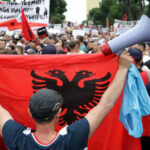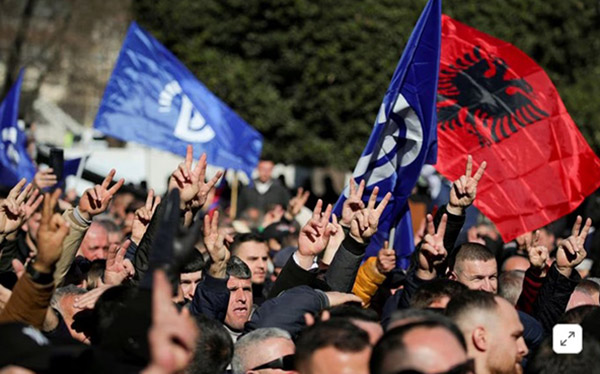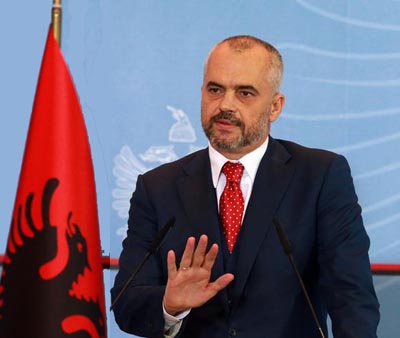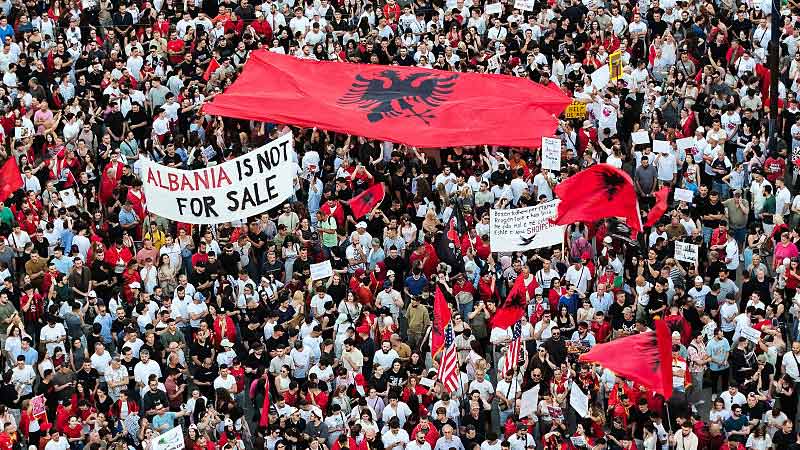
In the last two weeks, the streets of Albania’s capital, Tirana, have been filled with thousands of flamingos — or, rather, cardboard cutouts of the cotton candy-colored birds that have come to be the unofficial mascot of massive protests against Prime Minister Edi Rama’s government. At issue is a deal the government struck with one of Jared Kushner’s companies to develop a previously untouched island off the country’s south coast into a massive luxury resort, bulldozing a nature reserve in the process.
In his 12-year run as prime minister, Rama has tried to drag his nation out of the depths of postcommunist depression through an economic policy of saying yes to just about any development that could bring in revenue, or what he calls “strategic investors.” Gulf and Western-backed projects have been given expedited approvals and government support. “With no industrial, financial or human capital to offer on the global market, the only thing left to sell is nature,” the Albanian author Lea Ypi wrote this week in The Guardian.
But the Kushner project is just one in a long line of unsavory and unpopular deals Rama has undertaken in a bid to curry favor with Western partners as he hammers home his “Accession before 2030” agenda — the campaign to join the European Union — which has been a key part of maintaining power.
Ivanka Trump may have been able to swim up to an island in the Mediterranean and scramble ashore barefoot, but thousands of migrants seeking refuge on European shores are now being warehoused in Albania, thanks to a five-year deal Rama signed with the Italian prime minister, Giorgia Meloni, that was roundly criticized by human rights groups but praised as “out-of-the-box” thinking by Ursula von der Leyen, the president of the EU Commission. In exchange for holding up to 3,000 people at a time while their asylum claims are being processed, Albania, which has lost 1.2 million of its own citizens to migration, received not much more than an assurance of Italy’s support in its EU bid.
In 2013, the United States came knocking at Rama’s door with a direct request: Take on the destruction of Syria’s chemical weapons arsenal. The Balkan nation had successfully destroyed its own a few years earlier, and the U.S. couldn’t find another NATO country to play host to the more than 1,000 weapons, which included mustard gas and sarin gas. The deal was scuttled after it was leaked to the press and citizens complained, but the heart was willing, as it were.
It wasn’t the first time Albania was asked to take on an outsize risk as a favor for its supersized ally. Rama also expanded an arrangement, initially negotiated before his time, to host members of the Mujahedin-e Khalq — an Iranian movement that opposed both the Pahlavi monarchy and the Islamic Republic. Though it didn’t garner the same kind of public reaction the proposed chemical weapons dump did, some Albanians questioned why their country was taking on security risks for a conflict thousands of miles away. Their fears were confirmed when Iran began launching cyberattacks on critical government systems, including a crippling outage in 2022. The attacks haven’t let up; the most recent was in March.
In the past, opposition to Rama’s gambits was modest. Now thousands of people are on the streets with a single, unified slogan: “Albania is not for sale.” The growing disenchantment with the notion that the only thing the nation has to give is its land at bargain basement prices could be a tipping point for Rama and his economy of “yes.”
By Erin Clare Brown, New Lines Magazine