
An interview with Batool Soltani on MKO self-immolations – Part two
Sahar Family Foundation: Our greetings Mrs. Soltani. We are ready to continue the issue of suicide operation if you will. I will pose the first question unless you have some preliminary remarks to add.
Batool Soltani: before we continue with your question, I deem it necessary to add explanations on the previous session’s discourse. First, what motivates an operator to commit suicide when he happens to come face to face with the security forces and the police? Does it mean that there is absolutely no other way? Is it not really possible for a militiaman to strengthen himself physically and psychologically to bear pressures of probable tortures, prison and investigations instead of committing suicide as the last solution? It might be the easiest way to protect some information but for sure it fails to be equal to the value of a man’s life. Another point is that it may be regarded an act of bravery in itself, but can it not be considered an act of the ultimate weakness and a sense of inferiority? These questions may seem illogical in an obsessive atmosphere where anything is routinely scrutinized from a security point of view that may threaten the existence of the organization. But it does not mean that in no condition there is a logical and rational solution to any issue. Although a conjecture, I think it can be confirmed if discussed in detail with the wise and elite.
But how the organization justifies the suicide operation as the first and the last solution? What are its good reasons for exchanging such an easiest and simple way for a man’s life? Within the organization they say the capacity of enduring interrogational torture varies from person to person. I think I have read things in the organization’s sources about the applied inconceivable measures to assess the members’ resistance and response to the tortures by exposing them to a diversity of physical pressures like flogging, depriving them of sleeping, suspending them handcuffed from the ceiling in a variety of conditions and the like. Then they would conclude that in spite of varying degrees of resistance, it could be measured but the exact degree would always remain a matter of obscurity. In fact, nobody could stand the tortures that could continue to no definite degree. Of course, they knew that not all members would be put under the same tortures; it depended on the ranks and the extent of the information they held. Thus, an arrested key element and cadre to whom the survival of the organization depended would break in some point under the tortures, so suicide would be much more guaranteed than making a risk. It is instilled into him that suffering and torture are inevitably awaiting him and nothing is known to what degree he can hold out the arbitrary tortures that warrant the agents’ access to the concealed information. This is the angle of the organization’s look at the issue that needs to be studied in depth in itself.
As I pointed out earlier, the organization’s standards are absolutely different. The organization unrelentingly persisted that the ultimate solution to any problem was to offer a sacrifice. Somebody had to be sacrificed for the cause of the organization, which has been regarded more precious than the life of a militiaman, through suicide, self-harming operations or other similar acts. In one instance, as I remember, Rajavi in justification of the failure of the Operation Eternal Light stated that he had known from the very beginning that it was a futile operation from a military viewpoint, but he did it as it was tied to the survival of the organization that required so many lives. So worthless are evaluated the lives of the members that he sends them to their death in swarms to prove that the organization and the Rajavis are still breathing.
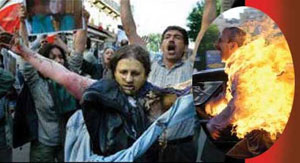
In a message he stated that if anybody set himself on fire in Camp Ashraf, it would be a cost paid to minimize the limitations imposed on the camp by the US forces. I mean the suicide case by Yaser Askari who was said to have committed suicide because of the imposed pressures on Camp Ashraf. The act is no more a countermeasure to protect the organization against any threat of annihilation but rather a means to further certain organizational, and even personal, ambitious objectives. Here the intention is no more measuring a member’s resistance degree in case of undergoing torture, rather suicide turns to be an imposed means to serve the survival of the organization, a purpose he, the member, has been destined from the very beginning to sacrifice himself for. I mean to say that the organization’s innovated self-burnings like that of 17 June and that of Yaser Askari in Camp Ashraf have been the easiest chosen solutions to overcome the crises. Even beyond that, the act is sanctified and glorified as a model for others to follow fervently instead of criticizing its exploitation for vague and hollow purposes. And as an alternative, the organization looks for belligerently innovated means that devour more sacrifices; crushed, scorched, crumbled bodies with no identity.
To be continued
Translated by Mojahedin.ws
 She was a member of the leadership council and the closest to the organization’s power hegemony and, consequently, she can be regarded the most reliable source of information compared to other separated rank and file. The best evidence is the statements and disclosures she has made, and is still making, on multitudes of issues concerning the organization.
 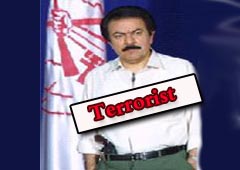 north-eastern province of Khorasan. He finished his primary school there and later he moved to Mashhad to continue his high school education. He was accepted as a law student at Tehran University where he was linked with the newly established organization founded by Hanif Nezhad, Badi’ Zadegan, Saeed Mohsen. In 1970, he was arrested along with a large number of his comrades in the group. Consequently, all MKO leaders were executed except Masud Rajavi who was released during the first days of the Islamic Revolution in 1979. Soon he declared his opposition to the Islamic Republic. I think he had some desires and he knew that he was not able to achieve them at that situation.
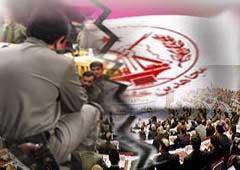 to the MKO cultic relations. Imagine Rajavi as a spider that everything in the organization forms around him, just like a spider’s web.

 through different means. He could get some youth away from their homes. They were innocent young individuals whose natural right was to live a normal life, but MKO could deceive them to join the group. I remember that at the time each person needed 30 thousand Tomans (roughly 30 American Dollars) to flee from Iran. The organization recruited those who were out of job or those who had other problems and sent them out of the country through various ways. There were also individuals who were introduced to the organization. For instance my husband was introduced by a member who had already joined the group. Then the organization sent a guy to recruit him in Iran and sent him abroad. There were some smugglers who took the recruited ones passing the borders and the journey was very dangerous. But it didn’t matter to Rajavi. When the organization tricked my husband and me, we were supposed to join MKO’s courier. We got out of Iran on camels. We risked our lives so many times but finally we could survive. I remember a lot of young couples were killed in the way.