
Washington may turn Romania into a hotbed of tension, which will prove quite a headache both to Romania proper and the neighbouring countries. The point is the United States is making efforts to move several thousand members of the People’s Mujahedin of Iran organization (Mujahedin-e Khalq) from Iraq to Romania. The so-called civilized society’s care for radical Islamists is due to the fact that the Mujahedin see their mission in fightin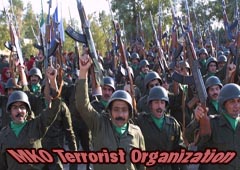 g Iran, which the West also seeks to weaken by all means available.
Both Iran and Iraq see Mujahedin-e Khalq as a terrorist organization. The armed wing of the organization, – the National Liberation Army of Iran, is believed to have founded the National Council of Resistance of Iran, which brings together all of Iran’s opposition forces. Those who opposed the rule of the Shah of Iran started their resistance in the middle of the 1960s on a romantic idea of building a class-free socialist society, but as time went on, the idea degenerated into mass-scale terrorist attacks and acts of sabotage. The Iranian authorities’ sharp rebuff caused Mujahedin-e Khalq to move to the neighbouring Iraq, whence it launched armed attacks on Iran during the Iran-Iraq War and helped the Iraqi regime to quash Kurdish rebellions. Mujahedin-e Khalq went on with its attacks on Iran in the subsequent years taking advice from and controlled by the United States.
But the impressive "record of service" (some 50,000 people killed, including Iran’s top-echelon officials) proved no hindrance to the EU and US recent decision to strike Mujahedin-e Khalq off their list of terrorist organizations. The EU and the US obviously proceeded from the assumption that "the enemy of my enemy is my friend", although the two saw Mujahedin-e Khalq as terrorists just a short while ago.
Washington’s plan to deploy the Islamists in Romania is inappropriate at the very least, says Russian expert in Oriental Studies Boris Dolgov, and elaborates.
"If the Romanian leaders have certain doubts, and they will certainly question the correctness of the decision, then they should stiffly oppose the move. The organization acts against Iran, Tehran sees it as terrorist, Mujahedin-e Khalq is known for numerous terrorist attacks and life attempts. Besides, the US plan is at variance with the recent trend towards improving relations between Washington and Tehran. Also, a presence of Islamic militants will serve to aggravate tension in the region. It’s obvious that peaceful coexistence with the people of other religions is the last thing the Islamists will think of when arriving in Romania".
So far, the US attempts have proved futile, even though Romania heavily depends on Washington. The US sees Romania as an important nation in terms of its geopolitical interests, and has been patronizing Bucharest throughout the post-Soviet period. But the pay Washington has demanded seems clearly excessive.
Yet, when the US State Secretary John Kerry met with his Romanian counterpart Titus Corlaţean in Brussels in December, they took up the issue of moving the Mujahedin in question to Romania, according to some reports. A year earlier, Germany and Albania said they were prepared to accommodate Mujahedin-e Khalq militants. But the organization chiefs insist on a compact settlement of all three thousand militants, who are currently making their home at a US military base in Iraq. But the Albanian and German authorities see this as too dangerous. The terrorist leaders are in a stalemate. They are welcome nowhere, while in Iraq they have been coming under rocket fire recently. The organization activists put the blame at the current Iraqi government’s door, namely because the Iraqi Cabinet has been openly demanding that the terrorists be removed from the country.
Action on the US plan is fraught with danger, but is highly improbable, points out an expert with the Moscow-based Institute for Strategic Studies and Analysis, Sergei Demidenko, and elaborates.
"A transfer of a large group of people, drilled ideologically and militarily, to an unstable European area will clearly add no quiet to the area. But Romania will hardly approve the scenario, since Bucharest realizes that Romanians will otherwise have to deal with people of specific mentality, oriented to fighting the non-Moslems, or kuffar, which is about the only thing they can do at all. But if the events do follow that scenario, this will only serve to further aggravate the situation around Islamic radicalism in Europe, the more so since the European security services can do nothing to counter Al-Qaeda militants who are active in southern Europe".
Of course, one may admit by a stretch of imagination that sticking to its friends in trouble is kind of noble of the United States; the more so since the US is due to build a military base in Romania, where the militants could be accommodated at first. Also, the recent agreement on Iran’s nuclear programme involving the United States will hardly prove a watershed event in the Iran-US standoff. Washington has not forgone up the plan to deploy its missile defence system in Europe to defend the West from Iran’s missile strike.
Whether to accept the members of an organization, placed on a par with Taliban and Al-Qaeda, or not depends wholly on the Romanian government, which will likewise be solely responsible for its decision. The authorities of the neighbouring Ukraine will also have food for thought. The well-trained fighters may prove effective as a force to change the government or at least rock the unstable situation, for they are not used to sitting idly.
Ilya Kharlamov – Voice of Russia
 group’s supporters to take action and accept these individuals in their countries.
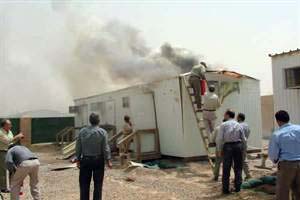 Camp Liberty, the temporary transit location of Mujahedin Khalq was hit by rockets on Thursday December 26, with three people dead and several others seriously injured, Reuters cited the camp’s spokesperson as saying.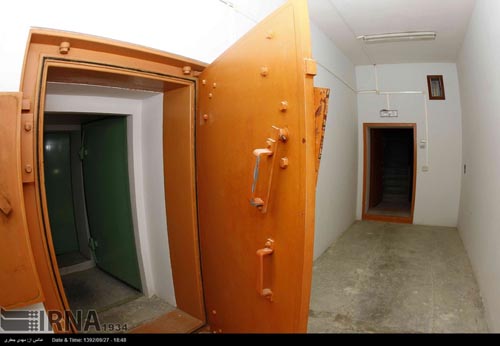
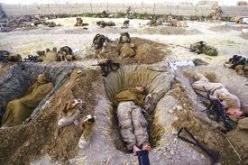
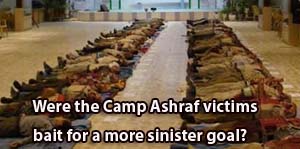 At that time, the MEK announced that 52 of its members had been killed. They published photographs of the victims along with their biographies and claimed that Iran had given the order to attack the camp and that Iraq had carried it out. Both governments denied any involvement and no evidence has been offered to contradict this. Weeks later Iraq announced that the death toll was 53, not 52 as previously claimed by the MEK. The revised figure was due to the fact that the 53rd victim had had his face so badly burned that it took a while to identify him as one of the MEK and not one of the attackers and to discover his true identity. Following this revelation the MEK published a documentary about the 53 in which a picture of Massoud Dalili was shown along with a sample of his handwriting in which he declares that he will never surrender to the enemy, the Iranian regime. In this documentary the MEK refer to them as martyrs.
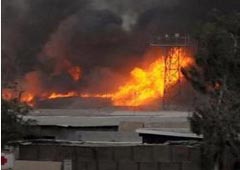 ambush for the terrorist MEK until they leave Iraq. In a separate interview with the Associated Press, al-Battat said, “It is time for the people of the MEK to leave Iraq. We have demanded that the government kick the group out of the country, but the Iraqi government did not respond positively to our demand”.