
Nasrin Ebrahimi is a former member of the Mujahedin Khalq Organization, who fled the group in 2006. She was one of the first survivors of the Cult-like MKO who dared to reveal the corruption of the leaders of the group. She was the first person to speak of the “Summit Operation” which was a cult jargon through which a large number of female members of the group became infertile by Hysterectomy surgery.
Nim Negah Website is publishing series of interviews with Ms. Ebrahimi. Nejat society translated excerpts of her memoirs of the sufferings of living in the MKO cult.
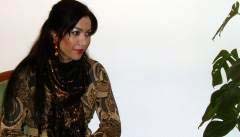
… I was attracted by the MKO when I was 13 and I joined the group in Iraq a year after. As I lived in a town near Iraqi border where the MKO TV Channel was available, I was absorbed by the group propaganda. I decided to join it. I was fourteen when I took some money from home and paid a human–smuggler to pass me through Iraqi border.
As a teenager, I had no correct information on either the Iranian government or the MKO. I had no idea of politics.
From the first days of my residence in Camp Ashraf, I realized Rajavi’s version of democracy, freedom, equality and human rights.
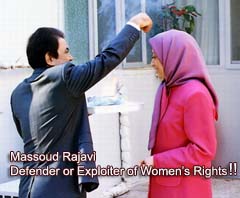
…. In a short time Rajavi found out that female members of the group can better run his plans. This way, women would think that they were promoted in the cult hierarchy and they would feel superior over their male comrades…Massoud Rajavi made women feel that they owe their position to him …
I remember Maryam Rajavi saying in a meeting for women:”Without Massoud, you are nothing so for your own promotion and your own growth you must blindly obey Massoud”! … Thus women in Ashraf were living in an illusion world that was built by the Rajavis. They were stranger to their inner self.
… Women in Ashraf had no freedom to choose their clothing; otherwise they would be oppressed by the worst methods. Cosmetics were forbidden in Ashraf. Women were not allowed to tide up otherwise they would be interrogated; they would be asked about what they had in their mind.
This was the “freedom of clothing” the MKO claims.
… We were not permitted to look at men and were constantly supervised by our superior officials. We had to confess all our thoughts; For example, if we had recalled a man, our husband or our boyfriend, we had to confess it in the meeting. We had to verbally abuse ourselves before others because we had betrayed Rajavi. We shouldn’t let our mind think of any other person except Massoud Rajavi who, was as we were told, our possessor.
Do you know any other place where women are so ruthlessly suppressed ? Even in Saudi Arabia the rules are not as anti-woman as it is in the MKO.
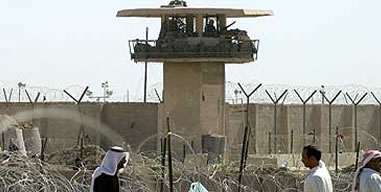
Camp Ashraf is like a prison in or in better words like Nazis Forced Labour Camps.
We were woken up by a dreadful march-like sound every morning at 5 or 5:30. A quarter later we had to go to the eating place for breakfast. After a quarter, we were supposed to do our public task, in public places until 6 o’clock. Then from 6 am until 13 pm, we were horribly forced to do exhausting labors including cleaning up the streets, pulling weeds in Iraqi arid desserts, moving goods from one place to another. We were regularly supposed to carry objects to a new place and again we had to move them to another location after a few weeks. This was just a way to keep us busy and exhausted. We had to clean and grind a set of old artillery that hardly ever could go more than a few Kilometers…
13:00 was lunch time. The food was so bad… after the US army was settled in Ashraf, the food became a little better because the group leaders wanted to pretend that everything was fine there…
After lunch, sometimes we had an hour to relax and again we had to start working until night. After dinner, we had to attend meetings such as Current Operation and Daily Cleansing (Two cult jargons practiced regularly in the MKO). Both sessions were like a court in which you had to report your thoughts during the day; others would humiliate you and abuse you verbally …
At 12:00 we had to go to bed. In the middle of night, we had to get up and get on guarding posts for 3 or 4 hours…Regarding such an awful condition don’t Iwe have the right to compare ourselves with Nazi forced labourers?
to be continued
 suffering families whose loved ones remain confined by the MKO are concerned, the fall of Saddam Hussein did not improve their situation and did not lead to their safety. On the contrary it ended in greater threat and suffering. The families are shocked by the passivism of international organizations, in particular the UN in the face of this situation.
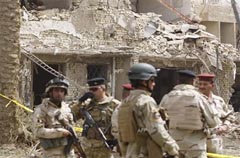 occupying forces, is still a problem for the Iraqis.
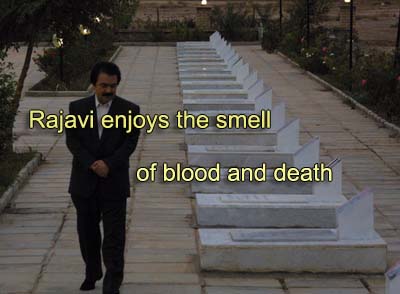 dependent on the blood of its devoted members, calling them martyrs. The terrorist cult of Mojahedin Khalq (aka. MKO, MEK, PMOI, NCR, NLA) is just one among a handful. And what is the necessity of such ever-growing dependence? The reason is simple; MKO needs flow of fresh blood to sustain its structure; it needs more and more martyrs to keep the whole enterprise going; it is a necessary means for the accomplishment of its causes, survival, and keeping its impressive propaganda machine going. As a vindication of its rightness in its struggle path, the group has always boasted about the counts of its members killed, injured and disabled as well as imprisoned members who are believed to substantiate its hegemonic legitimacy over all other opposition groups antagonizing the Iranian regime.
 under the tag of ideology, MKO inaugurated the ideological revolution to introduce a charismatic authoritarian leader to exert control over every aspect of his adherents’ life and to establishing a totalitarian pyramidal structure where the chosen devoted commanders would act as the leader’s deputies in his absence. But the leader needed certain facilities to implement the newly devised mind control. The most important prerequisite was of course a remote place isolated from the outside world to disconnect the contact of their followers from the outside world, particularly from their families and friends and even from their past. To phrase it in technical terms, MKO was desperately in need of a cultic milieu, the most central in creating the thought reform environment as depicted by Robert Jay Lifton:
 truth” for the well-being of their followers. In this way, they apply various bizarre practices to blind the followers from observing the reality of maltreatments against them. In the cult, they are constantly kept under a sever mind control manipulative system that they cannot see their leaders abusive acts.
 fuels global rage against Iranian regime but praises the group and its leaders as pro-democratic unity devoted to peaceful campaign against all cruelties and violations of human rights! MKO is not the first in history clinging to such a paradox but following the footsteps of countless bullies who were determined to shift the focus of public attention and rage away from their own devious intention and plans to a hateful image of a “single adversary”.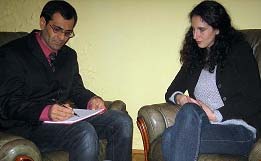
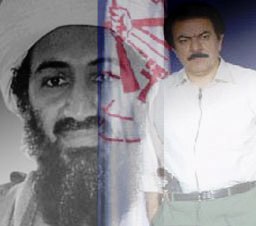
 similar to that of the ideological drift in 1975 drafted by Taghi Shahram, who broke the seemingly Islamic ideology of the organization and officially announced it to be Marxism. Consequently, Shahram suppressed any protest and opposition and even plotted assassinations to liquidate opponents or as a method of silencing them.
  agent of Iranian regime whenever the organization ever publicizes the news of some defection itself. The announcement does not appear just after the escape or defection but months and even years later and after the group fails to come to terms with the defected to stop him/her talking out. The stigma, MKO believes, on the one hand will possibly neutralize the disclosures and on the other, hand will boost a propaganda battle to talk big of its intelligence potentiality in detecting the infiltrated agents. Thus, it may appear to many as a never-ending battle between MKO and Iran’s Ministry of Intelligence and security; and of course the more secretive and sophisticated the ministry is depicted the more capable its rival can be proclaimed.