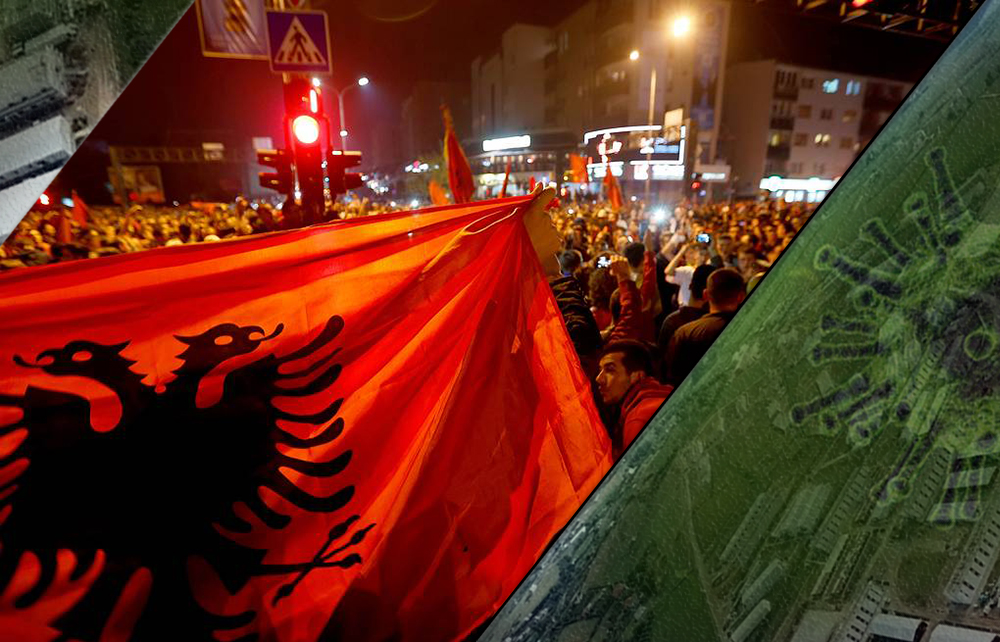
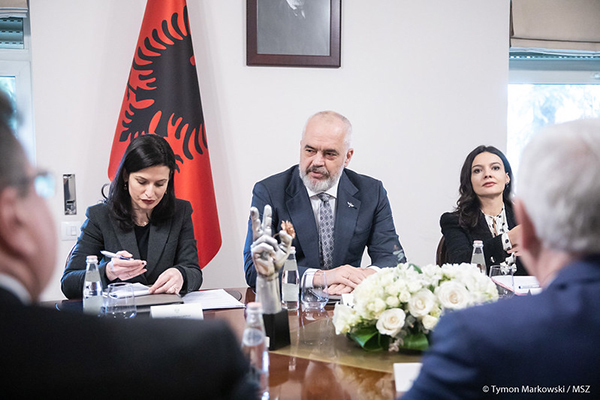
Albanian President Ilir Meta said a few weeks ago that”Albania is not a devilish country, but a democratic country that has suffered from an unprecedented devilish dictatorship and has come to value human rights as sacred“. His comments was a reaction to Iranian supreme leader ayatollah Ali Khamenei who mentioned Abania as a “very small but devilish European state, where Americans cooperate with Iranian traitors against the Islamic Republic.”
Actually, Albania backed the US attack to assassinate the Iranian general Qassem Soleiman, on the first days of January 2020. Whether Albania is a democratic country or not, it is now publicly supporting the terror of an Iranian official and advocating and sheltering the Mujahedin Khalq Organization (the MKO/ MEK/ PMOI/ Cult of Rajavi) with a long history of terrorist acts and cult-like practices.
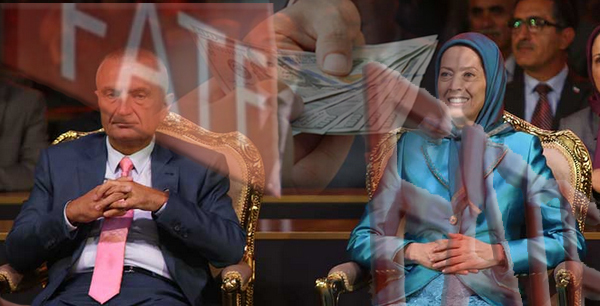
However, the stance of the Albanian president seems expectable due to the social and health services that the MEK offers the Albanian people for free. It is also very likely that a part of those huge sums of money that the group donates western politicians in exchange for their support, goes to the pockets of Abanian government officials that have warmly welcomed the terror group in their territory.
The MEK’s so-called humanitarian services to the Albanians can be regarded as an act of generosity and sympathy. But, the true face of the MEK lies in its history and the conditions of its rank and file: about two thousand elderly members who are kept in a hypnotic-like state.
The cult-like structure of the MEK makes it an inhuman entity from inside with a humanitarian face from outside. The potential threat of Rajavi’s cult of personality has been drawn into attention since the group’s relocation to Albania. The experience of the group’s residence in Iraq has given important lessons to the international society.
The MEK functioned as a private army for Saddam Hossein. They collaborated with Baath Party in suppression of Iraqi Kurd’s and Shiit uprisings in the early 1990’s. Meanwhile they were offering social services to Iraqi Sunni tribes who were hostile against Iraqi shiits and kurds and Iranians. The MEK played a very crucial role to escalate the divisions and instability in Iraq at Saddam’s era and after its collapse. Iraqi newly established government actually expelled the group from its territory since the beginning of its ruling but they could not manage the expulsion until 2013.
The group was received by Albania under a beneficial contract between the United States and the poor Albania. Albanian government is definitely gaining advantages by offering safe heaven to the MEK but they should be absolutely warned that a terrorist cult-like establishment like the MEK will come back to haunt their country someday. This is a serious warning.
Mazda Parsi
Albania
By hosting the People’s Mujahedin of Iran (MEK) on behalf of the US, despite the group being labelled a terrorist organisation by Iran, Albania has drawn the ire of Supreme leader Ali Khamenei.
The acting Albanian foreign minister Gent Cakaj announced on his Facebook account that an additional two Iranian diplomats would be expelled from Albania. This follows a decision in 2018 which expelled the Iranian ambassador and has made Albania a frontline in a clash between the United States and Iran.
The decision to expel the Iranian diplomats seems likely a result of the comments made by Iran’s powerful Supreme Leader Ali Khamenei in the aftermath of Qasem Soleimani’s assassination at the hands of the US in which he said: “In a very small European country but an evil country in Europe, there are American elements with some Iranian traitors, they got together to conspire against the Islamic Republic.”
In 2014, under US pressure, Albania took in more than 4,000 members of the People’s Mujahedin of Iran (MEK) a secretive group formerly based Iraq.
“Albania is hosting one of the most dangerous terrorist organisations on behalf of the United States,” says Dr Olsi Jazexhi, an Albanian academic and expert who has been tracking MEK activities in Albania.
“The Americans imposed them [MEK] on Albania and since Albania is a very fragile state they had to accept. The same thing was done by Prime Minister Edi Rama who is still hosting MEK in Albania,” Jazexhi tells TRT World.
Considered a terrorist group by Iran, the MEK was also listed as a terrorist organisation by the US State Department until 2012.
The Obama administration re-designated the group and formalised a relationship that the US had been cultivating covertly, protecting the group in Iraq at a US military base, then under American occupation.
“The reason for the MEK being brought to Albania is the general ignorance of Albanian politicians who do not understand the danger of international terrorism and the implications that this terrorism has on nation-states” added Jazexhi.
The MEK is a militant political organisation that subscribes to an unusual mixture of Marxist and Islamic ideology.
It has been accused of killing of American military personnel, bombing American companies and targeting innocent Iranian civilians during a campaign of terror over several decades.
A report by the US media outlet NBC News suggested that the group is being financed by Israeli intelligence and was also behind a string of assassinations targeting Iran’s nuclear scientists between 2007 and 2015.
“The MEK is deeply despised in Iran, they fought for Saddam Hussein against Iran for eight years. Then they spied for the Americans and the Israelis, they are mercenaries and a cult group,” said Seyed Mohammad Marandi, Professor of English Literature and Orientalism at the University of Tehran.
Former members of the MEK have spoken out about the oppressive cult-like rules enforced in the organisation, including marriages that have to be arranged by the leadership. There have been reports that the organisation has at times asked its followers to divorce en masse and locked up and even killed members who have criticised the dogma of Maryam Rajavi, the current head of the MEK.
“No one in Iran has any sympathy or respect for them [MEK], they are traitors to the country. They are tools of Western powers. Thousands of them are working as an online army in Albania,” said Marandi speaking to TRT World.
Earlier this year The Intercept, an online investigative publication reported on how the MEK had created a fake online persona called Heshmat Alavi in order to spread propaganda against the Iranian government, including advocating for regime change.
The so-called writer Alavi was managed in part from Albania and had fooled many American publications who had published the fake persona’s writing.
“Using different aliases on the internet, on Facebook as well as Twitter” they have managed to create a digital army, says Marandi, adding: “These social platforms do not block their activities because it is done in coordination with the US government and also they carry out spying activities in Iran.”
The US assassination of Iranian general Soleimani and the subsequent retaliation by Tehran in a series of rocket attacks on US bases underscores the dangerous manoeuvrings between the two powers and the potential to suck in other countries, including the small Balkan state of Albania.
“Albania has become the most dangerous country in the world for Iran after the United States and Israel,” says Jazexhi.
“While the United States and Israel are in open conflict with Iran, Albania by hosting MEK has become a major centre of anti-Iranian propaganda in the world.
The MEK doesn’t lack powerful friends in Washington and in particular enjoys close ties with the hawkish Trump administration. In 2017 the group paid National Security Adviser John Bolton and Trump’s personal lawyer Rudi Giuliani for speaking engagements.
With powerful friends like this, Albanian politicians don’t “dare to do anything” says Jazexhi even though “the majority of Albanians are appalled by what the government is doing.”
The MEK could also be acting against the Albanian penal code says Jazexhi.
“The Albanian penal code states very clearly that if a person or a group of people incites to fight against a foreign country or incites people or asks people to participate in a conflict in a foreign country they could be persecuted for this,” adds Jazexhi.
MEK actions in an impoverished country like Albania, which is still struggling to emerge from a communist dictatorship, doesn’t bode well for its long term stability or rule of law. Iraq has become a battleground of influence between the US and Iran, a faraway conflict for many Albanians.
“When you host terrorists and you aid terrorists than you should be afraid of suffering the consequences. These are not normal people,” says Marandi. “The Albanian government is foolish to cooperate in such a way with the Americans.”
Albanian President Ilir Meta shot back at comments made by [Ayatollah] Khamenei saying: “Albania is not a devilish country, but a democratic one.” However, Meta made no mention of the lack of democratic structures within the MEK and the human rights violations it has been accused of.
“MEK with its paramilitary camps that they have in Manza, Albania has created a state within a state,” says Jazexhi and as tensions between Iran and the US continue to heat up the role that the MEK is playing in Albania could also make it another theatre of conflict.
Elis Gjevori ,TRT world
Dear Madame,
We heard the news of some prisoners being pardoned on New Year’s Eve, and we hoped for justice in the light of your kindness.
Security and progress in human societies will be realized with more love and forgiveness because God loves the kind.
It takes courage to show kindness and you have shown that you have that courage. We congratulate you and your government for this courage and wish you success in serving your country and its people.
Madame Justice Secretary,
I would like to draw your attention to a case that appears to violate justice in your country, and which violates the rights of an innocent person and surely you will agree.
Last August, a friend of ours – Ehsan Bidi – was arrested and is being held in a closed camp in Mans. He has been denied access to a lawyer.
It should be noted that Ehsan Bidi has been in your country for six years already, has complied with all the rules and was given a ten-year residence permit by the government.
With his background, according to international laws and standards, he is recognised as a refugee. But unfortunately, he has been arrested and his human rights and asylum rights have been violated. He had chosen to remain in your country in the hope of finding a better and easier life because he believes he can have a good life in a law-abiding and civilized country, in line with international law, just like anyone else.
Madame Secretary, we look forward to seeing your courage in administering justice in this case. We urge you not to allow the violation of the rights of anyone who has sought refuge in your country and who has been bound by and has respected all the laws of the country since the time he arrived.
With the greatest respect
1- Mohammad Azim Mishmast
2- Hadi Sani Khani
3- Hassan Heyrani
4- Abdolrahman Mohammadian
5- Hassan Shahbaz
6- Ali Hajari
7- Ehsan Bidi
8- Gholam Mirzai
9- Malek bit Mashal
10- Moussa Damroudi
11- Gholamreza shekari
12- Parviz Heydarzade
The problem of radical jihadist and Islamist infiltration in the western Balkans is real and multiform, depending on the country of reference and its institutional, political and socio-economic characteristics. In fact, this is not a phenomenon that can be understood in general terms, but is, rather, linked to specific dynamics. Indeed, radicalism with an Islamist matrix breaks through where the state is lacking or absent, where socio-economic conditions (particularly those of young people) are severe, without forgetting the history of the relative country, which can in some way contribute to the modalities with which the phenomenon develops.
In the case of Albania, whether in fact the legacy of the communist regime led by Enver Hoxha, which led to the annulment of state religion in the country and the introduction of state atheism (1967) as official doctrine, may have contributed to reducing the fertility of the grounds which radical Islamism could progressively seek to breach after the fall of the regime is still a matter of debate today.
Despite some theories, according to which, reaction to state atheism has strengthened the beliefs of the Albanian people, so far the only proven effective consequence in Albania is mutual tolerance and cooperation between the different religious communities in a majority Muslim country, but with its Catholic, Orthodox and Bektashi presence. On the other hand, it is difficult to argue that state atheism has contributed to an increase in the number of believers in a country where nationalism, so-called ‘Albanianity’, takes precedence over ethnicity and religion and where the rate of mixed marriages is particularly high. It is therefore possible to hypothesize that the remarkable interreligious tolerance is actually the result of an approach which, through state atheism, has led to the religious aspect being seen as secondary to belonging to the nation. In addition, Albania has never been the scene of religious conflicts on its territory.
Radical Islamism fueled from abroad
Islamic extremism in Albania is a problem imported from abroad and connected to various sources. There are Gulf countries and charitable organizations that have every interest in spreading Wahhabism and Salafism, financing mosques, cultural centers, charitable associations of a religious nature, importing doctrinal material for distribution and imams for indoctrinating.
On the one hand the Albanian Muslim community (Kmsh) is very careful to identify and eventually reject radical drifts, to the point that already in 2015 it asked its institutions to intervene to deal with the problem, on the other there is a reality created by radical preachers, active in unofficial Islamic centers but also on the web, some of whom returned to Albania after periods of study in Islamic schools in the Middle East. These hate preachers are not only concerned with spreading that Salafist and Wahhabi ideology based on abuse and intolerance, but also openly invoke jihad. Not surprisingly, in March 2014, the Albanian security forces dismantled one of the largest networks of propagandists and recruiters for ISIS active in the western Balkans (and the most important of Albania), headed by the two imams Genci Balla and Bujar Hysa.
Among the characters connected to the ‘Balla-Hysa’ network there was also Almir Daci, ex imam of the Leshnica mosque, who appeared with the name ‘Abu Bilqis Al-Albani’ in the well-known video on the Balkans released by ISIS in June 2015 and entitled ‘Honor is Jihad’.
The areas targeted by hate preachers are mainly the peripheral ones of Elbasan, Cerrik, Kavaja, Librazhd, Pogradec, Skutari but also the outskirts of Tirana. Their targets are largely young individuals in precarious social, cultural and economic conditions.
A further problem is the economic and political infiltration of Erdogan’s Turkey, ideologically linked to the radical Islamism of the Muslim Brotherhood. Infiltration perpetrated through the use of so-called ‘soft power’; the ability to persuade, attract and co-opt, through such means as culture and politics. This poses a far more serious danger because it is more difficult to identify and manage. An example? The great mosque of Tirana (the largest of all the Balkans), built by Erdogan a stone’s throw from the Albanian Parliament on an area of 32,000 square meters. Obviously, everything has a cost and in this case it is of an ideological-political type. In fact, it is not surprising that the sermons preached within these mosques are the same as those pronounced by the imams of the countries of origin, with contents that go beyond the theocratic doctrinal aspects and flow into politics. A very powerful weapon in the hands of regimes.
Return of jihadis and the fight against terrorism
Albania has ‘contributed’ to the jihadist cause in Syria and Iraq with around 180-200 foreign fighters out of a population of 2,873 million, but also seems to have good control of the situation. The US State Department Country Reports on Terrorism for the year 2018 has in fact highlighted how Albania, despite the scarcity of resources, has still achieved good results in countering jihadism. The collaboration between Albanian CTU and US agencies in the fight against terrorism is currently at high levels; a further important aspect is also the modernization of the Personal Identification Secure Comparison and Evaluation System (Pisces) to protect Albania’s borders, in addition to the already high controls at sea and airports.
Overall, Albania appears to be able to manage the danger deriving from jihadism linked to the return of foreign fighters and radicalization in its territory; this is certainly the result of cooperation with European and US agencies, but also the presence of an efficient internal intelligence system, a legacy of the communist period. More problematic is the management of internet propaganda which affects not only Albania but also the diaspora (a problem among other things on a global scale), propaganda that could also affect jihadists who have returned to their homeland, as well as latent ones, who never left.
The headquarters of the People’s Mojahedin of Iran
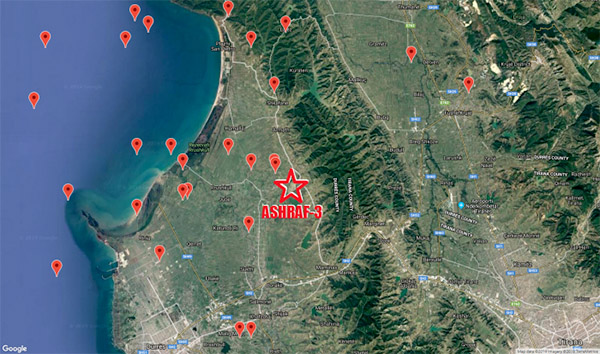
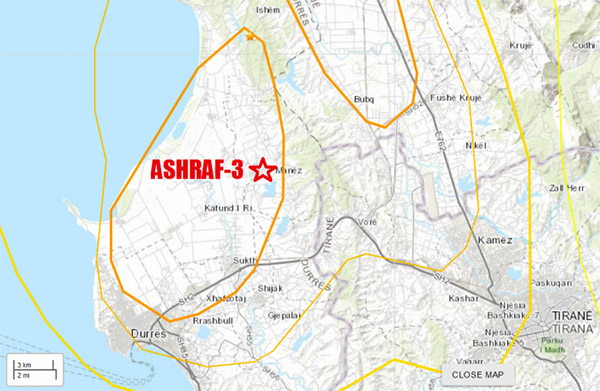
A further problem on Albanian soil is linked to the presence of the headquarters of the People’s Mojahedin of Iran (MEK), established in Manez (near Durres) since 2016, after years of activity in Iraq. A presence that has created many headaches for the institutions of Tirana.
The MEK was created in 1963 with the aim of fighting the Shah’s regime and in 1979 participated in the Islamic revolution led by Ayatollah Khomeini; however, the populist ideology (a cross between Marxism, feminism and Islamism) clashed with that of the Ayatollahs, and the Mojahedin was therefore banned and the group found refuge in Saddam Hussein’s Iraq.
With much suspicion of Israel[i involvement] and badly tolerated by many anti-Ayatollah Iranians, the MEK was previously blacklisted by the European Union, Great Britain, the USA and Canada, only to then be “cleared through customs” between 2008 and 2012, thanks also to the intervention of the then Secretary of State, Hillary Clinton.
While Washington sees in MEK “the main opposition force for promoting democracy and secularism in Iran”, on the other hand, Tehran identifies it as a “terrorist organization responsible for bombings and acts of political violence”. Whether the MEK is a promoter of “democracy and freedom” or not, it is difficult to say; it is certain that the union between Marxism-Leninism and Islam preached by the group is certainly not a guarantee of that, just as its structure which shows typical elements of a sect (cult) is not either, as recently illustrated by the BBC report.
It is worth pondering the usefulness of the MEK presence in Albanian territory, an uncomfortable, perhaps inopportune presence, which risks creating more problems than advantages in an extremely delicate context such as the Balkan one.
Inside Over, Tirana, Albania, Translated By iran-interlink
The following is an interview I conducted via email with Osli Jazexhi, an Albanian-based, Canadian-Albanian historian who specializes in the history of Islam, nationalism and religious reformation in Southeastern Europe. His interest covers nationalism, radicalism, religious and ethnic identities in the Balkans. The interview was conducted between December 17 and 19.

How popular is MEK in Albania?
MEK is a terrorist cult that resides in Albania, and which struggles to overthrow the government of a country that has done nothing wrong against Albania. As a result, the majority of the Albanians have no sympathy for this organization whose job is to wage war and terrorism against a foreign country. What MEK does is criminal and punishable according to the Albanian Penal Code and the Constitution of Albania.
MEK was brought to Albania by deception. Albanian politicians like Pandeli Majko, Fatmir Mediu, Sali Berisha etc., asked the Americans to host them in Albania without asking the Albanian people first. This is like as if German politicians were to take into Germany the ISIS army and command, and host them in their country without asking their citizens first.
The first members of MEK came to Albania in 2013. However, the bulk of them were brought in 2016, when the then US Secretary of State John Kerry announced their massive landing in Tirana. The coming of MEK created big fears in the country where many media, security analysts, journalists and the public opinion condemned the deception through which MEK was brought. From 2016 to 2018 the media in Albania has written and produced many debates against the MEK and ISIS fighters. Even the office responsible for fighting extremism classified them as an extremist organization in January 2018. The weird nature of MEK which operates as a messianic jihadi cult, whose members are mujahedeens, live isolated from the world, refuse civilian life and make continuous calls for jihad against Iran, and create fear among the peace-loving Albanians in the same way ISIS does for many people in the world. For this reason in the past years many journalists and activists have criticized the government of Prime Minister Edi Rama by blaming it for turning Albania into a safe heaven for terrorists.
In the past three years MEK has gained notoriety in Albania for its attacks against journalists, the media and any person who questions their activities. MEK defectors and their revelations have appalled the Albanians who hate the Stalinist past of their country, when they were indoctrinated and isolated like MEK does at present with its members.
When MEK first came to Albania they were housed in Tirana. Many of their members, who for many years had been kept in isolation in Iraq, started to defect en masse. Some were caught by the border police for trying to smuggle themselves into Western Europe. The stories that defectors presented to the Albanian public, which showed the brainwashing and radicalizing tactics of MEK against their members, shocked the Albanians. 2016 and 2018 have been critical for MEK, since it faced many defections and scandals from many family members of MEK jihadis who came to Albania trying to rescue their relatives from the organization. To stop this, the MEK leadership took the following steps:
1. They removed their members from Tirana and housed them in the paramilitary camp of Manza known as Ashraf 3, where they are kept locked in and not allowed to walk out of the camp.
2. They asked American and British politicians to intervene in Albania and ask the Albanian authorities to not allow any family member of MEK jihadis to come to Albania and meet their relatives. Their family members were branded as agents of Iran and the Albanian government was ordered to stop their entry in the country.
3. They spread fake news in Albania and Europe by claiming that Iran is sending terrorists to kill them and for this reason forced the Albanian government to keep them in total isolation from the outside world and discourage the media from investigating them.
4. They have asked from all the local media to never interview and investigate them, not to reveal their names and activities, by claiming that if interviewed the media will send out facts which will be used by Iran to kill them. While they succeeded in silencing the Albanian media, they failed with the Western media who have exposed them a lot.
5. They secured the shameful collaboration of the UNHCR office in Albania and Albanian government agencies through which any MEK member who escaped from the jihadi camp and wanted to de-radicalize himself was to be punished by the UNHCR and the Albanian authorities by having his / her social assistance cut, their political asylum rejected, and left without working and traveling documents. In few words, if the mojahedens abandon the jihadi organization, they were to be starved to death.
6. They co-opted some Albanian media like News 24 TV and Vizion + and paid their journalists to support their cause and propagate the fake MEK claims that Iran is a terrorist state which wants to kill them. The owners of News 24 and Vizion + did not allow any debate in their TV stations about what MEK does, how it spreads fake news and attacks their opponents without facts. Journalists like Sokol Balla who covered their events, even produced a documentary showing the jihadis as freedom fighters.
7. They demanded the Albanian authorities to close all Shia religious institutions of the country connected to Iran, block their bank accounts and expel all the Iranians from Albania. The Albanian authorities complied. A Quran foundation, a private High School and Rumi philosophical foundation that were cooperating with religious institutions and universities in Iran were all closed down. Hundreds of Albanians lost their jobs, students lost their education, many Iranians were deported back to Iran and many research projects and book publications were canceled. The Bektashi Community of Albania and other Sufi Tariqas who historically had very close relations with Iran have all been forced to severe their ties with Iran and not invite Shia religious scholars in the country anymore.
How much in the public are Maryam Rajavi and Massoud Rajavi? Do they have much support in Albania?
Massoud Rajavi, the founder of MEK is nowhere to be seen. People who study MEK believe that he is dead, probably because of an injury that the Americans inflicted on him in Iraq when MEK was on the side of Saddam Hussein and was considered a terrorist organization by the United States.
Maryam Rajavi the widow of Massoud, who leads the cult-organization, does not make public appearances. She never comes out in streets and few Albanians know where she hides. It is believed that most of the time she stays with her cult commanders who run the everyday life of the mojahedins and their subversive activities against Iran and probably Iraq.
Maryam Rajavi works mainly behind the curtains. Time after time she releases pictures of meetings with Albanian politicians, where she asks for favors and pushes them to stop the media from reporting on human rights violations that MEK does against her members. The story that MEK and Maryam Rajavi conveys to those Albanian media who have agreed to spread their fake stories is that MEK is ‘the democratic opposition of Iran’, that people in Iran live in a dictatorship and are being killed by the ‘regime’ and they are all waiting for Maryam Rajavi to go and save them from the Mullahs. MEK tries to play the victim in Albania and the West by spreading fake news against Iran and claiming that Iran is ready to conduct a major terrorist attack and kill the ‘democracy loving’ mojahedins. On the other hand, as the Albanian Deputy Minister of Interior Besfort Lamallari have accepted in a TV show, MEK, contrary to Albanian laws, runs its own secret service agency in Albania and serves as a major tool to direct Albanian policies towards Iran. In a few words, MEK has taken over Albanian foreign affairs in regard to Iran in the country, and apart from its foreign fight against Iran, conducts espionage activities inside Albania against Albanian and foreign citizens.
Even thought they spend a lot of money to counter their negative image, the Albanian public opinion and almost all the journalists and security analysts do consider MEK, at least privately, a violent terrorist organization which is hosted in Albania because the Americans have ordered it to be.
MEK has been trying hard to buy a number of Albanian politicians and NGO activists on their side by inviting them to their events in Albania and in France, and connecting them with American and European politicians. They spend a lot of money even with peasants who live in the vicinity of their village of Manza in order to recruit them on their side. There are reports that MEK is teaching its jihadi ideology to young children in the village of Manza; however, the Albanian government has done nothing to stop this dangerous indoctrination.
Nevertheless, the Albanian public opinion including the politicians do not take MEK seriously for what they do and say. MEK’s desire to do jihad and establish a utopian Rajavi cult-like regime in Iran does not make any sense for the Albanians who for 50 years lived under a MEK-like Stalinist regime of Enver Hoxha. No Albanian would ever want to live even for a day in the paramilitary camp of MEK or under the totalitarian ‘Utopia’ of Maryam Rajavi. I do not believe that any Albanian will be cheated to join the jihad of MEK against Iran as many did when they joined DAESH in Syria.
The only use that Albanian politicians have with MEK is the connections that MEK has with high neo-con politicians in the United States. Since the US Embassy has the absolute say about many things that happen in our country, having good connections with MEK for the corrupt Albanian politicians means that they will have access to the Americans and probably save themselves from being sent to jail for their crimes. For this reason, many Albanian politicians, including our president, participate in MEK meetings.
One Albanian deputy who used to seat in Albania’s Security Council in 2018 told me that ‘We know that MEK is a terrorist organization. But the Americans brought them here, and they and our British friends told us to keep them, and we are keeping them because we are told so.’
Is MEK growing in numbers and influence, or diminishing? Why do you think that is?
When the Obama administration brought MEK to Albania, the idea was that they will build an asylum where MEK terrorists will retire and die by escaping justice for their past crimes against Iran and Iraq. MEK was brought to Albania, probably as part of the Iran Nuclear Deal. Iran and Iraq did not want them in their region and the Americans had to do something in order to save them from justice. As a result of their past terrorism, no country wanted to host them. Even the Americans did not want them in the United States.
The only country which accepted them was Albania. Albania was a good choice since our country is run by criminal groups and does not have a functioning legal system like the United Kingdom, Italy or many countries in the West have. By being a lawless country with very weak legal institutions, a corrupt leadership and where the US Embassy has the final say on everything, the Americans made the right decision to bring them to Albania. The other option for MEK would have been the Guantanamo Bay. Many American senators who have visited Albania during the past years have told Prime Minister Edi Rama to protect MEK at any cost and do not allow them to be charged for the murder and crimes they have committed in the past. If MEK was to be located in the United States, United Kingdom, France or Italy, many of its members would have gone to court by now.
After coming to Albania, many MEK members have changed their names and ID-s. Last year, when a Canadian family of Mostafa Mohammady wanted to save their daughter, Sommayeh Mohammady, who is being held in the MEK camp – Mostafa revealed to the media that many MEK commanders who appeared in the media parading his daughter in Iraq had other names. Mostafa and other defectors have revealed that some of the commanders who are today in Albania, in the past have committed crimes and even killed people. This fact has shocked the journalists and the public, but no investigation has been opened by the office of the general prosecutor. The only court case that is ongoing at present against MEK in Albania is the case of Gjergji Thanasi, an Albanian journalist who has been accused for being an Iranian spy by commander Behzad Safari. Thanasi has sued Behzad Safari for slander, libel and defamation and is asking compensation for the damage that MEK fake accusations have made against him.
While during the days of Obama administration MEK kept a low profile, their influence and profile has changed during the beginning of the Trump administration. John Bolton, the National Security Adviser to president Trump, has been instrumental on radicalizing and promoting them as ‘the democratic opposition of Iran’ and promoting them as the ISIS or Free Syrian Army version of a future war against Iran – which would bring regime change in Tehran. In the last three years MEK has transformed its profile in Albania – from an asylum seeking organization who begged Albania to host and ‘save them from Iran and Iraq’ into a militant organization which together with the US administration has pushed Albania to undertake hostile actions against Iran; like the expulsion of the Iranian Ambassador in December 2018. In the past two years MEK and Maryam Rajavi have aggressively demanded from the Albanian government to cut all ties with Iran, expel Iranian diplomats, and has been involved in a huge campaign of spreading fake news against Iran.
The Edi Rama government, who at first was surprised by their demands and was hesitant to please them, in the past year has been forced to give them support on the fake news that they spread and in their attacks against MEK defectors.
However, after the sacking of John Bolton and the investigations that have started against President Trump and Rudy Giuliani in the US, MEK seems to have gone mute. In the past months they have been less aggressive in the Albanian media, and have launched only sporadic attacks against some foreign media outlets like the BBC, Der Spiegel or Albanian journalists like me and Gjergji Thanasi who have reported on their weird activities and organization.
MEK is very vicious against the media. Unlike ISIS or the Taliban who kill the journalists, MEK who cannot do such killings; in Albania, the attacks against them are through character assassination by accusing them of being agents of Iran and working for the Mullahs. This is how they have attacked the BBC, Channel 4, the Guardian, Al Jazeera and many journalists who dare to speak and investigate them. When they attack the media, they do not use their names. They post their attacks in anonymous websites who cannot be traced where they are located. As a result, journalists like me have difficulty to sue them in courts. But the case is different with Gjergji Thanasi, who was attacked by Behzad Safari, a notorious commander of MEK who has to justify his lies in court.
The hate that MEK has against the media is partly because Maryam Rajavi and her commanders live in a totalitarian utopia. They brainwash their soldiers with fake hopes about the imminent victory of their utopian regime change in Iran. Albanian politicians like Pandeli Majko have also fallen pray to MEK radicalization. Two years ago, Majko believed that before 2019 he and Maryam Rajavi would eat ice cream in Tehran after overthrowing the democratically-elected government of Iran. However, while the people of Iran hate MEK and their regime change has never materialized, MEK hates the media and perceives them as its greatest enemy. MEK behaves like the Communist Party of China. Their camps are not much different from the Xinjiang Concentration Camps where Uyghur Muslims are brainwashed to believe that chairman Xi Jinping is the leader of the great Chinese revolution. Like the CCP, which hates the media and have placed Xinjiang in a total lockdown, MEK does the same. Journalists are not allowed to enter in their camps to investigate their members, and the only time when ‘friendly’ journalists and guests are invited they are allowed to film MEK jihadis singing and praising Maryam Rajavi. Exactly what CCP does with its imprisoned Uyghurs in the concentration camps, who when presented to the media are told to sing and dance.
However, after the sacking of John Bolton and Donald Trump’s declaration of retreat from Syria and his abandonment of the Kurds, the MEK leadership seems to be having a very hard psychological time in Albania. Some defectors have told me that MEK fears that Trump will abandoned them like he did the Kurds and this will mean the end of MEK. The Saudi money which is believed to be funding MEK’s existence will cease, and without money its members who now stay in the Manza camp or Ashraf 3 will escape and defect en mass towards Western Europe. Maryam Rajavi will be forced to close her 50-year old jihadi organization and Albania and Europe will have to deal with MEK at the same way as they are dealing with the returning ISIS fighters. Albania will be in the position of Turkey with its 3 million Syrian refugees, while the Americans will discharge the MEK problem to Europe as they are doing with ISIS returnees at present.
How strong is the international support for MEK in your estimation?
MEK had a lot of support when John McCain was alive and John Bolton was advising the White House. MEK was perceived as the Iranian version of ISIS and Free Syrian Army by American neo-cons. However, with the death of McCain and dismissal of Bolton and troubles for Rudy Giuliani, MEK seems to have lost some very important supporters in the United States. MEK is not a military asset for the United States against Iran. They are a bunch of old terrorists, many suffering severe illnesses, who no longer have tanks and cannons like they had under Saddam Hussein. From Albania they cannot easily conduct terrorist attacks against Iran like they were doing from Iraq. The best that they can do in the great regional war between Iran and the Axis of Resistance on one side and Israel and the United States on the other, is to spread lies and disinformation against Iran or to stage false flag attacks in Europe.
MEK has been quite successful on that. Many ‘terrorist’ attacks that the media attributed to Iran in 2018, have in fact been faked by MEK and its members. To date not a single Iranian or Iranian-linked individual or organization has been found guilty in Europe during the past years, even though MEK and Israeli media keep on repeating that Iran is about to mass-terrorize the Europeans.
MEK is being used by Israel and certain elements of the American deep state to serve as a poisoning tool in the relations between Iran and Europe.
Their organization, which is believed to have around 3000 members, needs a huge budget to run. Each MEK member used to take around 500 EURO / month to survive in Albania from UNHCR. The minimum budget that MEK takes to sustain its members and camp is around 1.5 million EURO per month. It is believed that this budget comes from Saudi Arabia. In a year they need at list 18 million Euros, without counting here the money that they spend for building their facilities and hosting periodic events where they invite retired and second-class politicians from the West who get free hotel, food, airplane tickets and some stipends for their attendance.
Coming back to your question how strong is MEK’s international support I could say that they have the support of some countries that are hostile to Iran, like the United States, Israel and Saudi Arabia. But no European government loves them, and the European Union despises them since they perceive them as a security threat. The Italians, the Greeks, the Macedonians, the Turks, the Russians etc., all observe MEK with great concern.
MEK tries very hard to create the impression that it has mass international support. In its periodic conferences it invites retired Europeans and Americans, students, workers etc. who, in exchange for their free holiday trip to Albania, are required to go into their gatherings and spend a few hours in photographic meetings that Maryam Rajavi does with them. MEK stages shows in its camp like the CCP does in its concentration camps in Xinjiang with foreign journalists and diplomats. China invites foreigners who receive first-class treatment and in return are expected to lie about Xinjiang and not to investigate what is going on with the Muslim detainees. MEK’s invitees do the same. They do not interrogate MEK members who do not want to do jihad and want to escape from the camp. The invitees in most of the cases are happy to sell to the world a fake story by declaring that MEK is not a terrorist cult which wants to do jihad against Iran, but it is the ‘Iranian opposition’ who ‘wants to bring democracy to Iran’. However, some brave journalist like the brave Alice Taylor who have visited the MEK camp, have revealed to the world how MEK tries to fake its image and use the paid journalists for this fake make up.
When MEK came to Albania, their presence was rejected overwhelmingly by many civil society groups, the media and the public. There were many calls for their immediate expulsion from the country. However, in the past two years MEK, with the support of many American and Western politicians, has been able to buy many individuals and silence the media criticism on them. They do this by blackmailing the media who report on them, by character assassination of journalists, or when they cannot silence the media they try to buy them by offering money. Many journalists are paid when they go to MEK camp and produce fake stories on them. MEK never accepts open debates about what they do. They do not know how to act in an open society.
Since MEK is seen as an organization which the United States supports, no politician or religious personality in Albania dares to talk about them in public. Many journalists who have opposed them in the past have been told not to do so anymore. Many media have chosen to ignore them since they know that by speaking against MEK they put themselves into trouble, and as MEK commanders say to many journalists – they will ruin their career.
Do you think MEK is a well-organized group, or is it in disarray?
MEK has three types of members. Some who are fully indoctrinated and follow the ideology of Maryam Rajavi blindly and believe that she is some kind of Holy Person who will establish an utopian Marxist – Rajavist regime in Iran. Some who know that her totalitarian ideology is non-sense, but keep quiet because they know that if they leave the cult, now that they are too old they will not be able to survive and will die in poverty. The third type of their members, who are mainly youths, hate the organization and wait for their moment to escape and live in freedom. MEK does anything in its power to keep its members isolated and scared from the outside world. The majority of its members, especially the youth, are not allowed contact with their families, the media and the outside world since this will give them the connections to escape into freedom.
MEK runs as a paramilitary organization. It has a well-organized command structure, while the rest of its members are treated as simple jihadi soldiers. Some MEK defectors who live in Tirana have told me that there is an open mutiny among the soldiers and when foreign delegations visit the camp, many members are kept locked indoors and are not allowed to attend the mass events. They want to abandon the camp where they live isolated like in prison. MEK members undergo psychological brainwashing very much like the Uyghurs in China’s concentration camps. Camp members are forced to undergo indoctrination classes every day. They do not have access to telephones, the internet and are not allowed to communicate with their families. They are kept under constant supervision, radicalized with ideas of violent jihad and monitored by surveillance cameras. Defectors have told me that Maryam Rajavi rules over them with fear. She and her command scare the mojahedins by claiming that if they leave the camp they will die of hunger or Iran will kill them with its agents.
For as long as MEK receives a budget of millions of dollars and is protected and allowed to isolate its members and abuse their human rights, it will manage to survive for a few more years as an anti-Iran warmongering organization and center of espionage. If Washington or Tel Aviv would need, some of its still-able members will be also used to commit terrorist attacks in the Middle East and Europe. However, if the organization will be left without money, Maryam Rajavi will not be able to pay ‘international supporters’ like Bolton and Giuliani for her cause and its members who will be hungry will riot and abandon the cult like many of their comrades have done in the past.
If Iran reaches a new comprehensive and long-lasting deal with the United States, MEK will very likely lose its sponsors and the organization will either be sent back to Iran or it will dismantle by itself. But even if these things do not happen, in the coming 10 to 20 years the organization will cease to exist since many of its members will be dead by that time and Maryam Rajavi, if she is still alive, will not have the chance to abduct and brainwash new jihadis against Iran.
Robert Fantina, Counter Punch
Police said cell planned attacks on exiled Iranian opposition group. Others wonder if Albania is being drawn into US and Israeli fight with Iran
MEK defectors raise doubts over alleged Iranian ‘terror cell’ in Albania
Albanian police recently announced that they had discovered a terror ring, run by the Iranian Revolutionary Guards, which had planned attacks on an exiled Iranian opposition group living in Albania.
“A terrorist cell of the foreign operations unit of Iranian Quds was discovered lately by Albanian intelligence institutions,” Police Director General Ardi Veliu said at a press conference in late October.
The goal of the ring, Veliu said, was to strike the Mojahedin-e Khalq (MEK), an exiled Iranian opposition group which has been based in Albania for the past three years.
Names of group members were also released, including Alireza Naghashzadeh, whom Veliu identified as the cell’s operations chief and a member of the Quds Force, the arm of the revolutionary guards which conducts foreign operations.
The ring, he added, had been identified by sources inside it.
But no arrests have been made and Albania has yet to request international arrest warrants for the alleged attackers, leaving local journalists and Iranian dissidents with lingering doubts.
‘If it was true, why hasn’t Interpol arrested them?’
– Hassan Heyrani, former MEK member
Gjergj Erebara, a journalist with the Balkan Investigative Reporting Network, said the press conference – which he attended – was unusual, to say the least.
“Albanian police gave no proof to substantiate its claims. They said they have discovered the “terrorist cell”, but they didn’t make any arrests,” Erebara said.
Hassan Heyrani, a former high-ranking MEK member who defected from the group in 2017, said he believes the story that the police presented is fabricated.
“If it was true, why hasn’t Interpol arrested them? Albania is a very poor country where corruption is rife, police can be bought,” he said.
MEE repeatedly asked the Albanian police for further details about the alleged ring, but a spokesperson declined to comment. The Iranian Embassy in Tirana refused to comment.
Without further detail, some observers say they have been left wondering if the announcement is a sign that the Balkan country is being drawn further into America’s – and Israel’s – fight to overthrow the Iranian government.
From Iran to Albania
Established in 1965 as an Islamist-socialist movement, the MEK rose up against the rule of the Shah of Iran during the 1979 Islamic Revolution, but soon ran afoul of new leader Ayatollah Ruhollah Khomeini.
Facing a deadly crackdown, the MEK launched attacks on government officials and security forces and eventually was forced to flee the country, first to France and then eventually to Iraq.
MEK defectors raise doubts over alleged Iranian ‘terror cell’ in Albania
Massoud Rajavi, who led the MEK until he disappeared in 2003, and his wife Maryam, who now leads the group, seen in Paris in 1985 (AFP)
The group, whose activities have been described as cultish, with a goal of overthrowing the Iranian government using violence and indoctrination, was designated for more than a decade by both the US and the UK as a terrorist organisation.
But in recent years, and as both countries delisted the group, the MEK has become a favourite of anti-Iran hawks in the US and Europe who see it as a weapon against the government in Tehran.
Between 2014 and 2016, at the bequest of the US, at least 2,700 MEK members were resettled in Albania after the group came under attack at Camp Ashraf, the Iraqi refugee camp where they had been living since the mid-1980s.
These days, the group lives in a fortified camp in the country’s northwest, heavily protected by Albanian authorities.
Covert playground
Analysts say the group’s presence in Albania has raised alarm bells in Tehran and there have been reports that prominent members of the group have been under surveillance globally.
Ruslan Trad, an independent researcher focused on Iranian influence in the Balkans and co-founder of De Re Militari, said he believes Albania is now “a subject of espionage games” between Israel, Iran and the US.
Trad said Iran’s presence in Albania must be understood in the context of Tehran’s activities over the past two decades in the Balkans where it has been quietly establishing a foothold, triggering the concerns of western governments that the conflict with Iran had arrived in their backyard.
A 2012 attack killing five Israeli tourists, a bus driver and the bomber outside the airport in the Bulgarian city of Burgas, which Bulgarian intelligence eventually attributed to Hezbollah, was seen by many analysts as part of the covert war between Iran and Israel. Hezbollah denied its involvement.
Since then, however, Trad said he believes the Balkans have become an attractive location for Hezbollah, according to locally based Hezbollah members and sympathisers he has interviewed.
“Hezbollah is using Kosovo and Macedonia as a logistic centre and transit path, and Bulgaria as a hub,” he explained. He believes Hezbollah is heavily linked to Balkan mafia circles.
In turn, the activity has seen the Israelis step up their own operations in the Balkans, he said: “The Albanian authorities are probably cooperating with them.”
US-Albanian ties
Heyrani, the former MEK member who defected, said he believes the main reason Albania has been so supportive of the MEK is a result of the close relations between Albania and the US.
“Albania is under American control and also MEK is supported by the American Israel Public Affairs Committee (AIPAC),” he said, referring to the appearance of MEK members in an AIPAC-funded TV commercial against the Iran nuclear deal in 2015.
Under Donald Trump’s administration, hawkish support for the MEK has continued, including from now-former security advisor John Bolton and Secretary of State Mike Pompeo.
Bolton praised Albanian President Edi Rama at the end of last year for expelling the Iranian ambassador in Tirana in direct relation to an alleged terror plot targeting MEK members.
Trump wrote a letter acknowledging Albania’s “steadfast efforts to stand up to Iran and to counter its destabilising activities and efforts to silence dissidents around the globe”.
The continued support and safety measures that the Albanian government provides the MEK – now with the added questions about the alleged terror cell – has led many dissidents who have left the group to be concerned about their futures.
MEE spoke to several MEK defectors, several on condition of anonymity, who said they were distressed about what would come next for them, given the government’s stance.
“We just want a normal life, to get married and have a family. We have no citizenship, no passports, no land rights. We came here on humanitarian grounds, but we are treated like criminals,” Heyrani said. “I have no choice but to live here. I can’t go back to Iran. They do not accept us.”
Heyrani said that recently his image was splashed on Albanian television where he was described as an enemy of the state.
“They have no evidence, just like the alleged terror plot,” he said. “But here in Albania that is not important.”
Suddaf Chaudry, Middle East Eye
Devastating earthquake destroys the PMOI/NCR base in Albania, possibly dozens dead, survivors blame Iran
On 26 November, early Wednesday morning at 3:54 local time, northwestern Albania was struck by a strong 6.4-magnitude earthquake with an epicenter northwest of the capital Tirana. The maximum perceived intensity was VIII (severe) on the Modified Mercalli intensity scale. The tremor was felt in all parts of the country, and in places as far away as the Italian city Taranto and the Serbian capital Belgrade, some 370 kilometers northeast of the epicenter. It was the strongest earthquake to hit Albania in forty years. There have been hundreds of aftershocks, of which four have been greater than 5-magnitude.
Following the deadly earthquake, the Albanian government declared Wednesday a day of national mourning and a state of emergency in the Durres and Tirana regions. The earthquake razed several buildings to the ground in the port city of Durres and the surrounding villages, trapping dozens of people. Material damage and casualties have been reported in Tirana also. Neighboring and European Union countries have reacted to the earthquake with sending civil emergency rescue teams and financial aid.
For more than 36 hours, civil emergency crews, police, the army and specialized rescue teams from other countries have been digging in the ruins of collapsed buildings seeking survivors. The authorities say they have so far rescued 45 people. According to the latest official data, at least 48 people were killed in the earthquake, with 790 injured and more than 20 missing. These numbers are far from complete, especially considering the official hiding of foreign victims.
Unreported foreign casualties
While Albanian citizens living in Tirana and Durres, 30 km and 15 km from the epicenter respectively, had some luck to avoid disaster, the members of the People’s Mojahedin Organization of Iran (PMOI or MEK) aka National Council of Resistance of Iran (NCR) had none. Stationed only 5 km from the epicenter of the main earthquake, as well as less than a kilometer away from the epicenter of powerful 5.3-magnitude aftershock, the residents of poorly built barracks of the Ashraf-3 base have experienced true horror.
And everything almost went unreported. Standing with a colleague at the entrance of Tirana’s hospital in search of new information and tragic personal experiences, we were surprised to see a column of emergency vehicles led by a police car, trumpeting and shouting “Clear the way!” Wondering who is so important that ordinary civilians have to get out of the way, including wounded women and crying children, we followed the column until it stopped and politely asked the police officer about the VIP patients. “No camera, get back,” he ignored our questions and tried to drive us away.
Standing aside, but at a decent distance, we saw paramedics fastly carrying wounded on stretchers inside, at least two dozen of them. Some were covered with sheets full of blood, probably half dead, while others were howling in some incomprehensible language. Foreigners, therefore special treatment, I think to myself. But who? Too many for some embassy staff, too much well-treated for tourists, I wondered.
Given the obvious secrecy and strict police measures, we decided to change our approach. Instead of asking sensitive details with the press cards, we dodged the cops and approached one young paramedic: “They sent us here, we are translators, where should we go?” I asked him with self-confidence. “So you speak Iranian,” he responded. “Of course I speak Persian, or Iranian, as you inaccurately say,” I taught him differences and repeated the question about direction. “Second floor,” he explained, showing us where to go, and left quickly.
For me, things immediately started to make sense. Few in Albania do not know that there is a base near Tirana with 4,000 members of the controversial Iranian opposition group, displaced in 2016 from Iraq at the request of the US government. We journalists know a little more. Their compound is highly guarded and residents are strictly controlled, with no contact with the outside world. Several fugitives from the base gave shocking stories, and Albanian journalists who reported about their cases were facing tremendous pressures and harassment. Thus, this disastrous situation turned out to be a gold mine, a unique opportunity to find out what happened there. And what was happening earlier.
Repeating the same approach, I introduced myself as a translator and entered the hospital building. Fortunately, being busy in all that mess, none of the hospital staff asked additional questions or demanded documents, nor know Persian. Neither do I. Therefore, I hoped to find a sufficiently lively and friendly English speaker among the casualties, and I did. Teymur, a skinny mustachioed man in his late 50s, spoke English badly and slowly, but honestly.
“Not fair, we’re razed, but Tehran is not”
“It started shaking while I was sleeping in our dormitory with many others,” Teymur begins his experience. “At first the bed started to shake and I saw many waking up, then the windows and ceiling bursting down. Comrades in our and adjacent dormitories started screaming, some shouting that we were under attack. Finally, the structure began to collapse and the beam fell on my legs. I can’t feel my legs. In the half-dark I saw large chunks falling down, some were crushed, instantly dead. All this happened in less than a minute. Soon there was a lot of dust and I couldn’t see anymore, I just yelled for help. It felt like Mersad.”
Later, on the Internet I found out that Mersad was the name of the 1988 military operation in which Iranian army destroyed their troops in a canyon. Asked to evaluate the number of dead and the damage in their base, Teymur says:
“At dawn I was pulled out of the rubble. They lined us up the road and we waited for emergency vehicles. I heard that some were taken to Durres, others to Tirana. I saw seriously wounded and dead, perhaps dozens. I don’t know exactly. Earlier in the ruins I was calling out the names and out of twenty comrades in dormitory, only three answered me. But I know very well that the dormitory barracks have been destroyed, some razed to the ground, some badly damaged. Most of the base staff were sleeping, the rest were at computers in a hall, working an eight-hour night shift online. There are casualties there too, the ceiling has fallen and ruined our hard work. Simply not fair!”
It was astonishing that Teymur spoke calmly about the dead and wounded, but started to blubber like a baby about the computer hall. He seemed to be more upset by infrastructure losses than by human casualties. I asked him why the computer hall is so important to him.
“We arrived in Albania three years ago and since then we have been preparing for a new life. We have been told that our dear Saudi and Israeli allies have invested a lot of money in our base and infrastructure, that we are safe here. We have been told that we have full support of the US government and all their allies, mister Bolton even promised us to celebrate together in Tehran soon. A year ago, we got new computer equipment and for months we worked hard, promoting human rights and democracy. Just ten days ago, we saw Iranian people on the streets and Tehran buildings ablaze, we thought our dreams had come true. But today, no revolution, no halls, no computers. Everything was lost!”
“It has something to do with Iran”
Teymur’s raised voice elicited the reaction of his colleague in the next bed, chanting something like “mark bar this, mark bar that.” Asked to translate from Persian, Teymur explained that his comrade was cursing Iran and its government. “Why,” I asked.
“It has something to do with Iran, no doubt, we all know that,” Teymur claimed. I was pretty dazzled and asked him if he wants to say that Iran caused the earthquake.
“Yes, yes! How is it possible that an earthquake hits us directly? We were told that the earthquake epicenter was very, very close to our base, that there had been no such strong earthquake for decades! Is it a coincidence that it strikes precisely in the early morning hours when all comrades are at the base, inside the barracks? Someone obviously planned to cause as many casualties as possible! How is it possible that an earthquake strikes us just five days after the suppression of our revolution inside Iran? This is pure revenge! I’m sure that Iranian fingerprints exist. In fact, the Albanian police already announced that they had uncovered Iranian agents who were planning attacks against us, just a month ago. Maybe their agents buried and activated powerful bombs, maybe they use high frequencies via satellites to provoke earthquakes, I read that it’s possible. Iran should not posses such advanced technology, I hope our brother Trump will increase sanctions against their research networks, or respond by force,” Teymur said.
Just when his story was becoming more and more interesting, our conversation was interrupted by a security guard who banged on the door. “Who gave you permission to interview the casualties? If you don’t have an interview permit, get out”, security guard yelled, threatening to take our equipment. “If you publish anything in the media without permission, we will sue you and you will regret it,” a corpulent patron of alleged democracy fighters threatened us at the end.
BY Balkans Post,
Dear Ilir Meta, Albanian President,
Your Excellency,
We are a group of former MEK members. We have separated from this organization and have lived with all due respect for the laws of your country for several years now. We have pursued our personal lives as civilians in Albania and that is why we left the MEK who have been abusing us for many, many years.

We came to your country legally and have not acted contrary to its laws and we are bound by its laws. That is why we expect to be treated with dignity and to be treated in accordance with the laws.
Unfortunately, we are witnessing some acts that concern us, including a recent case of a friend of ours, Ehsan Bidi, who has been disrespected by your police, arrested and taken to prison without access to a lawyer or any legal advice. He doesn’t even have the right to visits.

Ehsan Bidi has lived in your country for 6 years, has a 10-year residency permit from the Albanian government and is a refugee by all international standards. He, as a human being, has the right to know why and with what legal authority and with what permission and for what crime he has been arrested, and he has the right to a fair trial and to defend himself. A right that that is accorded to all people in all the civilized countries of the world.
We are sure that the plot to detain Mr Bidi was designed by the Mojahedin Khalq Organization and those who took bribes from this organization. We have received information that commanders in the MEK announced in a meeting that they had planned for Ehsan Bidi to be arrested and that this would be carried out by their friends in the Albanian government, and that they would carry out the same plan for the remaining former members who do not cooperate with us.
Europe’s Extreme Right Is In Bed With MEK (Mojahedin Khalq and Alejo Vidal-Quadras)
Mr President,
On Friday September 13, you visited the MEK camp, but we know that you have been misinformed about this organization. We have enough information about this organization and its dreadful internal relations, and whenever you request it we are ready to present this information to you; the MEK is a terrorist and inhumane organization that does not even have mercy on its members. We have all been members of this organization for decades and are well acquainted with its cruel, inhuman and mafia-like functions.
This organization does not have mercy on us, people who have spent our lives with them and served them all those years and who only seek now to pursue our lives as ordinary civilians because we refuse to further sacrifice our lives for the anti-Iranian goals of this organization.
Mr President,
As your country prepares to accede to the European Union, we urge you, as the national symbol and supreme supporter of law and human rights of Albania, to support us the victims of the plots of this organization. In the name of humanity please prevent this injustice, and do not allow the rights of the innocent to be harmed.
Our kind regards and best wishes for you,
1- Mohammad Azim Mishmast
2- Hadi Sani Khani
3- Hassan Heyrani
4- Abdolrahman Mohammadian
5- Hassan Shahbaz
6- Ali Hajari
7- Ehsan Bidi
8- Gholam Mirzai
9- Malek bit Mashal
10- Moussa Damroudi
11- Gholamreza shekari
12- Parviz Heydarzade
iran-azadi-albania.info
In July, Donald Trump’s personal lawyer, Rudy Giuliani visited an Albanian village just outside Tirana. At a tightly-guarded encampment, he addressed the Iranian group who live there – the Mujahedin-e Khalq (MEK), or People’s Mujahedin Organisation of Iran (PMOI). MEK has been a leading opposition voice against the Islamic Republic of Iran for decades.
Following the revolution of 1979, MEK fell out with the Iranian government – members were persecuted, and the organisation moved to Iraq for around three decades. Migration to Albania was facilitated by the United States, and more than 3,000 members have arrived.
But in Albania – a fragile democracy – there’s disquiet. Critics claim MEK’s presence compromises Albania’s security, and is fuelling a crack-down on the press. Meanwhile, dozens of Iranian MEK members have defected but find themselves living a precarious existence in Tirana because they are stateless, without passports.
Assignment investigates the improbable relationship between Albania and MEK.
Presenter: Linda Pressly
Producer: Albana Kasapi
“MEK is a mafia sect, you should look out for your children”
This Tuesday, the issue of the Mojahedin camp in Albania was discussed by the “Stop” show on TV Klan. Built a few years ago, this camp holds thousands of MEK members. Albania was the country that gave 26-hectares of land in Manza to the organization and they are building their own “city” there. But nobody who is not already in that camp is allowed to enter.
The on-going film crews face violence and abuse, despite outside the camp being public land. There is an extraordinary control system there. Each of these members when they came to the camp had thousands of dollars in cash with them.
Former MEK members have told Stop Camera that day by day the MEK harass and are trying to manipulate and train Albanian children to be part of their cultic organisation.

Farid Shakarami has been out of the camp for over a year and a half due to the dire conditions. But the MEK opposition, which previously opposed a savage regime, no longer allows him to meet his family.
Farid Shakarami: Good evening to all TV Klan viewers! My name is Farid Shakarami! I grew up in a family that was against the current Iranian regime. In 2009, my family and I joined the MEK organization at Camp Ashraf in Iraq. I was 16 and in a separate section of the camp with other young people, where the “brainwashing” system worked. I was inside the organization in Iraq for 8 years until we arrived in Albania in 2016. I left MEK, but my mum, sister and brother are inside the camp. Since my separation, I have wanted to see my family, but they do not allow me to see them and I am anxious about them every day as they are alone. I am not even allowed to talk to them on the phone. Here we are not in Iraq, we are in Europe, in a free and democratic country. I ask you to help me, to meet my mother. It’s true that I belong to another country, but I am a human being, and everyone needs to see their family without restriction. For over a year and a half, I can’t even hear their voices. This is my last hope and I ask you for help.

Rahman Mohammadian, meanwhile, points out the problems with MEK and the Albanian youth. He says that through the MEK members, young Albanians are being drawn into dangerous ways.
According to him, MEK is a mafia cult and chose Albania because since the country is not part of the EU, members cannot escape, and they can use them for their own purposes.
He described how Albanian children are sent to Qur’an lessons and the money they are given helps MEK. Mohammadian admitted that each member was given thousands of dollars in cash when they arrived. But he said the money is dirty and taken from Saddam Hussein.
According to him, MEK is a mafia cult and chose Albania because since the country is not part of the EU, members cannot escape, and they can use them for their own purposes.
Rahman Mohammadian: Good evening to all TV Klan viewers! My name is Rahman Mohammadian. I was with the MEK organisation for 28 years before I escaped them three years ago. One of the motives I had to join the Mojahedin was that their propaganda convinced me their ideals were for freedom and democracy. I wanted my country to have a more liberal future. But as soon as I joined, I realized that everything I had been told was the opposite. In 2015, I arrived in Albania with the MEK organization and after only 11 days escaped.
The choice of Albania by MEK was strategic, as MEK being a criminal organization, wanted a country that was not part of the European Union so that its members could not run away, and they could use them for their own purposes.
I want to explain to the Albanian people how MEK treats those who have left them. The organization does everything to prevent us from becoming 100% refugees – corrupting the Ramsa charity, the UN refugee office, and throwing us under the wheel.
I want to warn the Albanian people that MEK is a mafia cult, so you should be careful with your children! We know that your children are being used to participate in their events and demonstrations.
They are sent to Qur’an classes and the money they are given is, in fact, used to help draw your children in closer. The more time passes, the more impossible it will be to pull them out. They want to increase their power in Albania by exploiting young Albanians. This is just a mafia.
In Skanderbeg Square, some time ago, we saw with our own eyes, an Albanian family with the MEK flag in their hands, while other members filmed them in order to use the footage as propaganda to convince Albanians to take part. Don’t let this organization grow.
They have a lot of dirty money taken from Saddam Hussein, which was brought to Albania illegally. Suppose each of the 3,500 members who came to Albania was given $30,000 in cash to bring. The most trusted were given $200,000. I would also like to say that the Ramsa area dedicated to Iranian refugees has closed and we have been completely abandoned. We need help, at least to see our families here in Albania. We want to be granted work permits because we no longer have financial assistance from Ramsa. It is closed and we are completely abandoned. We need help, at least to see our families here in Albania.
In a Sky News video several years ago, Baroness Nicholson spoke of Saddam’s money and links to international terrorist organizations. One of the videos filmed by Iraqi intelligence services shows Iraqi officials giving money to MEK officials. It identifies some persons, who take large sums of money from several boxes.
“Saddam was trusting fewer and fewer people. He used MEK soldiers to transport and conceal things, including carefully transporting chemical and biological weapons. I have a lot of information from former MEK members that I have met in the region in Iraq, Iran and other places about where they have stored biological weapons”, said Baroness Nicholson.
Show host Saimir Kodra said that there are some apartments in Tirana where MEK members go to in our country and receive money which is sealed with Arabic seals. He asked the question whether this has been declared or not.
“Behind this, after all, is part of the Albanian state that has made an agreement with MEK. Of course, it has its own position, but the approach they have with the youth of the area to recruit and indoctrinate them with their ideology is not based at all on pluralism and democracy, as they claim, because the camp’s own approach is a harsh dictatorship. People who have gone out and about looking for work, the Albanian state does not recognize their right to work, no longer accepts them. It’s a huge horror. I would compare it to Mauthausen [Concentration Camp] in that whoever goes in there can’t get out anymore”, Kodra said.
/tvklan.al
TV Klan, Translated by Iran Interlink