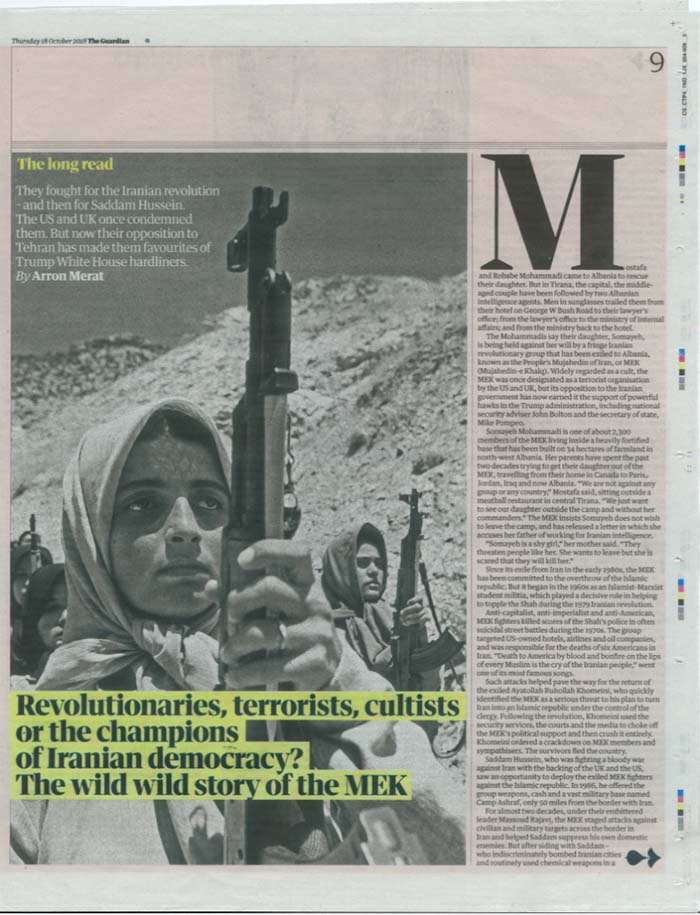
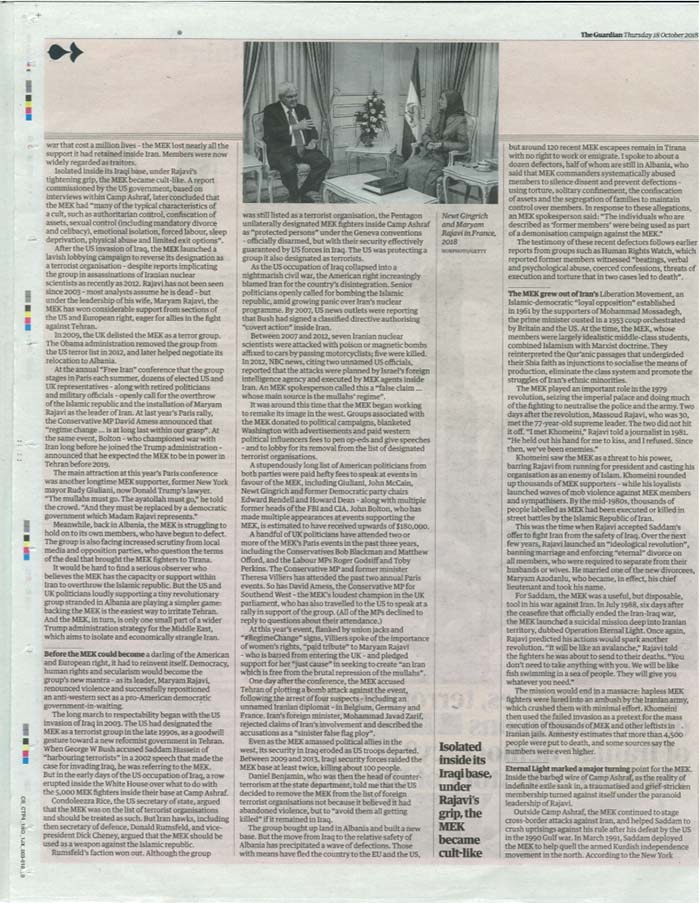
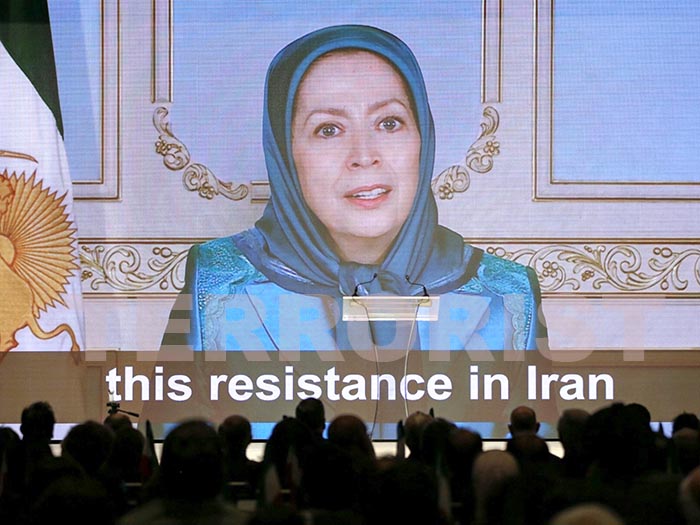
In a recent meeting with cult members, Maryam Rajavi told them that ‘the regime is now ruined, we clearly see signs and symptoms of overthrow of the regime – with this situation and the conditions that the regime has been going through for up to a year and a half, we will see that the regime cannot continue and it’s over, over, over …’
After her speech, one of the members called Mohammad Ali Agahi stood up and asked, ‘Sister Maryam, why are you lying to us about this’. Many then attacked him, but more people came to support him and some minutes later the meeting was ended. Mohammad Ali and the other people who supported him were then sent to Quarantine. For those who don’t know, ‘Quarantine’ is a place of isolation where a person is kept alone until the commanders and leading members of the organization come to talk in a process of so-called ‘Virus Removal’.
The fact is that the slogans of the cult have changed so often – according to circumstances – that it has become another ideological joke in their meetings. One day overthrow is the slogan, next day it was our fault there is no overthrow, next day overthrow is not important only obeying the ideology matters. What a joke.
BY Hassan Heyrani,
Ashraf 3
In the Tirana’s countryside, MEK has constructed a vast compound called Ashraf-3 where men and women lead segregated existences.
The gates are usually firmly closed, guarded by two sculpted lions atop stone pedestals and a large team of Albanian security guards. Unannounced visitors are not welcome at the fenced-off, secretive site, where more than 2,000 MEK members live, marks Shaun Walker.
The Cult-Like Group Fighting Iran
Members of the Trump administration have been providing support to a political sect that aims to topple the Iranian regime in Tehran. Around 2,000 of its members live in a camp in Albania. Former members say it subjected followers to torture and psychological terror.

Political sect from Albania fights against Tehran
On a country road in northwestern Albania, a rather odd collection of men and women living together in a camp are busy preparing themselves to topple the Iranian regime. Three times per week, many of them apparently practice slitting throats, breaking hands, jabbing out eyeballs with fingers and performing the so-called Glasgow Smile, which involves cutting cheeks from the corner of the mouth up toward the ear. That, at least, is the story told by a former member of the group.
The camp, roughly the size of 50 football fields and surrounded by high fences, is located just a 35-minute drive from the lively bars of downtown Tirana, but the people inside live in something of a time capsule. Former members of the group report that most of the 2,000 camp residents aren’t allowed to possess mobile phones, watches or calendars, though members of the organization that operates the camp deny those claims.
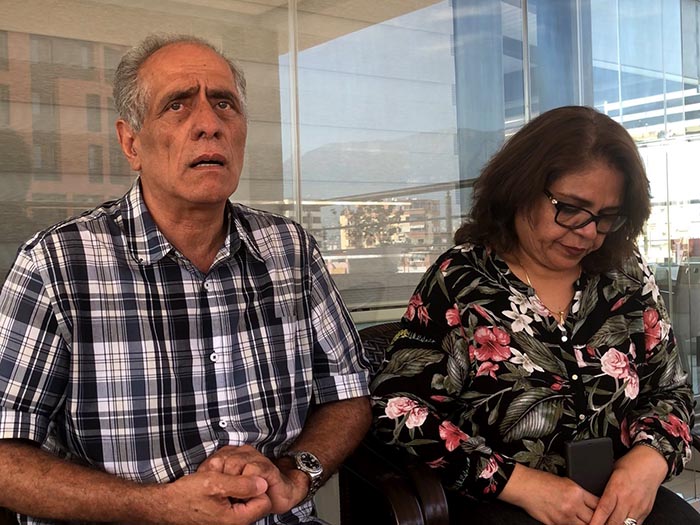
“My daughter is living somewhere in there,” says Mostafa Mohammadi, a 61-year-old Iranian man with a high forehead and deep eye sockets. Her name is Somayeh, a woman of 38. Her father, who lives in Canada, claims that she is being held in the camp against her will, which is why he spent several months in Albania last year. During a meeting there, he said:”I don’t have anything to do with politics. Please, I just want to see my daughter.”
Just like everyone in the camp, Somayeh Mohammadi is a member of the People’s Mujahedin, a once-militant Iranian opposition group that was listed by the United States. and Europe as a terrorist group until 2012. These days, however, several members of the administration of U.S. President Donald Trump are supporting the group, commonly known by the abbreviation MEK. Both the administration and the MEK, after all, want to see the end of the current regime in Iran — and now that the group has Washington’s backing, the Mujahedin apparently hopes that its time has finally come.
On the sidelines of the Middle East conference in Warsaw, which began on Wednesday, Israeli President Benjamin Netanyahu spoke of possible”war”with Iran. And at an MEK rally in Warsaw, Trump’s lawyer Rudy Giuliani called for regime change in Tehran.
For almost 30 years, several thousand members of the People’s Mujahedin lived in exile in Iraq, but in 2013, many of them moved to Albania. And since 2017, the majority of the group has lived in the isolated camp near Tirana.
Growing Influence
Ever since the group set up shop in Albania, however, more and more members have defected.
Some tell stories of torture experienced in the camp and of group sessions in which members are required to open up about their sexual fantasies. Women are allegedly forced to wear headscarves. And all of it takes place in the name of a phantom leader named Masoud Rajavi, who hasn’t been seen since 2003. Indeed, it isn’t even clear if he is still alive; photos from the 1990s show a mustachioed man in a green uniform.
The residents of the camp are just one part of the movement, which is led by Maryam Rajavi, the wife of the vanished leader. The 65-year-old commutes between Albania and her office in Paris, from which she leads the group’s political arm, the National Council of Resistance of Iran (NCRI), which is active in both Europe and the U.S. NCRI is structured as a kind of interim government, ready to take over in Tehran as soon as the current regime is toppled and the group has offices in many capital cities, including one in Washington not far from the White House. In Berlin, NCRI has an office in the Wilmersdorf district, located just southwest of the city center. The movement in Germany has just a few hundred members, but it has several thousand members around the world.
Maryam Rajavi is the acting leader of the People’s Mujahedin. Her husband has not been seen since 2003.
And they have proven to be adept lobbyists, having won over influential supporters in recent years. U.S. Transportation Secretary Elaine Chao, National Security Adviser John Bolton and Giuliani have all spoken at NCRI events and they all view the group as a viable alternative to the current regime in power in Tehran.
“The mullahs must go, the ayatollah must go, and they must be replaced by a democratic government, which Madam Rajavi represents,”Giuliani said at an annual NCRI rally in Paris in June 2018. And he suggested that such a regime change could come soon:”Next year, I want to have this convention in Tehran!”he said. Both Giuliani and Bolton have even visited the group in Albania, and last Monday, the 40th anniversary of the Iranian Revolution, the national security adviser issued a video message addressing Iranian Supreme Leader Ali Khamenei, in which he said:”I don’t think you’ll have many more anniversaries to enjoy.”
But who are Trump’s allies inside the secretive camp? Two lion statues guard the large iron gate at the camp’s entrance and guards call out”No, no!”if anyone stops out front. Three men march out of the gate and refuse to answer any questions, promising that interview requests will be responded to the next day. But nobody ever calls.
DER SPIEGEL never received a response from the People’s Mujahedin or from the NCRI to any of its interview queries prior to the visit, neither from Tirana, Paris or Berlin. A lawyer representing the group likewise declined to discuss the case of Somayeh Mohammadi. Indeed, the group only responded when DER SPIEGEL sent an email outlining the accusations that had been made against it, with an NCRI spokesman in Berlin essentially denying everything. On its websites, the organization claims to stand for democracy, human rights and the strict separation of church and state in Iran.”We want a pluralist system, freedom of parties and assembly,”it says, for example, in an article entitled”Maryam Rajavi’s Ten Point Plan for Future Iran.”
The statements suggest that once the People’s Mujahedin take over power in Iran, everything will immediately improve. But reports from those who have experienced life in the camp do not reflect that message. Instead, they appear to be prisoners of their own rebellion.

Gholamreza Shekari; Tirana; Der Spiegel
‘Lies, Manipulation and Fear’
It is, of course, undeniable that the regime in Tehran and the People’s Mujahedin are engaged in a propaganda war and lies from both sides are to be expected. But DER SPIEGEL has spoken with 15 former camp residents, some of them for several hours — and their stories are largely consistent on the most important point: The organization is essentially a sect that is difficult to escape.
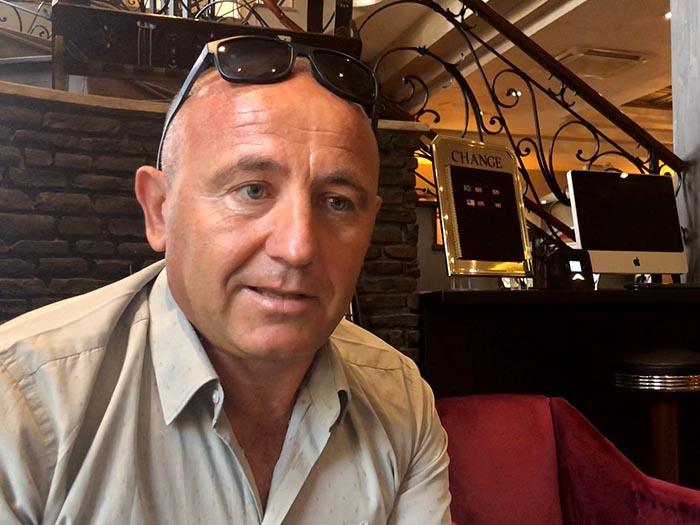
Gholamreza Shekari, a slender 50-year-old man with bony cheeks, says he spent 27 years as a member of the People’s Mujahedin, adding”the organization’s public face is liberal. Internally, though, it works by way of lies, manipulation and fear.”
Shekari fell into the group of fighters as a 20-year-old, as many others apparently did as well — through false promises. In 1988, during the confusion of the Iran-Iraq War, he fled across the Iraqi border, where he met members of the People’s Mujahedin.”They spoke of freedom and democracy for Iran,”Shekari says.”And then they promised me that they would arrange a visa for Europe for me.”He believed them.
Later, he says, they took his documents and told him that if he left the group, he would end up in an Iraqi torture prison. An organization spokesman rejects the claim as a”ridiculous and fictitious film scenario.”
“They told us lies to ensure our obedience,”says Shekari.”We were guarded and forced to break off contact with our families.”Claims that fighters were banned from maintaining contact with their families are”baseless lies,”says the organization.
Shekari says that he repeatedly asked when he would be allowed to leave. But that turned out to be a mistake: According to Human Rights Watch, the organization began torturing members who wanted to leave the group or who asked critical questions in the mid-1990s.
“They insulted me as a spy, beat my shins until they were bloody and put out burning cigarettes on my skin,”Shekari says. After a week, he says, his lower legs were completely black. He rolls up his jeans to reveal scars covering his legs.
Ultimately, he says, the leader Masoud Rajavi gathered all those who had been tortured.”He threatened that if we ever spoke about it, we would be handed over to the Iraqis, which would mean additional torture or death.”
Group Denies Torture Claims
When confronted with these accusations, the spokesman for the organization’s German chapter says that”neither in the 1990s, nor before or after, did the group keep its members prisoner or torture them.”
Despite everything, Shekari remained with the organization for another 23 years, which at best could be explained as being the result of brainwashing. Only in Albania did the others allow him to leave, in September 2016. Now, he lives in a sparsely furnished apartment in Tirana and receives financial support from the UN Refugee Agency. He doesn’t have much choice but to stay where he is because, as an Iranian, getting visas is difficult and there are many countries to which he is not allowed to travel.
After he left the group, he says he received the equivalent of 350 euros per month from the group for half a year”so that I would keep my mouth shut,”Shekari claims.”The organization claims that we are all agents so that nobody believes us,”he says.”But I’m not working for anyone.”

The People’s Mujahedin used to receive funding from the erstwhile Iraqi dictator Saddam Hussein, but these days, group supporters collect donations and can often be seen in the pedestrian zones of German cities, showing passersby photos of executions in Iran. They operate under the cover of organizations with names like the”Association for Future Hope”or”Aid Organization for Human Rights in Iran.”According to the Federal Office for the Protection of the Constitution, Germany’s domestic intelligence agency, these and other groups are linked with the People’s Mujahedin. In a message written to DER SPIEGEL about the camp’s financing, the group wrote:”All costs are covered by supporters of the resistance both inside and outside of Iran.”
Security experts believe that the U.S., Saudi Arabia and Israel also provide the group with financial support, but there is no proof for that supposition. The organization writes:”We haven’t received even a single euro from any government.”

Masoud Rajavi launched what he called an”ideological revolution”in 1985. He married the wife of a confidant and forced all others to get divorced
An ‘Ideological Revolution’
The transformation into a sect-like organization can be explained by history. After the overthrow of the shah, the militant group, still adamantly anti-American at the time, lost the ensuing power struggle and was persecuted by the religious regime under the leadership of Ayatollah Khomeini. The members fled to Iraq, from where they carried out terrorist attacks in Iran and fought against their own country in the Iran-Iraq War.
Fearing that the group might disintegrate, leader, Masoud Rajavi launched what he called an”ideological revolution”in 1985. He married the wife of a confidant and forced all others to get divorced, with children being sent abroad. Loyalties other than the one to the group’s leader were no longer to be tolerated — and that is when the personality cult surrounding Rajavi and his new wife Maryam began. Still today, many camp residents continue to wear the leader’s likeness on a chain around their necks.
The last time Masoud Rajavi was seen was in March 2003, shortly before the first American bombs began falling in Baghdad. But Maryam Rajavi continues speaking about her husband as though he were still alive. Not long after the beginning of the 2003 invasion of Iraq, the Americans captured the People’s Mujahedin’s camp and disarmed the group. Soon, though, the organization began claiming it backed the U.S., even though it had been fighting on behalf of Saddam Hussein only a short time before.
The group’s disarming could have spelled the end, but hardliners like then-U.S. Defense Secretary Donald Rumsfeld and Vice President Dick Cheney wanted to use them as leverage against Iran. Already in 2002, the group had worked with the Israeli secret service Mossad in revealing that Iran had begun covertly enriching uranium.

In 2007, units of the People’s Mujahedin began to receive training at a U.S. military facility in the desert of Nevada — even though the group was still listed by Washington as a terrorist organization at the time. And now, the Trump administration has taken the position that the People’s Mujahedin has been demanding for years: a hardline stance toward Iran. And the group believes that it has played a role: When Trump abandoned the nuclear deal with Iran in May, the group’s commanders celebrated as though they had just won a great victory.
Their list of supporters is currently longer than it has ever been, including numerous U.S. Senators and members of the U.S. military and security apparatus. The former Saudi Arabian intelligence chief, Turki Bin Faisal al Saud, is also a proponent. In the European Parliament, a group called Friends of a Free Iran advocates on behalf of the People’s Mujahedin as does a multipartisan group in the German federal parliament, the Bundestag, called the German Solidarity Committee for a Free Iran.
Trump confidant Rudy Giuliani:”The mullahs must go, the ayatollah must go, and they must be replaced by a democratic government, which Madam Rajavi represents.”
In October, Martin Patzelt, a parliamentarian with Chancellor Angela Merkel’s Christian Democratic Union (CDU), visited the camp in Albania together with former Bundestag President Rita Süssmuth, also of the CDU. Süssmuth raved about the”joie de vivre culture”among the People’s Mujahedin, adding that the Iranian secret service has repeatedly propagated”terrible things”about the group.
The People’s Mujahedin has often rejected all manner of accusations as propaganda from Tehran. And it has been an effective strategy, in part because Iran has brutally persecuted the group in the past and executed thousands of its followers.

around a thousand members work in the so-called”computer division,”allegedly using fake accounts to post pro-organization propaganda on Twitter and Facebook
War Footing
The depictions of those who have left the organization make it sound like the group is constantly on war footing. Eight residents sleep in each room and they have to get up between 4:30 and 5:00 a.m. In addition to combat training, they also take care of construction projects in the camp. The defectors also say that around a thousand members work in the so-called”computer division,”allegedly using fake accounts to post pro-organization propaganda on Twitter and Facebook. Others, say former members, use the messenger service Telegram to entice new Iranian recruits to join them in Albania.
The group’s spokesman counters that claims that the organization is running a troll factory are merely an”attempt to cover up fake accounts belonging to the Iranian regime.”
Former group members say that there are some 200 commanders in the camp and they sometimes read out a letter from their vanished leader, including sentences like:”Have no fear, victory is ours, we will be in Iran.”
The question as to why the Albanian government tolerates the Iranian group in their country is one that the Interior Ministry in Tirana is not willing to answer. But U.S. government documents make it clear why the People’s Mujahedin ended up in Albania in the first place.
After the fall of Saddam Hussein in 2003, the situation became increasingly dangerous for them. During her time in office, Secretary of State Hillary Clinton helped find a solution, together with the United Nations, and ultimately Albania agreed to accept a number of group members. In return, the U.S. donated $20 million to the UN Refugee Agency and pledged development aid to Albania.
Starting in 2013, group leaders began buying up more and more land and ultimately built the camp, including dozens of white containers and gray, two-story buildings. They house a large kitchen, a bakery, a music studio, a computer center and a dentistry practice — at least according to a propaganda video. On another one of the few videos from inside the camp, Somayeh Mohammadi can be seen, the woman whose father has been trying to free her for 21 years. In the clip, she is wearing a uniform with a headscarf and is being interviewed by two Albanian journalists. Her father, she says, is an agent of the Iranian regime and insists she wants to remain in the camp.”Here is a free country. If I want to go anywhere, I can go.”
The story that her father has to tell, one backed up with documents and video material, sounds quite different. Mohammadi himself was a long-time supporter of the organization and he collected donations for the group in Canada, where he has lived since 1994. When Somayeh was 17 years old, a woman from the organization offered her a”short trip”to the camp in Iraq.

Iranian families of some of the 3,200 members of the MEK, who said loved ones were trapped at the MEK base in Iraq at Camp Ashraf, during a conference on Nov. 25, 2011, in Baghdad, Iraq. The Iraqi government said it would close the base by the end of that year.
Photo: Scott Peterson/Getty Images
‘The Organization Gives Nothing’
Somayeh never came back. The organization sent a cassette recording of Somayeh saying that she had decided to remain in the camp. Her father says that the organization lured him to places in various countries with the promise that he could see her, but instead used him in demonstrations.”The organization gives nothing without getting something in return,”Mohammadi says.
On one video from June 2003, Mohammadi can be seen in front of the French Embassy in Ottawa, apparently drenched in gasoline as he pulls out a match — which a journalist then knocks out of his hand. At the time, group leader Maryam Rajavi was in pre-trial detention in France on suspicions of terrorism and protesters in many countries had lit themselves on fire in front of French embassies. Because he too had apparently been preparing to do the same, Mohammadi was considered a hero within the group from that moment on. He was even allowed to visit his daughter in the camp. But he ultimately distanced himself from the group and began filming everything in an attempt at collecting evidence that she was being held against her will.
On Oct. 17, 2013, Somayeh sent a letter to Canadian authorities, in which she wrote:”Please help me return to my former country, Canada, as soon as possible.”But Somayeh doesn’t have a Canadian passport and the authorities were unable to help her.
But then, she apparently changed her mind yet again — and a book was even published in her name as a PDF document, in which she claims that she wants to stay with the People’s Mujahedin.
“Who knows what they did to her,”says her father.
By Luisa Hommerich / DER SPIEGEL
From Wikipedia, the free encyclopedia
https://en.wikipedia.org/wiki/Criticism_of_Amnesty_International#Amnesty’s_controversial_visits_to_the_camp_of_the_People’s_Mujahedin_in_Albania
In December 2018, Amnesty published a report entitled, ‘Blood-soaked Secrets,’ that accused Iran of carrying out the mass executions of political prisoners in 1988.
Much of the evidence used in the report was based on the testimonies of members of the People’s Mujahedin who are now resident at a camp complex located in Albania, just outside of the capital, Tirana.
According to the report, Amnesty’s researchers,”undertook three field trips to Tirana, Albania, where a substantial number of survivors and family members are based.”
However, many reports indicate that human rights abuses take place at this camp and that members are allegedly subjected to indoctrination and torture.
An NGO, the Nejat society, which represents the families of members of the People’s Mujahedin who have been denied access to meet them, has complained that Amnesty should never have been complicit in human rights abuses that occur at the camp by approaching members that have likely offered testimonies under duress.
Iran Interlink, a charity run by two former members of the People’s Mujahedin, has also lent weight to the criticism by the Nejat Society of Amnesty for visiting the camp in order to elicit information.
On December 15, 2018, at a time when all Albania is protesting against the corrupt regime of the Resurgence government of Rama, and the Albanian people demand that the Rama government be dismissed, Rama’s Minister of the Diaspora instead of solving the Albanian students’ problems who are protesting against the government, has chosen to resolve Iran’s problems. Together with a bunch of international opportunists, Pandeli has gone to the annual meeting of Maryam Rajavi with her jihadists at the Mojahedin Camp in Manzas.
At this meeting, Pandeli has attacked the government of Iran and has expressed his support for the Iranian terrorist group that the corrupt Rama government harbors and enables with better conditions than Albanians in the jihadist camp in Manzas. Pandeli, who was cheered on by Iranian terrorists and the old terrorist old woman Rajavi, spoke in the jihadist tone, “Thank you very much”. Very excited and talking in broken English he said among other things:
“It’s a great honor as always to talk to you. Not as a minister or a former prime minister, but primarily as your friend. I know, as Mr Patrick Kennedy said earlier, it is a question why Albania has an Iranian official embassy in Tirana, and at the same time we host you. Why both? It’s a simple and honest question. And my answer is that we have had the official Tehran Embassy here for years, and they are here because of international law. But you are here for another cause. The Iranian Embassy represents the country today, while the MEK represents the Iran of the future.
“I am very proud that I and many of my friends are in the hands of Maryam Rajavi, one of the few women who will, with her leadership, change not only the future of Iran but also of the Middle East.
“I know that much news exists that says MEK is a terrorist group, they have done this and have done that. But this does not bother me at all! Because we know you, you came here under the umbrella of the UN and UNHCR. You and terrorism are two different things. You do not have diplomats who use diplomatic status to hide behind as terrorists. But some Iranian officials have done so. And acting like a terrorist while pretending to be a diplomat is a contradiction. But this is not up to me or Albanians, Iranian officials must give their full explanation. Things have changed, and times will change quickly. It is certain that the time is coming, and this piano melody that is playing here in Tirana will be sung throughout Iran as a song.
“I will not speak much, for many reasons, since today I did not know I even had to give a speech. But when you have friends like Hassan, who just said to me: ‘Pandeli, it’s your turn to talk’, believe me when I stand before you myself, a government official, but now that I have met you I know you very well and I’m sure that you and your families now understand that you are not just refugees like a few years ago, but you are now in your land. You have done in less than a year, performed a miracle by building a city. We Albanians say in Albanian: my home is my homeland. Albania is your homeland.“Thank you”
Pandeli’s speech was one of several at this meeting held by Maryam Rajavi – who along with the others cried over the problems of the Iranian people, people whom she, her husband and her jihadists have killed over the years. Maryam Rajavi’s lips did not mention anything about Albania, which is blocked by protesters demanding regime change. The whole problem for the old terrorists, but also Minister Pandeli Majko who eats Albanian bread, has been Iran.
Pandeli’s speech above, which broke international law and domestic law by saying ‘I do not care that you are terrorists, etc.’, tells of Rama’s arrogance, bribery and thievery. At a time when Tirana and all of Albania are consumed by protest, Pandeli and Maryam Rajavi have chosen to pretend to be a whore when a village burns.
Translated by Iran Interlink
1- Mansour Nazari, Iran Interlink, France, December 02 2018:
http://iran-interlink.org
Mr SOKOL BALLA
President of Vision Plus TV in Albania
Mansour Nazari
I am Nazari Mansour, a former member of the MEK organization who separated many years ago from the Mojahedin-e Khalq.
You recently provided a report on the Mojahedin camp in Albania, but this report is not real. Why?
The MEK are trying to whitewash their past. Surely they have not told you anything about their past. Why?
This organization has a black history and for this reason the MEK organization is trying to erase it. Why? Because they have a terrible past of violence and terrorism.
Its terrorist operations targeted American-owned businesses, and it killed six American citizens, in addition to its far more numerous Iranian victims.
After the victory of the Iranian revolution and the beginning of the war between Iran and Iraq the MEK joined Saddam Hussein in Iraq. The Iraqi dictator also gave the group weapons, cash, and a compound called Camp Ashraf in return for its continuing attacks inside Iran as well as helping Saddam suppress his own domestic opponents.
Within this organization are many things that you have not been told, for example: compulsory divorce, meetings to confess dreams in which everyone must describe their dreams, family contact is forbidden, having a phone was forbidden. If anyone wanted to leave the organization, they would have to spend two years imprisoned in Ashraf, then eight years in Abu Ghraib prison, then be handed over to the Iranian government. WHY? Just because they want to leave the MEK organization.
I suggest that the next time you want to report about the MEK, it would be better to ask them about their past, about forced divorces, working with Saddam Hussein, and imprisonment and torture inside Camp Ashraf. And in addition, invite investigative delegations to establish the truth.
Yours Sincerely
Mansour Nazari
–
2- Mir Bagher Sedaghi, Vatanam association, Switzerland, December 02 2018
Dear Mr Sokol Balla, presenter of the Real Story in Vision Plus in Albania.
Mir Bagher Sedaghi
Your program was brought to my notice in which you visited the Mojahedin Khalq (MKO, MEK, NCRI, PMOI and many other pseudonyms) terrorist organisation and held an interview with Mr Hassan Naybagha.
I noted that Hassan Naybagha falsely claimed that all foreign media are now trying to mislead the international community and claimed not only that the group is not a military group but the group and its members in the camp are from among the intellectuals of Iranian society, who have only resisted the regime in Iran by intellectual means (not military).
As an ex-member of the Mojahedin Khalq Organisation (MEK, MKO, or more properly known as the Rajavi cult),I can testify to you that the MEK is nothing more or less than a terrorist group. When I was with the group, I was regularly encouraged to carry out violent acts of terrorism. I have also been witness to the despatch of MEK terror teams from Iraq to Iran to carry out bombing campaigns, using mortars to attack buildings in residential areas. I am available to testify in any court of justice should there be the opportunity.
Please don’t be fooled by the charm offensive of this terrorist cult. Due to the defeat of Saddam Hussein who was the benefactor and the main strategic ally of Mojahedin Khalq, the group is now incapable of taking up arms. But make no mistake, they still have the dangerous potential to start terrorist operations should the time and the place by favourable to them.
Mir Bagher Sedaghi
–
3- Ghafoor Fatahin, Peyvan Rahaee, Paris, December 02 2018
To officials of the Albanian Vizion Plus television network,
Respectful greetings,
Ghafoor Fatahian
I am Gafoor Fatahian, a former member of the Iranian People’s Mojahedin Khalq organization (MEK). I spent twenty years in the headquarters of this organization in Iraq and I am an eyewitness to this organization when they were sending terrorist teams into Iran to kill innocent civilians.
Moreover, MEK has eliminated many of its own members who opposed its leadership’s policies. They also imprisoned and tortured others. Many of my ex-comrades were killed inside the organization’s headquarters in Iraq by order of the leaders of the organization and by its executioners who are now in the headquarters of the organization in your country, Albania.
I am an eyewitness to the repressive practices against members within the organization. They isolated them from the outside world, especially from their families in Iran and other countries.
In fact, the real MEK is not the one spoken of by Maryam Rajavi in Europe in the present, using the buzzwords of the free world to say her organization is committed to democracy, freedom and human rights in an attempt to win support from America and European countries.
What is going on behind the scenes and behind the barbed wire surrounding the headquarters of this organization is very serious and terrible and is intended to keep the members of the organization as prisoners held inside its headquarters in Albania.
This organization is no longer a political organization fighting for the establishment of democracy and freedom in Iran, but it has been transformed into a special community by its leaders, headed by Maryam Rajavi with beliefs, ideas and duties contrary to the principles and norms of humanity and universality in the present age. For this reason and for many other reasons, including the cooperation of the organization and its alliance with the regime of Saddam Hussein and its army and its financial, military and political dependence on foreigners, the MEK has lost its popular base among Iranians inside and outside Iran, even active opponents against the regime in Iran.
Hatred toward this organization and the atmosphere of alienation and opposition prevailing within the ranks of the organization among its members, has also led to the separation of more than two thousand members of the Organization over the past thirty years. In particular after the expulsion of the organization from Iraq and transfer to Albania whereby hundreds of members have now separated from the organization and are living in the Albanian capital, Tirana. And, if you want to prove your journalistic neutrality, you can interview these members who are separated from the organization in your country. They can tell you many facts about this organization so that you will discover that everything in your report about the organization’s headquarters in Albania is nothing but fabricated lies, artificial acts and false statements uttered by the leaders of the organization who wanted to display a fiction in front of your cameras.
This dangerous terrorist community has never renounced its violent ideas and terrorist tendencies because its ideas were built on the basis of terrorism, armed struggle and violence, not freedom and democracy, which it praises in its hollow slogans.
Gafoor Fatahian is a former member of the People’s Mojahedin Organization of Iran.
Paris – 30 November 2018
–
4- Easa Azadeh, Yaran Iran, France, December 02 2018
(Automatic Google translation)
Mr. SOKOL BALLA
President and director, vision Plus TV and host of the real story in Albania
Easa Azadeh
I am Easa Azadeh – from officials and former commander of the MEK. I’m more than thirty years in different parts of it have activity and Camp Liberty in Iraq, with the help of a UNHCR higher refugees, and the Office of the UN special of the cult, isolated and now in French I live in.french.
MEK with a history of terrorist is very dangerous, in the sight of the people of Iran, sorely hated. From the other side of the MEK by becoming a cult fanatics member himself about the most violent vexation, Singapore, gives, implying that members of the Liberator, had cut the minimum rights of members to ignore and not recognize. Even allowed to meet with the families and their loved ones to make excuses, wishful thinking has forbidden.
This cult saccate, mind control, continuous members, them, thought herself has Tank would have made that the leadership of this cult to put in place of God, and the aura of worship.
This cult basic transition operation a tehari in the world has gotten 38 years before the venture into operation a tehari in Iran and Europe.
The cult communities of the Iranians inside the country and out of country no place, and from the perspective of the people of Iran, this cult acutely unpopular and treacherous can be considered. Officials of the MKO with the costs of operation and through the media tried to downplay and white storage past full of killing and bloody. The case touts that in any way with the water hundred the sea of time, the White will not. This cult lacks the minimum principles of political is absolutely no Honesty in it, there is no continuous Heart and shanties and lie is trying to show with your silly Red Keep. And black white effects. And by bringing a number of Speaker rental and collecting the hundreds of refugees displaced with the money try to show the social base. The total human capital of this sect of about two thousand members Grime that with an average age of 55 and with cohesion of disease in the garrison the so-called Ashraf3, in the outskirts of Tirana, institutions of society.
I, as one of the commanders and authorities of the denomination to alert you to the tenth, that the lure of these cults do not eat, because these sects in Iraq together with the costs of operation and giving bribes, huge, from, media, started, and then, with the financial support into a terrorist like Al-Qaeda and ISIS to insecurity, the country of Iraq, security Iraq and killing innocent people.
This cult when the explosion of the Twin Towers in America by al-Qaeda in camps in Iraq celebrated introduced, and IT operations support for the terrorists will in time occupy a major part of the territory of Iraq by ISIS, again celebrated, and where can be found the ISIS in Iraq, about the types of support, direct and indirect.
This cult in Albany, too, the machinations of the evil his has to start ولابد you as a journalist Albanian better than we know that this cult how in the political affairs of the country, you can interfere.
This cult before any action should the situation ladder will determine the assignment that Dead or Alive. So politically, the cult of the hand her empty that death ladders the Turkish Al-Faisal, the former chairman of the information Arabia, has announced. Vine cult with tumult, the leader of his dead again, alive and has so far eleven messages appointed to he has published. Is this the same demagoguery and Heart not political?
I ask of you to think that, according to the principle of neutrality of the media, let the servant to accompany a few of my friends also facts related to this cult laid to inform people of Albania note reporters that your responsibility is one-sided and is basically a figment of the device demagogic this cult.
Please and please at least inform yourself, or a number isolated from the community representatives also interview to do. Without a doubt, a journalist, a professional from all angles to check the facts case analysis.
It is necessary to know to inform them that this sect the worst of the stifling and dictatorial toward members herself applies and now also in Albania with isolate out them in a camp context, breakeven is not out of the members unhappy.
The cult due to non-compliance with minimum human rights and transformed the MEK to a cult of terror and fanatic and use the tool parents of members, and such a divorce is mandatory and in celibacy going to be used, women and men, flawed, human rights, and have the crimes of the Ann disclosure, and under the jurisdiction used. Mr. sokol dear an organization sect and mercenary alien no time and can be seen as the opposition to mold. You, as a media can from the communities of Iranians outside through a Facebook survey. Surely more with the facts, and hated being MEK will wake.
With respect, Easa Azadeh
Paris, November 30, 2018
A recent report from The Guardian has uncovered systematic human rights abuse in the Albanian camp of the Mojahedin-e-Khalq (MEK), a former Iranian terrorist organization exiled from Iraq to Albania. As Exit has reported over the last years, multiple high-ranking US politicians have visited the MEK in Albania, as US administration’s interest in overturning the Iranian regime have grown.
The article in The Guardian reveals that members of the MEK have started to defect, many of whom end up in Tirana on their way to emigrate to EU countries or the US. These defectors have reported continuous human rights abuses within the Albanian MEK camp:
[T]he move from Iraq to the relative safety of Albania has precipitated a wave of defections. Those with means have fled the country to the EU and the US, but around 120 recent MEK escapees remain in Tirana with no right to work or emigrate. I spoke to about a dozen defectors, half of whom are still in Albania, who said that MEK commanders systematically abused members to silence dissent and prevent defections – using torture, solitary confinement, the confiscation of assets and the segregation of families to maintain control over members. […]
The testimony of these recent defectors follows earlier reports from groups such as Human Rights Watch, which reported former members witnessed “beatings, verbal and psychological abuse, coerced confessions, threats of execution and torture that in two cases led to death.”
The MEK camp appearsto fall “beyond the jurisdiction of the Albanian police”:
Ylli Zyla, who served as head of Albanian military intelligence from 2008 to 2012, accused the MEK of violating Albanian law. “Members of this organisation live in Albania as hostages,” he told me. Its camp, he said, was beyond the jurisdiction of Albanian police and “extraordinary psychological violence and threats of murder” took place inside.
The Albanian government, meanwhile, turns a blind eye to the human rights abuses on its territory, hoping that hosting the MEK will give them leverage over the US government:
Olsi Jazexhi, a professor of history at the University of Durres critical of the government’s decision to accept the MEK fighters, says that Albanian politicians hoped the deal would lead the US to turn a blind eye to their own corruption. “The MEK is a card which gives them leverage with the United States,” he said. “They think that by taking the MEK, the Americans will leave their business alone.”
Full protection of human rights is one of the five key conditions for opening EU accession negotiations. It seems that, once again, the Albanian government fails to honor its obligations in that regard.
Exit, Explaining Albania,


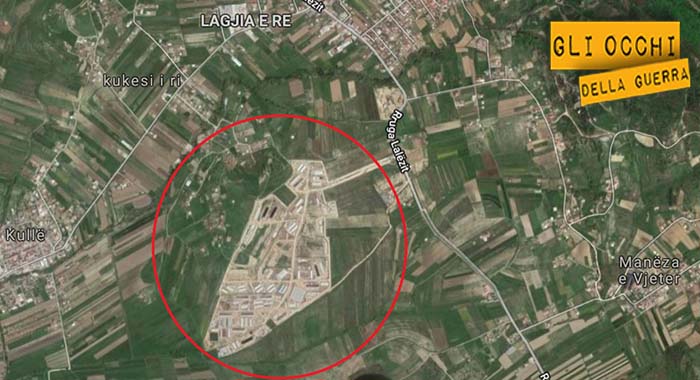
Last February, the occhidella guerra reported the transfer of 3,500 mujahideen to Albania. The Mek was previously kept at a base near Baghdad (Liberty Camp). Among other things, it referred to their new headquarters being constructed in Manez, near Durre. Today there are further evidence that confirm this project and much more. But let’s go in order.

What is the Mek
The Mek or Mojahedin Khalq Organisation of Iran is an organization which was born in 1963 in Iran with the aim of opposing the Western influence in the country and fighting the regime of the Shah. In 1979 the Mek participated in the revolution led by [Ayatollah]Khomeini but the ideology, a crossroads of Marxism, feminism and Islamism, clashed with that of the Ayatollahs.
In 1981 the Mek moved to Paris where Massoud Rajavi (The leader) founded his headquarters and five years later moved to Camp Ashraf, north of Baghdad, from where he supported and joined the war of Saddam Hussein against Iran. MEK also engaged in the repression of the Kurds on behalf of Saddam. In 2003 the Mek was disarmed by the Americans and moved to Camp Liberty. The Mek continued to play a role in the political and diplomatic activities against Tehran and continues to do so today.
Previously, the organization was blacklisted not only by Iran and Iraq, but also by the European Union, Britain, the US and Canada, only to be “cleared” between 2008 and 2012. A New York Times article by September 21, 2012 illustrated how the then Secretary of State, Hillary Clinton, had decided to clear the Mek , making it remove from the “black list” to be able to then put it away from the reach of Tehran, in a country willing to welcome them, in this Albania. The goal is more than evident: use the Mek to support a regime change in Tehran. But why in Albania? What is a “pledge” to pay for entry into Europe and NATO?
Today it is Maryam Rajavi who leads the Mek after the mysterious disappearance of her husband Massoud that coincides with the American invasion of Iraq in 2003. Some sources speak of a possible death while others say that the former leader is in hiding to escape the agents of Tehran.
Political support at the international level
The Mek has received support from various international political figures including former New York mayor Rudolph Giuliani, US ambassador to the United Nations John Bolton and Emma Bonino as vice-president of the Senate in June 2012. The New York Times noted that several members of Congress had become staunch supporters of the movement that, if once Marxist-Islamist, then changed its mind by transforming its own struggle and becoming the main organized movement against the Iranian government.
According to the New York newspaper, among the supporters of the Mek there would be R. James Woolsey and Porter J. Goss, former directors of the CIA; Louis J. Freeh, former director of the FBI; Tom Ridge, former Secretary of Homeland Security under President George W. Bush; Attorney General Michael B. Mukasey and national security advisor, General James L. Jones, operating under the Obama administration.
In the last year there have been several positions in favor of Mek by members of the national and international political scene. In mid-September an official delegation of the Italian Radical Party and the “Hands off Cain” association visited the mujahidin headquarters in Albania. The delegation included Elisabetta Zamparutti, Sergio D’Elia, Rita Bernardini, Mattia Moro, Maria Antonietta and Luca Coscioni; Albanian sources claim that the members of the Mek would provide an account of the violations of human rights implemented by the regime in Tehran.
Last June 30, it was the former Minister of Foreign Affairs of the Monti government, Giulio Terzi, who spoke at a meeting of the Mek where, in front of thousands of anti-Tehran protesters, he announced his “unconditional support to the Mek”, defining his militants “freedom fighters” and saying that “a large part of Italian society is convinced that being on your side means being on the right side of history”. The whole speech was published on the Mek website and can be viewed here.
Even the former mayor of New York, Rudolph Giuliani, in 2018 expressed himself at least on a couple of occasions in favour of the Mek with statements like: “The Iranian people have had enough of this regime that will be overthrown … We have no doubt that the Mek coalition can cope with this regime “.
And again: “The mullahs have to leave, the ayatollahs have to leave and must be replaced by a democratic government that Mrs. Rajavi represents”, as reported by the Guardian.
In short, yet another attempt to overthrow the government to export “democracy”, a film already seen and revised.
Last September 26, the Albanian journalist Kastriot Myftaraj, during the television program “Ju flet Moska“, had criticized the recent invocations to the uprising in Iran by the leader of the Mek, Maryam Rajavi, bringing up the article 221 of the Albanian penal code that punishes incitement to insurrection with penalties ranging from 15 years upwards.
Article 265 b / c of the Albanian penal code which prohibits involvement in military operations and violent actions in foreign countries should also be taken into consideration.
The Manez headquarters
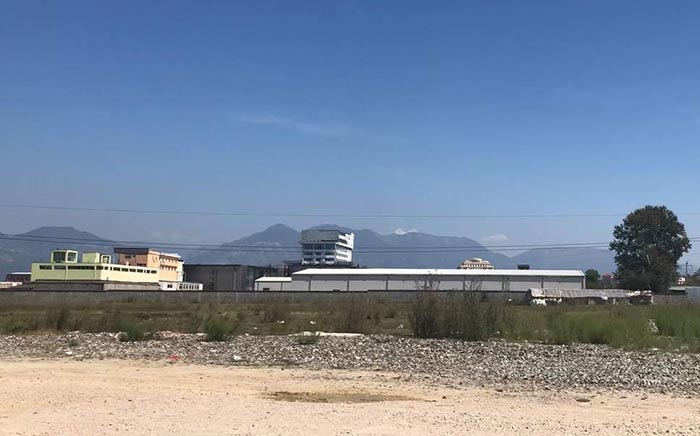
Numerous international sources have documented the presence of a large complex near the Albanian village of Manez, which serves as the main base for the Mek, a complex that has already been inhabited even though it is still being completed. Several local reporters have witnessed the presence of private armed guards outside the complex, a barrier and further unarmed guards inside.
The well-known Albanian investigative journalist Gjergj Thanasi was among the first to notice the presence of Manez and had shown the dynamics of the Eyes of War last February:
“The Council of the Territorial Organization (Keshilli i Rregullimit te Territorit) is responsible for issuing permits for the construction of public works and private buildings (factories, hotels, schools, roads, etc.). This Council had published a list of permits issued for a series of works and among them there was one against an NGO called F.A.R.A. The permit was dated 16 October 2017 and indicated the authorization for “a residential complex and services for the Iranian community in Albania”. At that point I investigated this F.A.R.A that, strangely and contrary to the Albanian law, was not registered with the Tax Office and did not even have a VAT number, which is prohibited in Albania.
I then continued the investigation at the town planning office of the town of Durres (which I know very well having lived here for 52 years); there they showed me a written request from the F.A.R.A. in which permission was requested for the creation of a building site (fence, water connections, electricity, containers, etc.) and it emerged that the Municipality had not issued any permit. The letter of request did not have a header, there was no address or telephone number. At this point I went to Manez (in the first week of November 2017) to see what was happening and I found myself in front of a finished fence, an already installed electricity grid, and some channels under construction, for the water network. There was also a container with offices inside the fence. Around the yard there were guards and also three policemen with the uniform of the State Police “.
The site would have been located precisely between the villages of Kulles and Manez e-Vieter, with entrance on the Rruga Lalezit road and the complex there are several aerial images and films.
On August 10th, British journalist Lindsey Hilsum of Channel 4 went outside the Manez complex to document its existence and was physically attacked by some members of the Mek.
According to reports from the Albanian media, some witnesses said that security guards tried to tear and break the crew camera while some members of the Mek hit Hilsum and took their chaperone by the neck. At that point, Albanian police officers arrived on the spot and stopped the attack and accompanied the two assaulted men to the barracks.
Later, a spokesman for the Mek told the Albanian media that British journalists are in contact with the Iranian secret services and that they had not been advised of their arrival.
The case of Somaya Mohammadi and interviews with dissidents
Another case that is doing a lot of discussion in Albania is that of Mostafa Mohammadi, father of 38-year-old Somaya, who left home when he was 16 together with a militant woman from the Mek.
Mostafa explained that he had immigrated to Canada with his family in 1994 and entered the orbit of the Mek, helping them raise funds but in the meantime the organization would brainwash his sister, convincing her years later to move to Iraq, Camp Ashraf, to fight the Iranian regime. She die on the spot during military attacks or could have been executed if arrested. Years later a Mek militant would have approached his daughter Somaya, telling her that they have met her aunt (with whom the girl had a close relationship) and that she would like to show her where she had been and what she had done. So the they went off on a journey that only lasted two weeks but Somaya never returned home, cutting all contacts with her family.
Last July Mostafa Mohammadi went to Tirana to try to raise the case and get in touch with his daughter, which he said was held against her will in the Manez headquarters and accused some members of the Mek of attacking him , as reported by Shqiptarija and Gazeta Impakt who also published a video.
The Canadian, Iraqi and Albanian judiciary have however expressed themselves against Mohammadi’s accusations, declaring that the girl is voluntarily a member of the organization and being an adult, she is able to make her own decisions in autonomy and freedom.
On 25 July 2018 Somaya released an interview where he rejected the accusations made by his father, claiming to be a voluntary member of the Mek and accusing his father of collaborating with the Iranian secret services. A controversial case whose dynamics are still unclear.
The Albanian investigative program Fiks Fare managed to get in touch with three of the 200 dissidents who have fled from the MEK in Albania and interviewed them, as also reported by the Prishtina Post.
All three confirmed that the mujahideen housed in the camp are all well-trained fighters and that it is strictly forbidden to maintain contact with their families.
The first interviewed, Sadolah Seifi, explained that he was born in 1969 and that he joined Mek voluntarily at 21 for economic reasons. Seifi explained that initially the Mek speaks of freedom, but in fact it is “a frightening organization” with many agents who force their followers to do what the leader says, and it is strictly forbidden to have a family. According to Seifi the main problem of those who would like to leave the Mek is that in Albania they do not have a status, they cannot work and they do not have money to live.
The second interviewee, Ehsan Bidi, confirmed the military preparation of the mujahidin, adding that he learned a lot about weapons and their use; Bidi also claimed that the Mek at the time sent men in to Iran to place bombs and conduct terrorist acts.
The third interviewee, Manuchehr Abdi, 55 years of which 13 years with the Mek, pointed out that in Albania the organization is trying to reconstruct the same context that was present in the Iraqi base.
On military training Abdi said: “When I was part of the organization I was a member of a group that virtually connected with young people in Iran and taught them to fight, because we need to know that everyone in this organization knows how to fight to kill, we are militarily prepared we know everything about weapons “.
Regarding the family context, the interviewee made it clear that visits to his family were forbidden in Camp Ashraf and that he himself could not have contact with his daughter. A situation that is also present in Albania following agreements with the Tirana government.
In conclusion
What is the Mek then? A group of dissidents and persecuted by the Iranian regime? A sectarian force of opposition composed of militarily trained elements ready to overthrow the regime? A terrorist organization? (According to what was stated by Tehran). Where do the Mek funding come from?
In geopolitics it is known that an organization can be considered “terrorist” or “resistance movement” based on the interests of those who support it and have seen it with many other organizations, from the Muslim Brotherhood to Hizbullah, from the PLO to the “resistance” “Syrian. What is certain is that it is difficult to combat terrorism when we cannot even find a universally shared definition of the term.
Meanwhile, however, the presence in Albania of the Mek does nothing but further aggravate the delicate situation in the Balkans where jihadist and Islamist groups are already present. The Balkan area seems more and more a logistics and transit area in support of the war policies in the Middle East and all this at the expense of regional stability, Italy included.
Giovanni Glacalone, Cliocchidella Guerra, Rome, Italy,Google Translation with Iran Interlink editing
Historian Olsi Jazexhi, invited to Arena by Dritan Hila of Ora News, said that Albania has become the main base of Israel’s Mossad and the Iranian Mojahedin Khalq (MKO, MEK, NCRI, Rajavi cult, Saddam’s Private army ….).
Jazexhi: Albania has become one of the main bases of Israel’s Mossad and the Iranian Mojahedin (Maryam Rajavi cult), a former terrorist group. Al Jazeera made a documentary a month ago which showed how 1700 computers have been brought from abroad to Manzas where the Mojahedin Khalq terror group stick online and attack any government trying to trade with Iran. The Mojahedin Khalq are used by Donald Trump to sabotage the European policy towards the nuclear deal with Iran. Whoever reads the news, the Mujahideen (Maryam Rajavi cult) produce an article every week or every month saying that ‘Iran has come to Albania to attack us.
Ora News.tv, Tirana ,Translated by Iran Interlink
The ‘political cult’ opposing the Iranian regime which has created a state within a state in Albania
In Tirana, Borzou Daragahi meets defectors of the People’s Mujahedin Organisation of Iran, a controversial group which has found itself the darling of Washington
An Iranian exile group that is a darling of Washington conservatives has set up what critics describe as “a state within a state” inside the tiny Balkan nation of Albania.
From a well-guarded 84-acre (340,000 square metres, or 34 hectares) property it has forged on a hillside in the Albanian countryside, the group – called the People’s Mujahedin Organisation of Iran, commonly known by the acronym MEK, has begun handing out mysterious wads of cash, set up its own radio communications network, and launched deceptive information operations to influence debate about the Islamic Republic – its avowed enemy – say defectors of the group, relatives of members, and Albanian journalists, lawyers and a former intelligence official.
In addition, it has been accused of locking up members inside the camp against their will, an allegation that has long dogged the organisation, which is led by Iranian exile couple Maryam and Massoud Rajavi, and described by former members and Iran experts as a political cult.
“We are supposed to be living in a free and democratic country. But they have built a state within a state that implements its own laws,” says Olsi Yazici, an Albanian writer who is part of the legal team attempting to find out more about the group.
“They are behaving in Albania like a mafia – breaking laws, blackmailing, paying people off, beating people, threatening defectors, accusing anyone who questions them of being an Iranian agent and controlling their members in the camp through Stalinist totalitarian methods. And at the end, they claim to be democrats who will save Iran.”
The Independent reached out to several MEK spokespersons and representatives, seeking comment for the story.
Inside the MEK’s state within a state
As this report was being prepared, the organisation released a five and a half minute video clip that showed drone footage of what it called its “residential compound”, which appears made up of dozens of buildings, and a main entrance flanked by a pair of golden lions, a symbol of the MEK.
The video showed Albanians on construction jobs in the camp, as well as members sipping tea with Albanian neighbours, or making music in a studio, including a cover of Frank Sinatra’s “My Way”.
We are supposed to be living in a free and democratic country. But they have built a state within a state that implements its own laws
Olsi Yazici, Albanian writer
“Terrorist, terrorist,” the men screamed at the elderly couple, their arms locked, as they sought to walk away. Canadian-Iranians Mostafa and Mahboubeh Mohammadi say they have struggled to get their daughter, Somayeh, out of the MEK for 21 years.
They haven’t spoken to her since 2004, when they travelled to central Iraq to make a desperate attempt to get her and her younger brother out of the camp the group then occupied. Once they had been sympathisers and had even raised money for the group.
“We would spread out on the streets and show pictures of Iranians the regime had killed, and say their kids are stuck in refugee camps,” recalls Mostafa Mohammadi.
But eventually the Mohammadis turned against the group, which they claimed tricked their daughter into travelling to Iraq, seized her passport, and pressed her into the organisation. Through tremendous effort involving US and Canadian diplomats, they say they managed to extract their son, who is now living in Canada, but not their daughter.
The MEK says Somayeh is in the organisation of her own free will, and has issued videos of her disowning her parents.
At least one other former member of the group in Tirana says he was able to leave the organisation once he told them he wished to part ways.
“I choose to pursue my own life,” he says, asking that his name not be published. “There was no pressure to stay.”
A lengthy statement by the group on the website of its front group, the National Council of Resistance of Iran, said that that Mostafa Mohammadi had been in Tehran in 2008 – an allegation he denies – and called Mohammadi’s lawyer an “agent” of the Iranian intelligence services.
The five and a half minute video shows footage of Somayeh Mohammadi with a caption reading that she insists the “Iranian regime deployed her father to accuse MEK (of having) kidnapped her”.
When the Mohammadis first came to Albania to find Somayeh, they were given the runaround by authorities in Tirana, who insisted she was not in the country.
But they managed to get confirmation from a sympathetic local refugee resettlement group that she had arrived in Tirana in 2015. Just days before the confrontation with the MEK members, the Mohammadis managed to prompt a police officer to enter the camp and confirm that she was there, possibly the first time an Albanian official wielding a warrant entered the compound.
“This was a big shock for the MEK,” says Yazici, the writer. “This diminished the role of the commanders in the eyes of the members.”
The Mohammadis had heard that she made her way one day a week to a Tirana hospital, serving as a translator for MEK members seeking medical care. They waited nearby to catch a glimpse of her on 27 July. After a few hours they became discouraged, and began heading back to their hotel.
That’s when a group of four men – who later transpired to be MEK enforcers – surrounded the elderly couple and began screaming “terrorist” at them.
Police soon arrived to break up the melee. Startling the officers, the MEK enforcers continued to strike Mohammadi in front of them, screaming that the frail couple were “terrorists”.
The police rounded up the Mohammadis as well as the MEK enforcers and took everyone to a Tirana police station. MEK leaders summoned their lawyer, Margarita Kola, as well as some leaders of the group. Kola, who once worked as a counsel for the US Embassy in Tirana, claimed she was acting on behalf of the Americans.
“She said, ‘You know who I am or not?’” recalls Migena Banna, the lawyer representing the Mohammadis, who was also at the police station. “She said, ‘I am not just a lawyer, I’m a legal representative of the US embassy.’ Then the police changed their behaviour.”
Kola told The Independent that she did not work for the US embassy but declined to answer whether she had originally made the claim.
Under pressure, police let the MEK members go, but held on to the Mohammadis for eight hours. The Tirana prosecutors’ office told The Independent the case remains under investigation.
Mostafa Mohammadi went to a hospital for treatment for his bruises. By then, the video of the pack of MEK enforcers assaulting the couple had gone viral on Albanian social media. Local television stations arrived to meet the couple, and stories about the search for their daughter began to air. Albanians were outraged.
“We have so many other refugees, Syrians, Iraqis. They can do everything. They go shopping. They are out on the streets,” says Yazici. “Where are these MEK people? Why can’t we see them?”
Much of the world was worried when Donald Trump was elected US president in November 2016. The leaders of the MEK celebrated.
“It was like a wedding,” recalls Hassan Heyrani, a former member of the group’s political committee who defected this year. “It was the whole election of Trump that prompted the group to move forward with the new camp. They were so happy. They said, ‘The geopolitical engine of the region is turning.’”
The story of the 50-year-old group is bound up in the wars, uprisings, and political twists of the Middle East. It was founded by leftist students decades ago to fight against the regime of Iran’s Shah Mohammad Reza Pahlavi, carrying out assassinations of US officials in Iran who were backing him.
It later turned against the clerics who took over in Tehran during the 1979 revolution, staging bomb attacks during the 1980s, when it was granted a camp northeast of Baghdad and joined along Saddam Hussein in the Iran-Iraq war.
That move destroyed its popularity among the vast majority of Iranians. But with dozens of tanks and thousands of fighters positioned at a sprawling and inhospitable desert compound called Camp Ashraf, in a province adjacent to the Iranian border, it remained a threat to the Islamic Republic.
Its fortunes changed after the 2003 US-led invasion of Iraq and toppling of Saddam Hussein. US forces at first bombed the group as an appendage of the Baghdad regime, pulverising many of its tanks. But Washington conservatives later began to cultivate MEK as a potential way of pressuring Tehran.
The group eventually ran afoul of Iranian-backed politicians of the new Iraqi political elite. Members were pressured to leave Camp Ashraf, which was taken over by the Iranian-backed Badr Brigade militia, and relocate to Camp Liberty, on the same compound as US forces and the Baghdad International Airport.
Under pressure by Baghdad authorities to remove the group, the US managed to convince the government of Albania to take in a couple hundred members of the group as refugees in 2013, in what was described as a humanitarian gesture.
But as they came under attack by Iranian-backed Shia militias, as well as pressure by Isis militants, the plan to move a few hundred to Albania somehow turned into bringing the entire organisation from Iraq to southeastern Europe.
Once they had fully moved to Albania, the group first took up residence in a series of empty apartment buildings scattered around the city, and continued its fade into obscurity and irrelevance.
Leaders tried in vain to keep long-isolated members – curious about the modern world, and barred from sex and dating –from drifting away. They tried to erect barriers around one apartment building, but they were promptly torn down by angry local authorities.
With Mr Trump’s election, everything changed. The MEK had spent years cultivating Washington figures such as John Bolton and Rudy Giuliani, who were forces in the new administration in Washington.
In addition, an ambitious and stridently anti-Iran Crown Prince Mohammad bin Salman took the reins in Saudi Arabia, and began looking for allies in his aim to roll back and possibly topple the clerical government in Tehran.
Beginning in July 2017, just as Trump began re-imposing sanctions on Iran that Obama had lifted as part of the nuclear deal, the MEK suddenly began buying plots of land in Albania, in a rural stretch of farmland near the town of Manza, between the Albanian capital and the Adriatic Sea.
The Trump administration continues to maintain strong ties with the MEK. At the weekend, the president’s lawyer addressed a gathering of the group at a midtown Manhattan hotel, describing the MEK as an antidote to the brutality and repression of the “outlaws and murderers” in power in Tehran. “Iran is entitled to freedom and democracy,” he said.
Albanian investigative journalist Gjergi Thanasi said the group paid $13m (£9.9m) to buy the first 200,000 square metres of the compound, has since bought another 140,000 square metres, and continues buying up property and racking up significant water, electricity, and internet bills.
They pay for everything with huge wads of cash, sometimes piles of local currency that they purchase through street vendors rather than banks or exchange shops, but also with “crisp hundred-dollar bills”, says Thanasi, leaving no bank trail.
“They pay bills on time,” he says. “They pay in cash. They buy small things in shops or even in malls. They always pay in cash. They do not use bank cards. They love not leaving a footprint.”
Thanasi found the group purchased 1,700 Lenovo brand computers and monitors from an Albanian firm. At first he thought it was some scam to evade import duties and resell the computers at a profit. But the MEK paid full price for the devices. They wanted the computers for the camp, and paid for them in cash. “What the hell do you need so many computers for?” he quips.
The group has a number of big-ticket expenses. It has set up a dedicated high-speed internet. It also managed to obtain official permission to set up its own antenna atop Mount Dajti, on the peaks overlooking Tirana, giving it effectively its own communications network.
A private Albanian security firm, called Argon, guard the camp and its entrances, deploying perhaps nine personnel armed with assault rifles and handguns in six-hour shifts around the clock.
It remains unclear why Albania, a small Balkan country struggling to overcome its reputation for corruption and money laundering in order to become a member of the EU, would allow such a shadowy group to operate with so little scrutiny.
“If I want to buy a car for 2,000 or 3,000 euros I have to use a bank in order to pay for the car,” says Thanasi. “I have to circulate the money through the bank and justify that this quantity comes out of my personal savings.”
The organisation appears to have strong connections to senior Albanian officials. Pandeli Majko, a minister in the current Albanian government of Prime Minister Edi Rama, Fatmir Mediu, a former defence minister, and Elona Gjebrea, a former deputy interior minister, were with Giuliani when he visited Tirana earlier this year for Persian New Year festivities hosted by the MEK.
Heyrani, the 38-year-old former member of the MEK’s political section, says he suspected the group’s sudden riches were coming from Saudi Arabia’s coffers, through a channel organised by Saudi prince Turki al-Faisal, who over the summer, attended an MEK rally in France, along with Giuliani, Trump’s lawyer, and Bolton, the White House National Security Adviser.
Heyrani says he had no evidence of Saudi support for the group other than conversations with members of its political leadership. “I said, ‘What a big camp, with so many buildings,’” Heyrani recalls. “He said, ‘Finally, Faisal laid the golden egg.’”
A spokesperson for the the Saudi embassy in Washington did not respond to a request for comment. Ali Shihabi, founder of the Riyadh-backed Arabia Foundation think tank, said that Prince Turki has denied serving as a conduit for MEK funds.
Hassan Shahbaz, 50 years old, had joined the MEK shortly after the US invasion of Iraq. But it wasn’t until he got to Tirana that he discovered that his elderly mother, two brothers, and two sisters had risked their lives to travel to Iraq in the midst of that country’s 2006 civil war to visit him. When they arrived they were turned away from the camp entrance. “They told them I wasn’t there, and turned them back,” he says today.
When he confronted MEK superiors about their action, they told him to let it go. “For now, freeze it,” he was told.
A few weeks later, during an outing with other MEK members in April, he quietly slipped away from the group, took a taxi back to Tirana and became one of the growing members of the group to defect.
“Back then when they kept us locked up, they could say it’s for our own protection, that the government of Iraq is in the pocket of Iran,” he says. “What’s the argument here?”
Sheltered inside the camp, which members nickname Ashraf 3, the organisation has recreated what critics call its cult-like structure. Members are told to spy on each other, recount their dreams, and take part in hours-long indoctrination sessions.
Defiant members are punished with days-long isolation, barred from contact with their comrades. After outings to hospitals or shops they are patted down, for fear they have tried to smuggle phones into the camp.
The camp is divided into several sections, with the northernmost end reserved exclusively for France-based Rajavi on her rare visits, and an underclass of mostly male labourers separated from the rest of the elite by fences and checkpoints at the far south of the camp.
Heyrani calls the camp a version of Animal Farm, after the book written by George Orwell about an isolated and authoritarian society. In a statement, the group said MEK members “have been been targets of the Iranian regime’s terrorism,” and needed protection. The statement said the MEK members at the camp “have always welcomed friends, dignitaries and journalists from Albania and other countries, both in their current and previous residences. But they are vigilant and experienced enough not to welcome the Iranian regime’s agents.”
Unable to draw new recruits, the organisation is aging and greying, and many of the members might choose to remain in the camp for fear of the outside world.
“They are very lost people,” says retired Colonel Ylli Zyla, a former Albanian counter-terror and intelligence official. “On average they are more than 50 years old. They are slowly, slowly dying off one by one. They don’t have any useful professional backgrounds. All of them are brainwashed.”
Most days, the cadres seem to be deployed on the social media battleground, in an attempt to give an illusion of the popularity the group lacks on the ground.
They spend long hours engaged in Twitter wars against supporters of the Tehran government or even Islamic Republic opponents who also publicly oppose the MEK. “We are told to attack accounts of people who are opposed to or critical of the MEK,” says Heyrani. “Or we would retweet Maryam Rajavi’s speeches.”
They were also told to pretend to take political identities other than MEK supporters. “They would tell us right now the environment is not good for us,” he recalls, in an allegation that was confirmed by other defectors. “They would say that because of the propaganda against us by the regime, it’s better to pretend we’re monarchists, or just Iranian democracy activists.”
Shahin Gobadi, a spokesman for the MEK, on Twitter denounced allegations that the group was running a troll factory in Albania as “preposterous”, calling it a narrative “dictated” by Iranian intelligence officers to international media. The video for the group shows a room full of computers, with members collecting video of protests inside Iran.
Zyla has become something of an expert on the group. Though he says it poses no threat to Albanian national security, he says it has begun to challenge the country’s public order. Its members have been known to harass defectors, who mill about in Tirana’s cafes, and attend weekly vocational training sessions organised by the UN. One defector said he’s been threatened six times since he left the group.
“Even the police are not allowed to go inside,” Zyla tells The Independent. “The Ministry of Interior almost has no control over the camp. Police patrols, to my knowledge, are not allowed in the MEK complex. Their camp has turned into a mysterious bunker.”
Borzou Dargahi, THE INDEPENDENT,
The MEK terrorist organization, which recently faced a series of national and international allegations about the totalitarian way that it keeps its members isolated, is spending a lot of money recently to show it is not a terrorist organization but is a baker’s organization.
MEK recently deployed its high-level commander in America, Ali Safavi, who is the MEK’s liaison with the Trump administration, to show that MEK is a human and not a terrorist organization. Commander Ali Safavi, who has previously headed Saddam Hussein’s military operations against Iraqi Kurds in which thousands of Kurds were killed, recently brought American ex-bomber pilot L. Todd Wood to Albania. American Wood, who hosts neocon warmongering and anti-Russian warfare site Tsarizm.com and writes for the Christian fundamentalist media Washingtontimes.com, an outlet founded by false Korean messiah, founder of the Moonie religion Sun Myung Moon, came to the Manzas jihadist camp to inspect the “democrats” that the Trump administration has sheltered in Albania.
As a man trusted by MEK, L. Todd Wood in an internet video he produced, calls Manzas camp a residential complex – like Sunny Hill or the Malaysian palaces in Tirana. Unlike other journalists who were beaten, expelled, treated as Iranian agents and attacked by Argon’s private armed police, L. Todd Wood gives the impression that the terrorist camp of Manzas is a five-star resort where some angels sleep and not the devils of jihad. The idea is given that the camp is open and anyone can enter there.
In the video, under the supervision of Commander Ali Safavi, elderly Iranian jihadists are shown as bakers, scribes, playing with computers, playing music, fixing their teeth, and being totally peaceful. The video also shows the terrifying commander Behzad Saffari, who led the Mojahedin gangs in Tirana several weeks ago in beating Canadian citizen Mostafa Mohammadi. The video also shows Mostafa’s daughter Somayeh, who tells the US bomber L. Todd Wood about the documents MEK has fabricated against her father and gives the idea that Somayeh is free to meet anyone, anywhere.
To give the impression of normality, the Iranian terrorists invited some Manzas villagers to their camp to eat cakes and drink Fanta, and in the background watch and listen to folk songs. The Manzas villagers, who eat sponge cakes, are divided into separate tables where the women sit with elderly terrorist women, while the men sit with the terrorist men. Bomber L. Todd Wood looks happy as he tries the food and sees the MEK’s terrorist military squads cooking. L. Todd Wood looks happy when he has a Mojahedin cake along with fearsome commander Behzad Saffari.
However, L. Todd Wood’s video shows one of the many rooms where daily the Iranian terrorists produce fake news and troll the internet to spread fake news against Iran. In the terrorist’s internet attack hall hang photographs of the MEK’s supreme leaders, Maryam Rajavi and her husband Massoud Rajavi, killed by the Americans. The Mojahedin tell Wood how they deal with spies from their internet rooms and how they use secret apps to deal with terrorist activity around the world.
To show that they are not a cult of jihadists and terrorists, the Mojahedin show Wood some music videos that MEK made. They convey the idea that you are not in a terrorist camp where women are separated from men and live alone and ageing under the Manzas sun and live isolated in the camp in the hope of waging war against Iran one day, but as if you are in an Iranian bubble. The video ends with a jihadist who seems to be a member of the Roma community, who falls into an Iranian stupor while above his head sits the lion holding a sword – the emblem of MEK.
Todd Wood’s visit is one of the MEK’s recent desperate moves to fix its image in Albania and the world. In recent weeks, the MEK High Command has visited many newspapers and media in Albania where, under the leadership of Commander Zhila, journalists and various owners are “respected” by MEK in order to remain silent and not talk about them anymore. The campaign of intimidation visits by the high terrorist command is silencing many Albanian media who are no longer talking or reporting about the MEK’s lies which the international media are reporting. Commander Zhila controls MEK’s money and money pisses upward, as the Albanian people say.
Had MEK been a baker’s organization living in a residential complex where Iranians eat rice, fix their teeth and listen to music, Somayeh Mohammadi’s father and all Albanians would flood into Manzas and meet with Somayeh and the hundreds of other terrorists who are not allowed to meet their families. They would meet with the MEK’s ordinary members and ask why they are not free and why they live inside this idiotic military camp where Maryam Rajavi feeds them like rabbits with bread and rice, sterilizes them so as not to have sex and keeps them like mice to be thrown to death and jihad one day? But MEK does not allow any such thing.
Gazeta Impakt, Translated by Iran Interlink