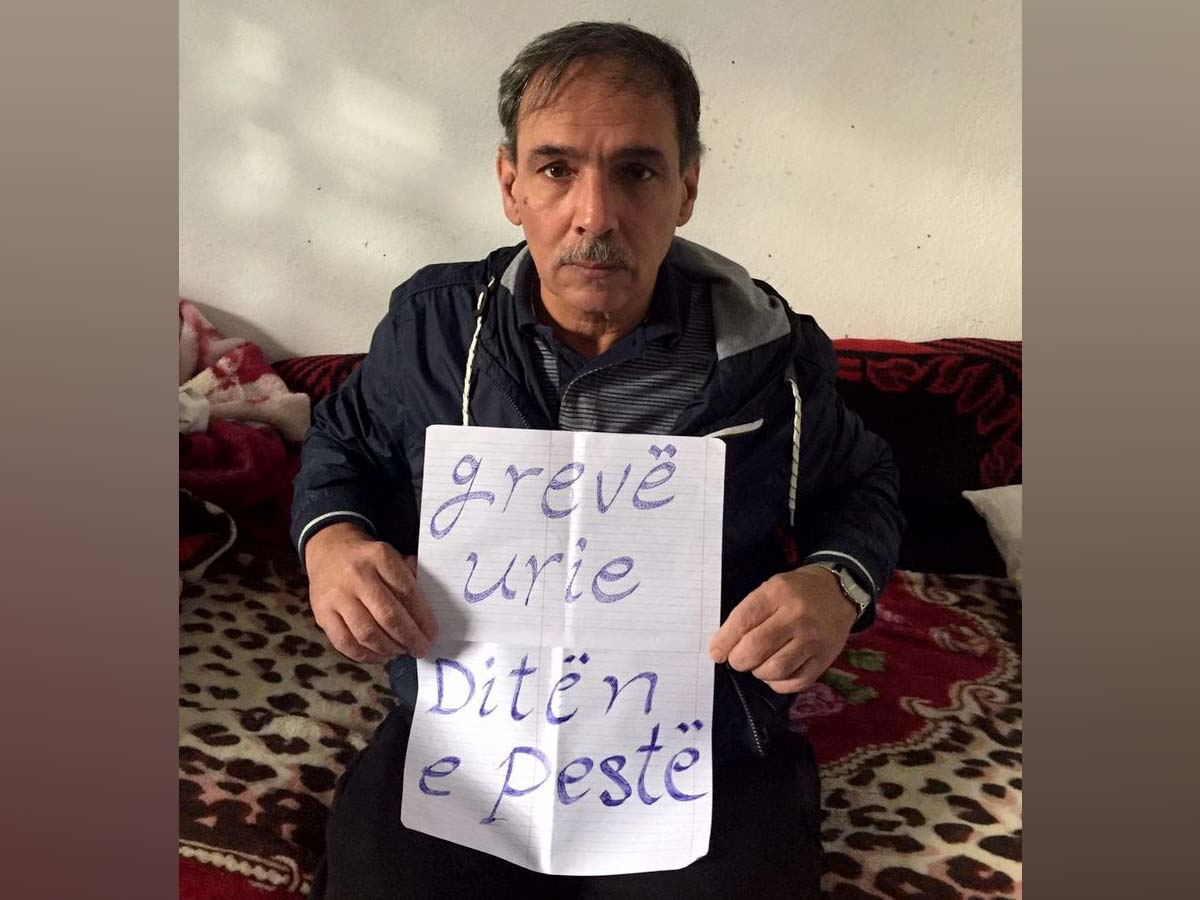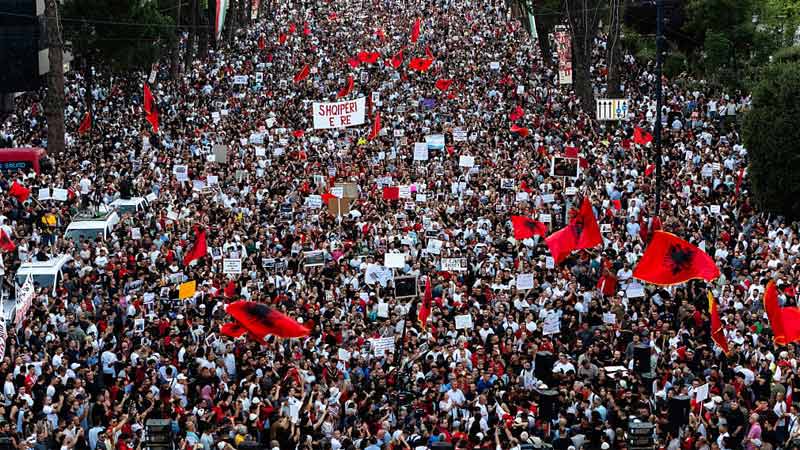
Albania is not often featured in Australian news programs. However, this changed during the last couple of days because of major protests in the capital, Tirana, against the proposed development of Sazan Island, a pristine wetland environment where migratory birds flourish. Protestors have challenged the legality and transparency of the project and the government decisions that enabled it.[1] These issues have become even more prominent, considering that the proposed development is traced to companies controlled by Jared Kushner, the diplomatic son-in-law of US President Donald Trump. The protests focus on the age-old conflict between environmental protection and corporate greed.
The Sazan Island project and redevelopment of a former communist‑era military facility span the Vjosa‑Narta lagoon and surrounding wetlands, an ecologically sensitive area known for bird migration routes and marine wildlife such as sea turtles. Environmental groups warn that bulldozers and excavators have already begun clearing sand, pine forests, and coastal habitats.[2] The government’s decision in 2024 to grant “strategic investor” status to Kushner’s affiliated firm Affinity Partners allowed accelerated approvals, bypassing standard competitive bidding and streamlined land‑use permissions.[3] Critics argue this effectively circumvented normal legal safeguards.
The proposed development, tied to Kushner’s investment firm, envisions a massive transformation of Albania’s southern coastline. Plans reportedly include 10,000 hotel rooms and villas, along with a luxury resort on Sazan Island. Albania’s Prime Minister, Edi Rama, has defended the project as a strategic investment that could turn his country into a premier Mediterranean tourism destination.
But Albania’s Special Prosecution Office Against Corruption and Organised Crime (SPAK) has opened an inquiry into decisions made in 2024 that altered the legal status of land in the Vjosa‑Narta region and around Sazan. Authorities are examining whether protected areas were reclassified specifically to enable the Kushner‑linked project.[4]
Public anger intensified when heavy machinery began carving access routes and fencing off land. In Tirana, thousands of protesters marched for consecutive days, carrying pink flamingo cutouts, a symbol of the threatened lagoon ecosystem.[5] They challenge the legality of land‑status changes, the granting of “strategic investor” privileges, and the absence of completed environmental impact assessments. Demonstrations have turned confrontational with protestors breaking through police cordons and necessitating the deployment of water cannons to disperse hostile crowds. Viral videos showed security forces dragging away demonstrators at the construction site.
The continuing protests reflect not only environmental concerns but also broader frustration with perceived corruption, lack of transparency, and the influence of foreign investors over public land. A central question fuelling public outrage is whether the land, especially Sazan Island, could legally be transferred to foreign interests, or leased for private development at all. According to officials, despite the scale of the project, final environmental impact assessments have not yet been completed. This raises questions about whether construction activity already underway is lawful.
Sazan Island’s historical status as a military zone and its ecological sensitivity complicate any private development. The environmental issue is that such projects often expose tensions between economic modernisation narratives and the institutional fragility of environmental oversight. The Sazan case fits this pattern, with critics arguing that the government’s accelerated approval process reflects broader concerns about transparency and political favouritism.
It is certain that the controversy surrounding the proposed development of Sazan Island by entities linked to Jared Kushner has drawn renewed attention to Albania’s long‑standing position at the intersection of regional politics, foreign influence, and global strategic interests. Indeed, while the current dispute is rooted in environmental, legal and governance concerns, it also resonates with earlier episodes in Balkan political history, including the recently cancelled Kushner‑associated development project in Serbia, the 1935 Zionist exploratory mission to Albania and Albania’s contemporary role as host to the Mujahedin‑e Khalq (MEK), an Iranian opposition group. Taken together, these episodes illustrate how Albania’s geography and political orientation have repeatedly placed it within broader geopolitical currents.
The Albanian controversy closely parallels events in Serbia, where the government recently cancelled a Kushner‑associated real‑estate development involving the former Yugoslav military headquarters in Belgrade. Public opposition in Serbia centred on concerns about non‑transparent negotiations, the valuation of state property and the symbolic implications of transferring historically and architecturally significant property to politically connected foreign investors.[6] The main spark that ignited the public protest against the Kushner-associated real estate was the fact that the Yugoslav military headquarters was bombed twice by the United States Air Force during the NATO campaign in 1999, and that the American investor, ironically, promised to build a memorial for people who died in the bombing of the buildings.
Political analysts have argued that the Serbian government’s reversal reflected a combination of public pressure, legal uncertainty and political risk, particularly given the sensitivity of the 1999 illegal NATO campaign.[7] The Serbian case has since been invoked by Albanian civil society groups as evidence that such agreements can be halted when institutional accountability mechanisms function effectively.
The parallels between the two cases reveal a pattern of public distrust, environmental concerns and political sensitivity surrounding foreign mega‑projects tied to politically influential figures.
While the development is simply a business project driven by profit, politically influenced but not politically motivated, the Sazan Island debate has revived scholarly interest in a lesser‑known episode of interwar history: the 1935 Zionist exploratory mission to Albania. During this period, Zionist leaders, facing British restrictions in Mandatory Palestine, examined several alternative sites for potential Jewish settlement. Albania’s religious tolerance, low population density, and Mediterranean access made it an intriguing candidate for resettlement. Although the proposal never advanced beyond preliminary discussions, it foreshadowed Albania’s later role during the Holocaust, when the country became the only Nazi‑occupied territory in Europe where the Jewish population increased, due to widespread adherence to the Albanian code of besa. The Albanian code of besa, a customary ethic of honour and protection, played a significant role in motivating Muslim and Christian families alike to shelter Jewish refugees. This legacy has become a foundational narrative in modern Albania–Israel relations, frequently invoked by both governments as evidence of a historically rooted moral affinity. Contemporary Albanian and Israeli diplomatic discourse frequently mentions this historical legacy, framing it as evidence of a long‑standing empathy between the two nations.
The Prime Minister’s defence of the Sazan project on the ground that it offers long-term gains for the Albanian tourism sector is symptomatic of the influence of foreign political considerations on domestic policy decisions. For example, Albania’s acceptance of the Mujahedin‑e Khalq (MEK), an Iranian opposition organisation exiled originally from Iran and later from Iraq, adds an instructive dimension to the country’s geopolitical positioning. The MEK’s presence has been the subject of controversy, given its contentious history and the Iranian government’s designation of the group as extremist. Hosting the MEK has placed Albania at the centre of a sensitive geopolitical triangle involving Iran, the United States, and Israel. Albania’s decision reflects its broader strategy of aligning with Western security interests, particularly in the post‑2014 period.
The convergence of these episodes, the Sazan Island dispute, the 1935 Zionist mission and the MEK’s presence, highlights a recurring theme in Albanian political history: the country’s strategic location has repeatedly made it a site of external interest, geopolitical experimentation, and contested sovereignty.
While the specific actors and circumstances differ across decades, the underlying dynamics remain consistent. Albania’s political choices, whether concerning land use, foreign investment or security partnerships, are shaped by the interplay between domestic governance structures and broader international pressures. The outcome of the Sazan Island controversy will therefore not only determine the fate of a single development project but will also signal how Albania navigates the complex geopolitical landscape of the 21st century.
But the main message to take away from this controversy is that sometimes corporate greed trumps even well-intended political intentions. Indeed, the Sazan project proves the veracity of Mahatma Gandhi’s statement that the “Earth provides enough to satisfy every man’s needs, but not every man’s greed.”
[1] Anna Skinner,’ Ivanka Trump, Jared Kushner Island Resort Project Under Scrutiny – Here’s Why’, Newsweek, 2 June 2026, at https://www.newsweek.com/jared-kushner-trump-albania-resort-environmental-corruption-protests-12021501.
[2] Urooba Jamal, ‘Kushner Island? Why a planned resort has provoked protests in Albania’, Aljazeera, 5 June 2026, at https://www.aljazeera.com/news/2026/6/5/why-the-kushners-plan-to-build-an-albanian-resort-has-sparked-protests.
[3] Ibid.
[4] Anna Skinner,’ Ivanka Trump, Jared Kushner Island Resort Project Under Scrutiny – Here’s Why’, Newsweek, 2 June 2026, at https://www.newsweek.com/jared-kushner-trump-albania-resort-environmental-corruption-protests-12021501.
[5] Zana Cimili, ‘What to know about the growing opposition to Trump family-linked resort in Albania’, AP, 4 June 2026, at https://apnews.com/article/albania-kushner-trump-development-protest-tourism-sazan-8d7d0e216c28d23fe1b2e51cbb05b926.
[6] Petrović, M., ‘Urban Redevelopment and Political Economy in Belgrade’, Southeast European Studies Quarterly, vol. 9, no. 2 (2024): 77–101.
[7] Vučinić, D., ‘Foreign Investment and Public Resistance in Serbia.” Balkan Policy Forum Papers 2024.
Dejan Hinic is a financial and investment expert operating from Belgrade, Serbia He received his law degrees from the University of Belgrade and the University of Queensland.
Gabriël Moens AM is an emeritus professor of law at the University of Queensland where he served as the Garrick Professor of Law. He also served as pro vice-chancellor and dean at Murdoch University. He is the co-author of The Legal Right to Disobey Law, Sidestream Press, 2026.
By Dejan Hinic and Gabriël Moens, Canberra Daily