
If political objectives are determined in accordance with true requirements of the society, they can simply play their role in the way to achieve human rights, freedom and the ideal democracy. 
The manner a political group evaluates its political goals, will justify the existence or non-existence of the group.
Therefore, the gang of Rajavi who has been engaged in terrorist acts, armed struggle policy and suicide operations, for more than three decades – to achieve power in Iran – will have no fate except removal from international political scene although they have never had a significant role.
The final objective of terrorist cult of MKO is the absolute sovereignty on human beings and the accomplishment of Rajavi’s middle-aged ideas under the cover of religion and democracy. 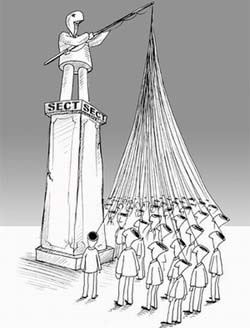
The investigation of MKO’s objectives, ideas, functions and political positions, clearly show that the group’s ideological leader is a totalitarian, fascist one.
The totalitarian, fascist approach of the leader is obviously represented in the internal relations of the group. Camp Ashraf, as the ideological and strategic container of MKO is the concrete symbol of totalitarianism in MKO style where the worst terrorist, manipulative approaches are performed.
The testimonies of a lot of defectors of the cult reveal physical and psychological torture of dissident members, solitary confinement, and suppression of emotional and sexual needs in the name of ideological revolution.
The mind control system which includes manipulation meetings and brainwashing sessions (Cult jargons) helps the ideological leader relate all aspects of the lives of Ashraf residents to their so-called armed struggle and terrorist strategy. When a group of individuals are isolated in a Camp in desert, under a mind control system behind physical and mental bars, for three decades and the relations are organized on the basis of an ill-minded leader’s thoughts, totalitarianism is definitely achieved. It is obvious that opposing such a horrifying system is not simply feasible.
In a totalitarian system, one can except any kind of behavior such as terror act, suicide, homicide, hunger strike … since the people in the system are some humiliated individuals without free will. They are very useful victims for their leader.
Doubtlessly, in the age of democratic evolutions, cults like MKO and Al-Qaida that prepare violent terrorist agents to accomplish their ambitious goals, will never succeed in running their ideas. The historical experiences prove the declining way of such cults as an unchangeable tradition.
By Arash Rezaiee
 achievements for the organization. They can be summed up from two aspects. One is the negative outside consequences and another is the internal achievements the organization thought it had achieved. It is the latter aspect that I mean you explain exclusively from Rajavi’s point of view.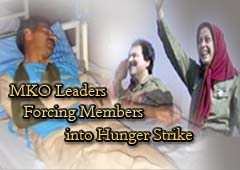
 Leadership Council to Maryam’s arrest was a histrionic rather than genuine; a mixture of pretense, sincerity, and the agitated atmosphere that made quite an impression on the audience. Then, it becomes clear that in spite of the created flutter following the news of Maryam’s arrest, the shown sentiments lacked the needed depth and most were imitating and role playing feelings. In such an abrupt outpour of emotions, it won’t be surprising to see a senior member, excited and impressed by the atmosphere, set himself on fire. Imagine what would have been the effect on the lower ranks.
  relationships was the outcome of those arguments made by Maryam about “traditional woman “or “woman in quotation marks”. Massoud Rajavi never limited himself to present any sort of problem. Even before marrying every woman in the leadership council, he was always relaxed to ask his questions or to convey his arguments in a manner he desired.