
Sander Lleshaj and the MEK did not want the case of Ehsan Bid and his illegal dumping at the Greek border to come to the media but they failed. Here we are.

Sander Lleshaj and the MEK did not want the case of Ehsan Bid and his illegal dumping at the Greek border to come to the media but they failed. Here we are.
An Iranian citizen and ex-member of MEK has been accused of being a foreign agent and is at risk of being expelled from the country.
Ehsan Bidi came to Albania with more than 2000 Mujahadeen from the Freedom Camp in Iraq. He was granted refugee status, supposedly lasting until 2023. During his time in Albania, he defected from the MEK and had his refugee status revoked. He was then imprisoned for one year at the Karrec detention centre with several other defectors.
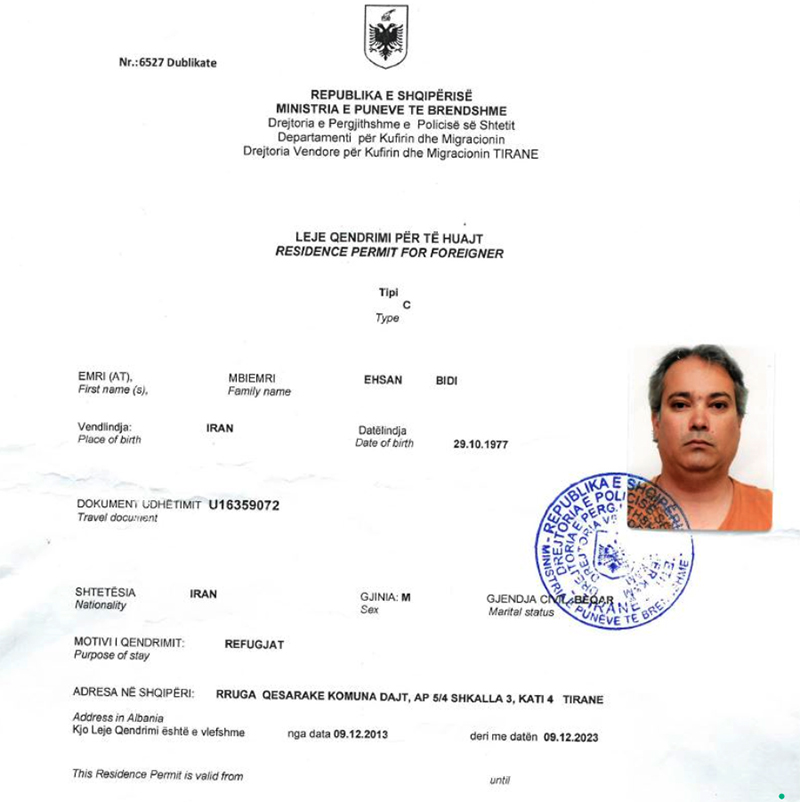
On 13 August, media reported that he would be deported from Albania to Greece because he is an “Iranian agent”. The MEK claim that “an asylum seeker, under international law, is a person whose life is in danger in his country of origin,” and that Bidi does not fit this criterion.
Bidi was then taken to the Greek border at Kapshtica where the Greek authorities wouldn’t let him cross. It was reported that the Greek side did not want to carry out deportation procedures.
A representative of Bidi speaking to Exit said that he is not an Iranian agent and that the attempts to deport him and therefore “risking his life” are because he defected from the MEK camp. Exit has been unable to verify this either way.
Bidi was due to hold a press conference at Tirana International Hotel today at 11.00 in an attempt to clear his name but the Hotel cancelled at the last minute, citing orders from the police.
Exit called the hotel and asked what reason the police gave for cancelling the conference, and they said it was due to COVID-19 protocols.
https://exit.al
Sorayah Abdollahi appeals to Albanian government to allow her to meet her son Emir Aslan Hasanzadeh
Dr. Olsi Jazexhi:
Emir Aslan Hasanzadeh is an Iranian mojahedeen taken by MEK in 2002 (1381) when he was 21 years old. Now he is 38 years old. Not married. Kept in isolation as a jihadi by the Maryam Rajavi mojahedeen gang in Manza, Albania. His mother Sorayah wants to meet him. But Albanian authorities who obey to the Mojaheeden command do not allow her and hundreds of other Iranian mothers to come to Albania and see their sons.
In the following video she explains to Dr. Olsi Jazexhi her story and the struggle that this Iranian mothers do in order to liberate their children from the Mojahedeen el Halk terrorist organization. Sorayah pleads like a mother to her son, the Albanian government, international community to allow them to meet their children.
BY Olsi Jazexhi,
By hosting the People’s Mujahedin of Iran (MEK) on behalf of the US, despite the group being labelled a terrorist organisation by Iran, Albania has drawn the ire of Supreme leader Ali Khamenei.
The acting Albanian foreign minister Gent Cakaj announced on his Facebook account that an additional two Iranian diplomats would be expelled from Albania. This follows a decision in 2018 which expelled the Iranian ambassador and has made Albania a frontline in a clash between the United States and Iran.
The decision to expel the Iranian diplomats seems likely a result of the comments made by Iran’s powerful Supreme Leader Ali Khamenei in the aftermath of Qasem Soleimani’s assassination at the hands of the US in which he said: “In a very small European country but an evil country in Europe, there are American elements with some Iranian traitors, they got together to conspire against the Islamic Republic.”
In 2014, under US pressure, Albania took in more than 4,000 members of the People’s Mujahedin of Iran (MEK) a secretive group formerly based Iraq.
“Albania is hosting one of the most dangerous terrorist organisations on behalf of the United States,” says Dr Olsi Jazexhi, an Albanian academic and expert who has been tracking MEK activities in Albania.
“The Americans imposed them [MEK] on Albania and since Albania is a very fragile state they had to accept. The same thing was done by Prime Minister Edi Rama who is still hosting MEK in Albania,” Jazexhi tells TRT World.
Considered a terrorist group by Iran, the MEK was also listed as a terrorist organisation by the US State Department until 2012.
The Obama administration re-designated the group and formalised a relationship that the US had been cultivating covertly, protecting the group in Iraq at a US military base, then under American occupation.
“The reason for the MEK being brought to Albania is the general ignorance of Albanian politicians who do not understand the danger of international terrorism and the implications that this terrorism has on nation-states” added Jazexhi.
The MEK is a militant political organisation that subscribes to an unusual mixture of Marxist and Islamic ideology.
It has been accused of killing of American military personnel, bombing American companies and targeting innocent Iranian civilians during a campaign of terror over several decades.
A report by the US media outlet NBC News suggested that the group is being financed by Israeli intelligence and was also behind a string of assassinations targeting Iran’s nuclear scientists between 2007 and 2015.
“The MEK is deeply despised in Iran, they fought for Saddam Hussein against Iran for eight years. Then they spied for the Americans and the Israelis, they are mercenaries and a cult group,” said Seyed Mohammad Marandi, Professor of English Literature and Orientalism at the University of Tehran.
Former members of the MEK have spoken out about the oppressive cult-like rules enforced in the organisation, including marriages that have to be arranged by the leadership. There have been reports that the organisation has at times asked its followers to divorce en masse and locked up and even killed members who have criticised the dogma of Maryam Rajavi, the current head of the MEK.
“No one in Iran has any sympathy or respect for them [MEK], they are traitors to the country. They are tools of Western powers. Thousands of them are working as an online army in Albania,” said Marandi speaking to TRT World.
Earlier this year The Intercept, an online investigative publication reported on how the MEK had created a fake online persona called Heshmat Alavi in order to spread propaganda against the Iranian government, including advocating for regime change.
The so-called writer Alavi was managed in part from Albania and had fooled many American publications who had published the fake persona’s writing.
“Using different aliases on the internet, on Facebook as well as Twitter” they have managed to create a digital army, says Marandi, adding: “These social platforms do not block their activities because it is done in coordination with the US government and also they carry out spying activities in Iran.”
The US assassination of Iranian general Soleimani and the subsequent retaliation by Tehran in a series of rocket attacks on US bases underscores the dangerous manoeuvrings between the two powers and the potential to suck in other countries, including the small Balkan state of Albania.
“Albania has become the most dangerous country in the world for Iran after the United States and Israel,” says Jazexhi.
“While the United States and Israel are in open conflict with Iran, Albania by hosting MEK has become a major centre of anti-Iranian propaganda in the world.
The MEK doesn’t lack powerful friends in Washington and in particular enjoys close ties with the hawkish Trump administration. In 2017 the group paid National Security Adviser John Bolton and Trump’s personal lawyer Rudi Giuliani for speaking engagements.
With powerful friends like this, Albanian politicians don’t “dare to do anything” says Jazexhi even though “the majority of Albanians are appalled by what the government is doing.”
The MEK could also be acting against the Albanian penal code says Jazexhi.
“The Albanian penal code states very clearly that if a person or a group of people incites to fight against a foreign country or incites people or asks people to participate in a conflict in a foreign country they could be persecuted for this,” adds Jazexhi.
MEK actions in an impoverished country like Albania, which is still struggling to emerge from a communist dictatorship, doesn’t bode well for its long term stability or rule of law. Iraq has become a battleground of influence between the US and Iran, a faraway conflict for many Albanians.
“When you host terrorists and you aid terrorists than you should be afraid of suffering the consequences. These are not normal people,” says Marandi. “The Albanian government is foolish to cooperate in such a way with the Americans.”
Albanian President Ilir Meta shot back at comments made by [Ayatollah] Khamenei saying: “Albania is not a devilish country, but a democratic one.” However, Meta made no mention of the lack of democratic structures within the MEK and the human rights violations it has been accused of.
“MEK with its paramilitary camps that they have in Manza, Albania has created a state within a state,” says Jazexhi and as tensions between Iran and the US continue to heat up the role that the MEK is playing in Albania could also make it another theatre of conflict.
Elis Gjevori ,TRT world
The problem of radical jihadist and Islamist infiltration in the western Balkans is real and multiform, depending on the country of reference and its institutional, political and socio-economic characteristics. In fact, this is not a phenomenon that can be understood in general terms, but is, rather, linked to specific dynamics. Indeed, radicalism with an Islamist matrix breaks through where the state is lacking or absent, where socio-economic conditions (particularly those of young people) are severe, without forgetting the history of the relative country, which can in some way contribute to the modalities with which the phenomenon develops.
In the case of Albania, whether in fact the legacy of the communist regime led by Enver Hoxha, which led to the annulment of state religion in the country and the introduction of state atheism (1967) as official doctrine, may have contributed to reducing the fertility of the grounds which radical Islamism could progressively seek to breach after the fall of the regime is still a matter of debate today.
Despite some theories, according to which, reaction to state atheism has strengthened the beliefs of the Albanian people, so far the only proven effective consequence in Albania is mutual tolerance and cooperation between the different religious communities in a majority Muslim country, but with its Catholic, Orthodox and Bektashi presence. On the other hand, it is difficult to argue that state atheism has contributed to an increase in the number of believers in a country where nationalism, so-called ‘Albanianity’, takes precedence over ethnicity and religion and where the rate of mixed marriages is particularly high. It is therefore possible to hypothesize that the remarkable interreligious tolerance is actually the result of an approach which, through state atheism, has led to the religious aspect being seen as secondary to belonging to the nation. In addition, Albania has never been the scene of religious conflicts on its territory.
Radical Islamism fueled from abroad
Islamic extremism in Albania is a problem imported from abroad and connected to various sources. There are Gulf countries and charitable organizations that have every interest in spreading Wahhabism and Salafism, financing mosques, cultural centers, charitable associations of a religious nature, importing doctrinal material for distribution and imams for indoctrinating.
On the one hand the Albanian Muslim community (Kmsh) is very careful to identify and eventually reject radical drifts, to the point that already in 2015 it asked its institutions to intervene to deal with the problem, on the other there is a reality created by radical preachers, active in unofficial Islamic centers but also on the web, some of whom returned to Albania after periods of study in Islamic schools in the Middle East. These hate preachers are not only concerned with spreading that Salafist and Wahhabi ideology based on abuse and intolerance, but also openly invoke jihad. Not surprisingly, in March 2014, the Albanian security forces dismantled one of the largest networks of propagandists and recruiters for ISIS active in the western Balkans (and the most important of Albania), headed by the two imams Genci Balla and Bujar Hysa.
Among the characters connected to the ‘Balla-Hysa’ network there was also Almir Daci, ex imam of the Leshnica mosque, who appeared with the name ‘Abu Bilqis Al-Albani’ in the well-known video on the Balkans released by ISIS in June 2015 and entitled ‘Honor is Jihad’.
The areas targeted by hate preachers are mainly the peripheral ones of Elbasan, Cerrik, Kavaja, Librazhd, Pogradec, Skutari but also the outskirts of Tirana. Their targets are largely young individuals in precarious social, cultural and economic conditions.
A further problem is the economic and political infiltration of Erdogan’s Turkey, ideologically linked to the radical Islamism of the Muslim Brotherhood. Infiltration perpetrated through the use of so-called ‘soft power’; the ability to persuade, attract and co-opt, through such means as culture and politics. This poses a far more serious danger because it is more difficult to identify and manage. An example? The great mosque of Tirana (the largest of all the Balkans), built by Erdogan a stone’s throw from the Albanian Parliament on an area of 32,000 square meters. Obviously, everything has a cost and in this case it is of an ideological-political type. In fact, it is not surprising that the sermons preached within these mosques are the same as those pronounced by the imams of the countries of origin, with contents that go beyond the theocratic doctrinal aspects and flow into politics. A very powerful weapon in the hands of regimes.
Return of jihadis and the fight against terrorism
Albania has ‘contributed’ to the jihadist cause in Syria and Iraq with around 180-200 foreign fighters out of a population of 2,873 million, but also seems to have good control of the situation. The US State Department Country Reports on Terrorism for the year 2018 has in fact highlighted how Albania, despite the scarcity of resources, has still achieved good results in countering jihadism. The collaboration between Albanian CTU and US agencies in the fight against terrorism is currently at high levels; a further important aspect is also the modernization of the Personal Identification Secure Comparison and Evaluation System (Pisces) to protect Albania’s borders, in addition to the already high controls at sea and airports.
Overall, Albania appears to be able to manage the danger deriving from jihadism linked to the return of foreign fighters and radicalization in its territory; this is certainly the result of cooperation with European and US agencies, but also the presence of an efficient internal intelligence system, a legacy of the communist period. More problematic is the management of internet propaganda which affects not only Albania but also the diaspora (a problem among other things on a global scale), propaganda that could also affect jihadists who have returned to their homeland, as well as latent ones, who never left.
The headquarters of the People’s Mojahedin of Iran
A further problem on Albanian soil is linked to the presence of the headquarters of the People’s Mojahedin of Iran (MEK), established in Manez (near Durres) since 2016, after years of activity in Iraq. A presence that has created many headaches for the institutions of Tirana.
The MEK was created in 1963 with the aim of fighting the Shah’s regime and in 1979 participated in the Islamic revolution led by Ayatollah Khomeini; however, the populist ideology (a cross between Marxism, feminism and Islamism) clashed with that of the Ayatollahs, and the Mojahedin was therefore banned and the group found refuge in Saddam Hussein’s Iraq.
With much suspicion of Israel[i involvement] and badly tolerated by many anti-Ayatollah Iranians, the MEK was previously blacklisted by the European Union, Great Britain, the USA and Canada, only to then be “cleared through customs” between 2008 and 2012, thanks also to the intervention of the then Secretary of State, Hillary Clinton.
While Washington sees in MEK “the main opposition force for promoting democracy and secularism in Iran”, on the other hand, Tehran identifies it as a “terrorist organization responsible for bombings and acts of political violence”. Whether the MEK is a promoter of “democracy and freedom” or not, it is difficult to say; it is certain that the union between Marxism-Leninism and Islam preached by the group is certainly not a guarantee of that, just as its structure which shows typical elements of a sect (cult) is not either, as recently illustrated by the BBC report.
It is worth pondering the usefulness of the MEK presence in Albanian territory, an uncomfortable, perhaps inopportune presence, which risks creating more problems than advantages in an extremely delicate context such as the Balkan one.
Inside Over, Tirana, Albania, Translated By iran-interlink
At the mass that took place at St. Paul’s Catholic Cathedral in Tirana for Christmas, besides many corrupt personalities, thieves and criminals who went on to pardon sins and appear on television as good men, there were also representatives of the former terrorist Iranian Mojahedin-e Khalq organisation (MEK).
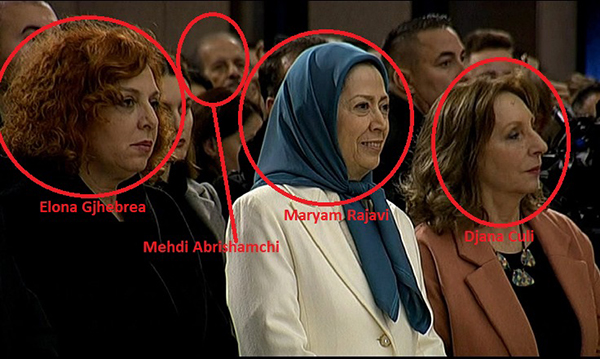
Present at the Christmas Mass was the head of the Iranian Jihadis, Maryam Rajavi. Behind Maryam Rajavi, in the photo published by an Albanian newspaper, is her first husband Mehdi Abrishamchi, who because her second husband, Massoud Rajavi, is now dead, is apparently replacing the former.
On the left of Maryam Rajavi is the feared Communist spy, Djana Culi, who is notorious in Albania for sending the brothers Blloshmi and Genc Leke to the gallows, and who is now a fiery supporter of the MEK jihad against Iran. On the right of the hijab wearing Maryam is Elona Gjhebrea, former Deputy Minister of the Interior, who is also controversial for her acquaintance with the Habilaj clan drug gang.
Attendance by the former terrorists, former communist spies and friends of drug traffickers has been welcomed by Monsignor George Frendo. In a repetition of the biblical tragedy of Pontius Pilate and the hypocritical religious leaders who condemned Jesus Christ to the cross, Monsieur George Frendo was happy with the presence of former terrorists, spies, criminals, etc. who attended the Christmas Mass. Their presence turned the Mass into a biblical tragedy.
Knowing that Maryam Rajavi presents herself to members of her cult as the messenger of Imam Mahdi who will save Iran from Islam and the Imams, the Christmas Eve Mass in Tirana resembled messianic dust. Maryam the ‘saint’ was celebrating the day of the birth of the saint Jesus Christ in the presence of many sins and sinners.
If Christ was in the grave, the night would have been a freakshow of horror!
Hallelujah!
Gazeta Impakt, Tirana, Translated by Iran Interlink
Devastating earthquake destroys the PMOI/NCR base in Albania, possibly dozens dead, survivors blame Iran
On 26 November, early Wednesday morning at 3:54 local time, northwestern Albania was struck by a strong 6.4-magnitude earthquake with an epicenter northwest of the capital Tirana. The maximum perceived intensity was VIII (severe) on the Modified Mercalli intensity scale. The tremor was felt in all parts of the country, and in places as far away as the Italian city Taranto and the Serbian capital Belgrade, some 370 kilometers northeast of the epicenter. It was the strongest earthquake to hit Albania in forty years. There have been hundreds of aftershocks, of which four have been greater than 5-magnitude.
Following the deadly earthquake, the Albanian government declared Wednesday a day of national mourning and a state of emergency in the Durres and Tirana regions. The earthquake razed several buildings to the ground in the port city of Durres and the surrounding villages, trapping dozens of people. Material damage and casualties have been reported in Tirana also. Neighboring and European Union countries have reacted to the earthquake with sending civil emergency rescue teams and financial aid.
For more than 36 hours, civil emergency crews, police, the army and specialized rescue teams from other countries have been digging in the ruins of collapsed buildings seeking survivors. The authorities say they have so far rescued 45 people. According to the latest official data, at least 48 people were killed in the earthquake, with 790 injured and more than 20 missing. These numbers are far from complete, especially considering the official hiding of foreign victims.
Unreported foreign casualties
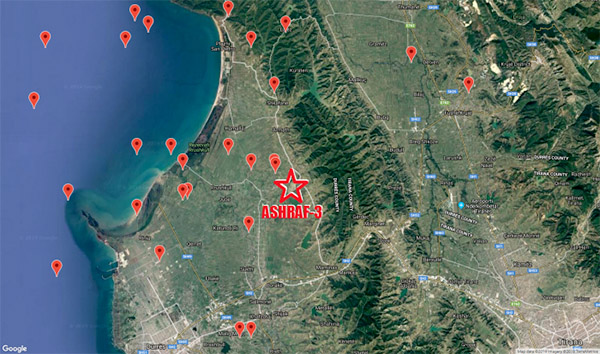
While Albanian citizens living in Tirana and Durres, 30 km and 15 km from the epicenter respectively, had some luck to avoid disaster, the members of the People’s Mojahedin Organization of Iran (PMOI or MEK) aka National Council of Resistance of Iran (NCR) had none. Stationed only 5 km from the epicenter of the main earthquake, as well as less than a kilometer away from the epicenter of powerful 5.3-magnitude aftershock, the residents of poorly built barracks of the Ashraf-3 base have experienced true horror.
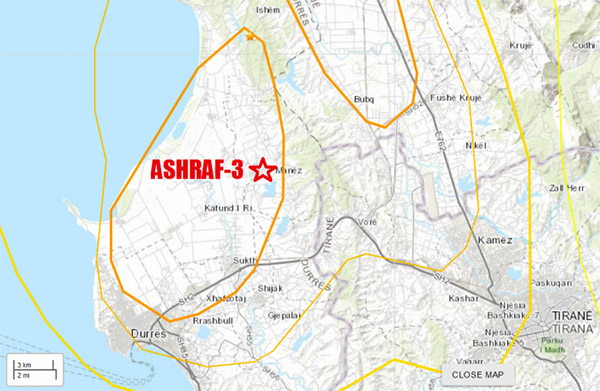
And everything almost went unreported. Standing with a colleague at the entrance of Tirana’s hospital in search of new information and tragic personal experiences, we were surprised to see a column of emergency vehicles led by a police car, trumpeting and shouting “Clear the way!” Wondering who is so important that ordinary civilians have to get out of the way, including wounded women and crying children, we followed the column until it stopped and politely asked the police officer about the VIP patients. “No camera, get back,” he ignored our questions and tried to drive us away.
Standing aside, but at a decent distance, we saw paramedics fastly carrying wounded on stretchers inside, at least two dozen of them. Some were covered with sheets full of blood, probably half dead, while others were howling in some incomprehensible language. Foreigners, therefore special treatment, I think to myself. But who? Too many for some embassy staff, too much well-treated for tourists, I wondered.
Given the obvious secrecy and strict police measures, we decided to change our approach. Instead of asking sensitive details with the press cards, we dodged the cops and approached one young paramedic: “They sent us here, we are translators, where should we go?” I asked him with self-confidence. “So you speak Iranian,” he responded. “Of course I speak Persian, or Iranian, as you inaccurately say,” I taught him differences and repeated the question about direction. “Second floor,” he explained, showing us where to go, and left quickly.
For me, things immediately started to make sense. Few in Albania do not know that there is a base near Tirana with 4,000 members of the controversial Iranian opposition group, displaced in 2016 from Iraq at the request of the US government. We journalists know a little more. Their compound is highly guarded and residents are strictly controlled, with no contact with the outside world. Several fugitives from the base gave shocking stories, and Albanian journalists who reported about their cases were facing tremendous pressures and harassment. Thus, this disastrous situation turned out to be a gold mine, a unique opportunity to find out what happened there. And what was happening earlier.
Repeating the same approach, I introduced myself as a translator and entered the hospital building. Fortunately, being busy in all that mess, none of the hospital staff asked additional questions or demanded documents, nor know Persian. Neither do I. Therefore, I hoped to find a sufficiently lively and friendly English speaker among the casualties, and I did. Teymur, a skinny mustachioed man in his late 50s, spoke English badly and slowly, but honestly.
“Not fair, we’re razed, but Tehran is not”
“It started shaking while I was sleeping in our dormitory with many others,” Teymur begins his experience. “At first the bed started to shake and I saw many waking up, then the windows and ceiling bursting down. Comrades in our and adjacent dormitories started screaming, some shouting that we were under attack. Finally, the structure began to collapse and the beam fell on my legs. I can’t feel my legs. In the half-dark I saw large chunks falling down, some were crushed, instantly dead. All this happened in less than a minute. Soon there was a lot of dust and I couldn’t see anymore, I just yelled for help. It felt like Mersad.”
Later, on the Internet I found out that Mersad was the name of the 1988 military operation in which Iranian army destroyed their troops in a canyon. Asked to evaluate the number of dead and the damage in their base, Teymur says:
“At dawn I was pulled out of the rubble. They lined us up the road and we waited for emergency vehicles. I heard that some were taken to Durres, others to Tirana. I saw seriously wounded and dead, perhaps dozens. I don’t know exactly. Earlier in the ruins I was calling out the names and out of twenty comrades in dormitory, only three answered me. But I know very well that the dormitory barracks have been destroyed, some razed to the ground, some badly damaged. Most of the base staff were sleeping, the rest were at computers in a hall, working an eight-hour night shift online. There are casualties there too, the ceiling has fallen and ruined our hard work. Simply not fair!”
It was astonishing that Teymur spoke calmly about the dead and wounded, but started to blubber like a baby about the computer hall. He seemed to be more upset by infrastructure losses than by human casualties. I asked him why the computer hall is so important to him.
“We arrived in Albania three years ago and since then we have been preparing for a new life. We have been told that our dear Saudi and Israeli allies have invested a lot of money in our base and infrastructure, that we are safe here. We have been told that we have full support of the US government and all their allies, mister Bolton even promised us to celebrate together in Tehran soon. A year ago, we got new computer equipment and for months we worked hard, promoting human rights and democracy. Just ten days ago, we saw Iranian people on the streets and Tehran buildings ablaze, we thought our dreams had come true. But today, no revolution, no halls, no computers. Everything was lost!”
“It has something to do with Iran”
Teymur’s raised voice elicited the reaction of his colleague in the next bed, chanting something like “mark bar this, mark bar that.” Asked to translate from Persian, Teymur explained that his comrade was cursing Iran and its government. “Why,” I asked.
“It has something to do with Iran, no doubt, we all know that,” Teymur claimed. I was pretty dazzled and asked him if he wants to say that Iran caused the earthquake.
“Yes, yes! How is it possible that an earthquake hits us directly? We were told that the earthquake epicenter was very, very close to our base, that there had been no such strong earthquake for decades! Is it a coincidence that it strikes precisely in the early morning hours when all comrades are at the base, inside the barracks? Someone obviously planned to cause as many casualties as possible! How is it possible that an earthquake strikes us just five days after the suppression of our revolution inside Iran? This is pure revenge! I’m sure that Iranian fingerprints exist. In fact, the Albanian police already announced that they had uncovered Iranian agents who were planning attacks against us, just a month ago. Maybe their agents buried and activated powerful bombs, maybe they use high frequencies via satellites to provoke earthquakes, I read that it’s possible. Iran should not posses such advanced technology, I hope our brother Trump will increase sanctions against their research networks, or respond by force,” Teymur said.
Just when his story was becoming more and more interesting, our conversation was interrupted by a security guard who banged on the door. “Who gave you permission to interview the casualties? If you don’t have an interview permit, get out”, security guard yelled, threatening to take our equipment. “If you publish anything in the media without permission, we will sue you and you will regret it,” a corpulent patron of alleged democracy fighters threatened us at the end.
BY Balkans Post,
Without a Trace finds the Mojahedin accused of being terrorists: MEK camp is a prison! In Iran, MEK ordered us to kill people
Former members of the Mojahedin who fled the Iranian opposition’s camp in Manez and were then accused of terrorism, gave evidence in an interview with Without a Trace of the massacres that the former terrorist fighters, MEK, committed in Iran. They consider the camp in Manez a prison, they say they have left because they want to live freely.
Testimony: Some Albanian officials have been corrupted by this organization, this means we are not allowed to work, nor have a residence permit. It’s a fanatical organization. They want us in prison.
Interviews conducted by the investigative editorial board of Without a Trace
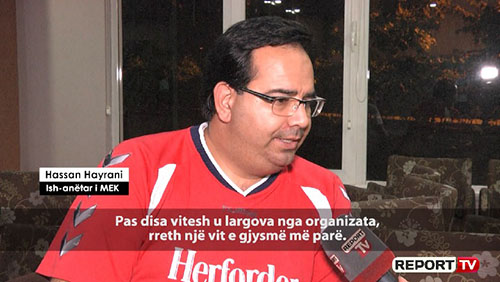
Hassan Hayrani: My name is Hassan, I am a former MEK member. After the fall of Saddam Hussein in 2010, I joined the organization. After a few years with them, I left the organization about a year and a half ago. And now I live here at Fresco, and thankfully this is the best opportunity for me.
When were you recruited by the MEK organization?
Hassan Hayrani: At first we came here after the leader of the organization promised us that the situation would change once we arrived in Albania. But sadly, after about a year, MEK leaders, with money coming from Saudi Arabia, set up a prison rather than a camp in Manez, similar to those in Iraq. There are other people in there who unfortunately can’t get out of this situation in Manez. We asked the leaders of the organization why are you forbidding us from having a family, forbidding outside contacts, no internet or freedom, and why do you say we are fighting for the freedom of the people of Iran, when you don’t allow freedom within the organization. They told us that they do not believe that these are the conditions inside and that they believe in freedom. The leaders of the organization told us that these conditions were there for our benefit at a time when Saddam Hussein was overthrown and the Iranian regime was spreading terror, and so under these conditions we agreed. But if you go to Manez, you will see that it’s like a prison, and that security is done with a shotgun. So, it’s just like a prison.
Did you receive an order to carry out a mission there?
As for the organization, I joined after the fall of Saddam Hussein. At that time the organization had no operations against Iran. But we had some attacks by the Iraqi government because the organization did not follow their laws. There were some conflicts between them, and members of the organization were involved in these conflicts.
Are there any dangerous persons in this organization in Albania?
No, they do not have dangerous persons, because Albania is a safe country. There is no need for this to become a battleground either. But the leaders of the organization only want to turn the camp into a jail, to keep those living in Manez confined. The leader of this camp does not want members of this organization to have contact with other people outside this camp. And on the other hand, it does not want out-of-camp people to have contact with the people inside. For example, there have been cases where journalists have not even been allowed to interview persons living in Manez on the grounds that their news organization is affiliated with the Iranian secret service and they fear a terrorist attack. This is laughable. They only want us to have the toughest conditions here.
We escaped MEK without conflict, we are just looking for a quiet life. We have no problem with either the Albanian citizens or the Albanian government. We have been living here for 3 years, and we are free, we are living a peaceful life. We have no problem. It’s MEK who doesn’t tolerate us here.
Who is accusing you?
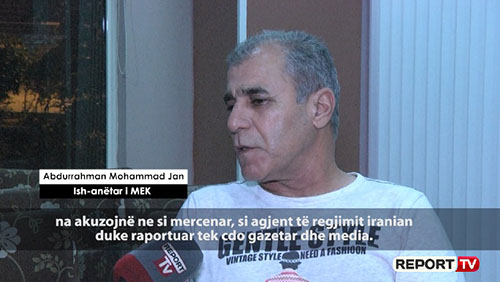
The Mojahedin Organization called MEK, which you have already heard of, accuse us of being mercenaries, agents of the Iranian regime, they reported that to every journalist and media outlet here. Because we broke away from this organization to lead a civilian life and we now lead lives as civilians, they don’t allow us to do that. Our existence in this country, as free and civilized people, encourages other members to leave this organization.
How did you become part of this organization?
From my experience in this organization there are some people I know of, some Albanian officials who are corrupted by this organization and do not let us work, nor have a residence permit. It’s a fanatical organization. They’d love us to be in prison.
When were you recruited by the MEK organization?
I’ve been a part of it for 28 years and have spent much of my life, my youth, with them.
I have given so much of my life, all they wanted from me. I decided to break away from this organization to have a free life. After all these years I have known about the terrorist acts carried out earlier, and that now they want to fall into American hands, I don’t agree with this, this is sufficient for me to want to live my life as a civilian. My free life here consists of all this. I lost all my life, maybe a lot, maybe a little. After so many years I found out about the free world, the free life and I wanted to live it. And when I saw free life here I decided to break away from this organization.
I decided to leave the organization three years ago. Now I live in Tirana.
A few days ago, the spokesman of this organization, of which I was a member, accused me of being an Iranian agent as well as a terrorist. He has no basis for this nor to ask the government to arrest me. This is faked news because they do not want me and my friends to live freely. This has created problems by limiting us and our lives here, they want to force us to move to another country, illegally if necessary. But even if we wanted to go to another country, we cannot because we have no documents.
What is the purpose of this organization?
When I decided to leave this organization, they were ordering us and dictating rules for us. They said, If you leave, we will pay for you, you can spend our money, but you have to obey some rules, such as: you can’t talk to anyone and you can’t live as you want. We will tell you who you should live with and what to do. I did not accept this and so received no money from the organization.
Then why did you accept to be a part of MEK for 30 years?
I really trusted this organization at first. When I joined, I believed. I believed in freedom, in democracy. I thought that the people in Iran would live freely. That MEK would bring democracy. But little by little I realized that this organization was a lie and that democracy would not come and that the only ones enjoying power were the leadership.
Did you witness the massacres in Iraq?
When I was in Iraq, in 1998 maybe, I don’t remember well, I was in an operation in Kurdistan. In this operation I was the shooter and the one driving the tank. And during this operation I was ordered to kill people, to carry out a massacre there.
Have you been ordered by MEK to commit terrorist acts?
When I was in MEK, I was part of a group that would go to Iran and were ordered to commit terrorist acts; to detonate a bomb and kill people as terrorists.
I was part of a group, and there were plenty of groups who went to Iran to do the same thing, to kill people.
A small group consisted of 3 or 5 people and we went to Iran after crossing the border and went to several Iranian cities and killed some civilians.
I was in that group, but to my good fortune I didn’t act because I wasn’t ready to do it, physically, my body wasn’t ready to do it. And that mission was given to another person in the squad.
We ask the Albanian government to give us a residency permit, or another document to allow us to have a better situation. We need work, to make money. We need help.
Some of my friends are trying to earn money by doing business. Now we have spent all the money in the [Ramsa charity] package. My mom, my brother sent me money to help me make my life here.
Forty years ago, I was living with my family. When I was a soldier sent to the war front, I was a prisoner of war for 9 years during the Iran-Iraq war. Then I was with the Mojahedin for 20 years. For 40 years I have seen no one in my family. For 30 years I had no contact with them, because in MEK there were rules, no one, no one was allowed to call their family.
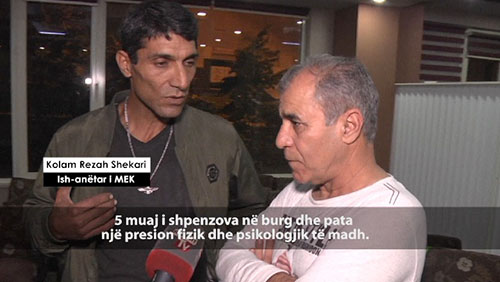
I’ve spent 20 years of my life with MEK and after that, I live as a civilian today. For a long time I had realized how great a lie MEK was. I spent 5 months in jail under them and was under great physical and psychological pressure. I decided to leave the organization. Why am I accused of being a terrorist when I am living a free life? I have also given an interview to the German media.
I work here in Tirana, work in the duralum, do electrical work, paint houses. I work for a living. I work from 8am to 8pm. How can I be a terrorist. Here’s my hands, how can I commit terrorist acts once I’m back from work.

I was with MEK for 30 years, and I’ve been separated from MEK for a year and a half. I heard talk of news that we were accused of terrorism. In this organization everything we did was restricted. Even inside MEK the members were abused about this news, that we were terrorists and that we needed to be arrested.
Shqiptarja, translated by Iran Interlink
Former MEK speak out: We are not terrorists, do not drive us out!
The Mojahedin members who deserted the camp in Manëz regret that they worked for Saddam Hussein and demand that they not be persecuted.
Defectors from the Mojahedin camp in Manëz, Durres, demand that they are not accused of being terrorists and agents of Iran. They admit they had been fighting for Saddam Hussein for years but have repented and now want to live away from the pressures and threats.
Mojahedin defector: It is not true that we are terrorists. We left this organization to live our lives as civilians. We no longer want to fight as jihadis. We seek to live freely, as this organization has made many mistakes in the past.
They ask the Albanian government not to expel them.
Mojahedin defector: I am here to tell the Albanian public and the government that we are not agents of Iran. I was part of Saddam Hussein’s regime and then fought alongside him, now I want to live as a free citizen.
About 4,000 Mojahedin live in the Manëz camp and it turns out that 400 people have left there, 40 of whom live in Tirana.
ORA News, Translated by Iran Interlink
Former MEK in Albania Expose MEK Stupid Lies
On 23 October, the Albanian Chief of Police exposed himself to ridicule by reading out badly a prepared statement written by the MEK disseminating fake news. The statement claimed that a terrorist cell run by an individual in Iran, helped by several named individuals involved in organised crime and a MEK associate who lives in Austria and whose mother is trapped in the MEK camp in Manëz, Durres, were intent on plotting to kill the Mojahedin in Albania in March 2018. This is what the Police Chief read out loud. No evidence was produced.
To counter the backlash, the MEK sent one of their veteran spokespersons to Albania in a bid to exert some damage limitation. However, the MEK only managed to make things worse by publicly and randomly accused some former MEK members who, having rejected the group, now live peaceful and law abiding lives in the capital Tirana, of being “agents of the Iranian regime”. The MEK appear to have forgotten that they are embroiled in a court case over exactly this stupid accusation. Albanian journalist Gjergji Thanasi has sued MEK member Behzad Saffari for defamation after Saffari several times made public accusations that Thanasi is an “agent of the Iranian regime”. Putting aside the question ‘what does that actually mean and who actually cares’, we can see there is a clear pattern here. The MEK defends itself by spuriously and falsely attacking others.
In response, a group of former MEK members in Tirana visited the Interior Ministry to denounce the MEK and its fake news and fake labels.[Iran-Interlink comment]
Representatives of the Iranian opposition in Albania said on Thursday that other persons, former MEK members, are also in Albania, who, according to them, are ‘agents of the regime’ and should be arrested and expelled from Albania. Ali Safavi, a member of the National Council of Resistance of Iran, told ABC News that Gholam Zadeh Shekari, Hassan Hayrani (Hajrani), Rahman Mohammadi are in Albania, but he doesn’t know where they live.
The aforementioned persons, former MEK members who left the organization, told ABC News on Friday that they live in Albania with residence permits and work permits issued by the Interior Ministry and that they respect the laws of the country.
FULL INTERVIEW
ABC News: Can you tell me your name?
My name is Abdurrahman Mohammadian and I am a former member of the Mojahedin. I separated from this organization two or three years ago and I now live my life in Tirana.
ABC News: What about your friends?
My friends also left the organization and now live their lives as individuals. We do not want anything to do with this organization because we do not see anything in this organization. We left and now we don’t want to know anything about this organization. This is not a good, humanitarian organization, but a terrorist organization. As you know, the name of this organization was blacklisted, on the American terrorism list, it was on the UN blacklist, on the UK blacklist, and on the Canadian blacklist. It was listed as terrorist and has committed acts of terrorism in Iran as a terrorist organization. This is a terrorist organization and we know all about it; this organization did wrong against the Iranian people, they killed a judge in Iraq, Iraqi judges, committed massacres, we saw them, and we are witnesses to that. This organization is afraid that we can talk about these.
ABC News: Are you affiliated with the Iranian government?
No, we do not support anyone, no party, we live our personal lives and we do not want any problems with anyone. But this organization does not want us in this country because we live as free people. They do not want us to live here because other people within the organization see us living as free people and maybe want to come out too. So, they put pressure on us to leave this place because our freedom here is not good for them.
ABC News: Why did you leave MEK?
Because this organization is not good. We used to believe it was a good organization for the Iranian people, but we found out during the years the bad things they did against the Iranian people. We left and also because the pressure on relations in this organization is not good…
ABC News: Do you have permission from the Albanian government to live outside the camp?
Yes, we have permits and every year we renew them and…
ABC News: Who gave the permission?
The interior ministry, the interior ministry gave us work and residence permits. We are legal, we live legally in Tirana, in this country, we have not done anything against the law, we accept the laws in this country, and we live our own personal lives as individuals.
ABC News , Translated by Iran interlink