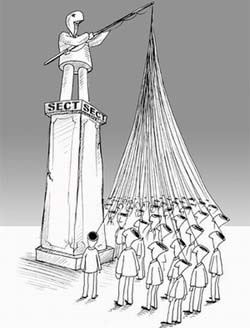
MKO brainwashes its members
Manipulation Techniques of the MEK cult leaders
“…the government would fall within 12 months if foreign powers remain neutral in the crisis” said Maryam Rajavi, in her interview with AFP.
This is not the first time and certainly not the last time either, that Maryam Rajavi as well as her fugitive husband Massoud Rajavi promise the overthrow of the Iranian regime in a particular period of time. 
As a matter of fact it has always been a special policy in MKO history to determine a time for the fall of IRI. The use of the policy is that the leaders of the cult find a new topic for their manipulative sessions, they entertain the members injecting them the hope for the victory of their so-called struggle, especially in the current declining situation of the group in Iraq. Once the members are promised and given the hope of victory, they will stop their hesitations about leaving the group and will be persuaded to stay at camp Ashraf, in the hope of their alleged victory against Islamic Republic.
But the history recalls that thirty years ago (!) when Massoud Rajavi fled Iran to France he claimed, in his interviews, that he would get back to Iran in six months!
He repeated these words regularly during the past three decades since in various phases of MKO history the members were stuck in depression and disappointment due to failures of the cult, including failure in Eternal Light Operation (in which MKO attacked Iran), failure in their civil war and terror acts, their designation as a terrorist organization in the world and the fall of their main financial and military supporter, Saddam Hussein.
Now, Maryam Rajavi’s claim for the overthrow of IRI in 12 months is the latest use of their old policy. It is worth to know that this time Mrs. Rajavi has made a condition in her prediction and that’s:”if the foreign powers remain neutral in the crisis.”
The condition is certainly used as a safety valve to put the blame on the other governments in case that her prediction will not come true. Then this will be used as an appropriate pretext to present the members after her next failure.
From the other side, the condition she makes is not only deceitful but unrealistic, experts say. Regarding the Islamic Revolution in 1978, when the Shah of Iran was enormously backed by the West especially the United States, the protesters could prevail Shah’s tyranny and its many supporters who were not neutral on the case. Therefore the condition Mrs. Rajavi makes is not only meaningless but also funny.
By Mazda Parsi
In order to achieve power on Iranian political scene, MKO leaders view three basic factors for their organizational promotion:
Working more actively, dissolving in the organizational system and actually the most dependence on the organization. 
The internal relation in MKO has been based on “ambition” and “obedience” as the two faces of same coin. The “ambitions” of leaders lead to “obedience” of members. Such a notorious relationship makes a horrifying network of terror and cult-like practices.
Member-leader relationship, in MKO is based on “absolute humiliation” and “absolute power”. In such an organization, the principal rule is the absolute devotion of members and sympathizers to leaders. The minor members have to obey the superior members as an unchangeable principal. The members never believe in their own talent, independence and abilities.
According to MKO cult-like methodology, human rights do not include freedom and democracy as a natural right for human being. The leaders believe that freedom is an obstacle against member’s relation with his UNIQUE leader: Masud Rajavi. They believe that member’s mind is disabled unless when it links to his leader. Thus, they believe that democracy is corruptive and not reforming.
The leader is the only source of goodness and if the relation between the leader and the member interrupts for a moment, the member’s fall (collapse) is inevitable.
The member should never trust his own mind. A member who is not dependent on the leader is always guilty.
Therefore, information is the worst poison for members’ minds. Awareness is a tool for free will and making free decision so it bars the members from absolute obedience. Therefore, awareness is not only redundant in the cult also an obstacle in the way to obey the center [the leader] of the cult.
Behind such bars in the cult of Rajavi, the members submit themselves to the organization. They see the whole world from the restricted aspect Maryam and Massoud Rajavi force them to.
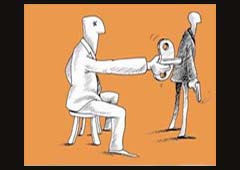
Long term membership in such a cult paralyzes logic and common sense of individuals and paves the way for manipulative practices the leaders use to achieve their ambitions. When the member’s individuality is denied, his thought and emotions will be consequently ruined, the only remaining idea is what the leaders want. So, member becomes an automatic machine which works under the leader’s order. Thus they are always prepared to be sent for suicide operations.
By Mazda Parsi
A constant, regular monitoring technique within the cult of Mojahedin to have the mind and behavioral changes of the insiders under control is weekly confessions sessions (Jari sessions), better to call inquisition, through which members have to confess before others of their thoughts and intentions and are in fact forced to pledge allegiance to the leadership. Following critical situations and sensitive cases, it is before the leader himself rather than other subordinates that certain members have to prove their allegiance. Although people living in free, democratic world may laugh at such seemingly droll things in the modern world it is strictly practiced in most of cult particularly in the cult of Mojahedin.
Soon after the freedom of 36 MKO on the part of the Iraqi government and their settlement in camp Ashraf, the so-called Jari sessions were held for them via a telephone conference under the responsibility of Masoud Rajavi, a program aired by Mojahedin TV. There are some significant points to be noted in this regard. The behavior of the organization regarding these members was against humanity to force them take part in long sessions and interrogations despite their adverse physical conditions and the fact that some were under interrogation while lying in bed receiving medical treatment.
The fact is that bearing the conditions of these sessions is impossible even for the healthy members let alone those being one step far from death; as Maryam Rajavi said they would have died in 12 hours if they had not been released. Her claim may imply that the basic and fundamental pillars of the ideological-political survival of the organization are their organizational bastion, camp Ashraf, as well as inquisition sessions in particular to the point that they are not to be stopped under any conditions. Even those under treatment have to explain where they were, what they did, and how sincere they had been to operating Jari sessions by firm proof and evidence in the first hours of their arrival to the organization.
According to the statements made by Mrs. Soltani on suicide attacks, even two-manned teams entering Iran for accomplishing terrorist activities had to hold regular Jari sessions. In confirming her statements, it has to be pointed out that these 36 members insisted that they would hold Jari sessions among themseles under any conditions all through the course of their detention.
In no better way could the organization warn the adversaries. The airing of these inquisition sessions by Mojahedin’s TV may be considered a threat and warning particularly against the Iraqi government and officials. The organization is vigilant to observe the reaction of Iraqi officials to these programs to organize its future actions and policies. Iraqi officials are to pursue these sessions watchfully and analyze them carefully to find out the true cultic identity of Mojahedin.
Beside the paradoxical statements of these 36 individuals regarding the conditions of their imprisonment and the behavior of Iraqi government, what is apparent is the full influence of organization on these individuals. The only solution for queering this influence is separation of high rankings from the rank and files without which neither can the freedom of captive members be materialized nor can Mojahedin be expelled from Iraqi soil.
The shared point of the statements of all these 36 persons is pleasing the person in charge of Jari sessions, Masoud Rajavi. These statements focus on some points like confessing to their full dependence upon Masoud to whom they feel indebted under any conditions. The other point is their insistence on proving their loyalty to the leader and organization that guarantees their survival.
Externalizing these relations in one of the most critical periods of the organization when it is trying to attract the attention of the West has paradoxical dimensions. Although those familiar with the nature of the organization have fathomed its cultic and terrorist threat, there are still those who need to observe these aired footages and think of a way for minimizing or eliminating the threat of the organization as an unknown cult. The internal structure of the organization may imply its policy in dealing with the outside world too. It has out-and-out focus on submission and obedience toward one person as the leader at any price. The fact that all these 36 members and the audience state clearly that they are ready to die, kill, and bear hunger and thirst since their leader carries the main burden of the adverse conditions and pains may have many lessons for the outside world.
The publication of Rajavi’s own presence in the management of these sessions is of very significance and may raise some speculations. It may mean the termination of his organizational-cultic hide-out to stop the disintegration of the organization, a warning for the outsiders, or his presence in camp Ashraf and justifying the attempts of MKO members in defending Camp Ashraf and resisting to leave it. If it is so, a great part of the incidents happening inside and outside camp Ashraf may be attributed to his presence in camp Ashraf. According to RAND report, the Americans have evaded to inspect many Mojahedin facilities and it is very likely that Masoud Rajavi is settled somewhere inside Camp Ashraf.
The process of manipulation in cults is a never ending and non-stop methodology which guarantees existence of the cult and maintenance of members in the isolated atmosphere of the cult. 
The 36 Ashraf residents, who had been detained by Iraqi Police after the raid on the camp, attended their cleansing meeting under the supervision of Massoud Rajavi, following their release from Iraqi prison. The video of the meeting was aired on MKO’s TV channel and published on their website a few days ago but only for a short time. The video showed some of the released members attending the meeting on their hospital bed. They attended the meeting just a few hours after their release. This shows how vital indoctrination meetings are for cult leaders. The immediately held cleansing meeting where some of the participants weren’t feeling well due to the hunger strike they had gone in the prison, according to their indoctrinations.
The participants confessed that they held their self – criticism meetings even in Iraqi prison! They told to their God-like leader, Massoud Rajavi, that they held the meetings even in groups of two under any circumstances. As MKO’s TV channel showed, Current Operation (cult jargon) is so influential that the 36 released members noted that their only objective is satisfying their leader, Massoud Rajavi.
During the meeting Massoud Rajavi spoke to the audience via telephone. The presence of Rajavi himself in the meeting indicated the importance of meeting to the organization that held the cleansing meeting under the supervision of the highest authority of the group.
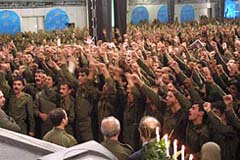
The video showed the audience including the 36 released members clearly declared that they are always ready for absolute obedience to leaders’ orders. This film represents one of the few times that MKO’s internal relation is revealed to outside world and maybe that’s why they kept it on their website only for more a few days and then they removed it. The true nature of Rajavi’s cult was announced on its website in the best way.
Today MKO’s propaganda champagne launches too much effort to gain the West’s support but the film of the cult’s manipulation session sill bring about contradictions around the group which has always claimed to be democratic, to seek freedom and liberation of thought and speech for people. The show asserts the undemocratic cult-like nature of the group that will definitely make the West feel the threat of such a destructive cult.
The West is absolutely concerned about the threat of cults such as Al Qaida or MKO because the danger caused by such cults today is risking the lives of a lot of people in the world including Iraq or Afghanistan.
The devoted members of the cult always promise that they are prepared to commit suicide operation for the cause the leader says.
As the participants of Rajavi’s cleansing session said, they welcome pain, hunger and death just for their leader who, according to them, is the only one who suffers the most. The confessions of Ashraf residents would be a great lesson for the West since the potential danger of such a cult will not be limited to the cult itself but to the world community as what happened in June 2003 after the arrest of Maryam Rajavi by French Police.
By Mazda Parsi
An interview with Batool Soltani on MKO self-immolations – Part 37
Sahar Family Foundation: One of the interesting points you referred to was the organization’s insistence on regular confession sessions of cleansing even in the course of the missions. I am interested to know how they justified it when on a mission.
Batool Soltani: Any operation team was composed of two or three depending on the nature of the operations. One was in charge and he was the one to arrange and run the cleansing sessions. Even in his/her absence, other members had to sit by themselves to conduct it. They insisted on its performance since it was much necessary when members were out on mission in a free world among people and just a few steps away from the adversaries.
In the camp there were no enemy and consequently no fear. But out of the camp there always existed a potential threat that could lead to an influential demoralization. When among the society that the members were long away from, the felt nostalgia could obsess them with the thought of craving to be with their family and starting a warm, pleasant life just like other people. The temptation could easily erode their confidence in the organization to encounter it. That is where they needed to be cleansed of such temptations that could diminish their fighting morale. I think we have already talked enough about the issue.
SFF: Did Massoud have any contact with the teams while in isolation?
BS: before their departure, they would once meet with him which worked as a factor of encouragement. He would talk to them on the phone or received them individually in the presence of Maryam where they gave their pledge of loyalty to the red-line and the organizational principles and that the enemy would never succeed to have access to anything out of them. The emphasis was on Ahmad Rezai as the archetype they had to follow. Then he would say, ‘now move to show what you will give to the enemy and what you’ll take’. These meeting were really instrumental and some looked at it as their unforgettable memories and a matter of honor.
The impact of the meeting was enough to encourage and motivate them to the end and to risk their life for the accomplishment of the mission and the will of leader. The head-team of Lajevardi’s assassination, for instance, had a meeting with Maryam where he, Ali-Akbar Akbari, promised her to shot him just between his eyes. It was Massoud’s skill to instigate and provoke members and there were times when they would kneel before him crying and begging to be sent for the operations. He knew how to prepare them psychologically and if you could listen to his speech delivered before the operation Eternal Light, you would feel his charismatic influence in provoking three-four thousand forces, as he could well justify the failure of the operation.
SFF: Was the age of members of any importance in selecting them for the operations?
BS: Not very much. The average age of the members was 40 or younger. However, it was physical readiness rather than the age that could be counted. A physical test well indicated the degree of members’ readiness.
SFF: In this phase of operation we encounter the arrest of Marjan Malek and the organization’s contradictory reactions. Do you have anything more to add?
BS: At first, the organization thought she had been killed. So it began praising and glorifying her daring deed in its official gazette, Mojahed. Then it was surfaced that she was alive and arrested and it was brought into the Leadership Council to start advertising her collaboration with the regime’s information system. It was immediately put into action and her pictures were removed from the gazette. To justify her published disclosures about the organization, the organization tried to convince the lower cadres that she had failed to stand and resist the regime’s pressures and so had surrendered. Interestingly, the organization never mentioned her team-mate, Akbari, and evaded questions concerning him.
SFF: How successful was the organization in its ‘operations of ultimate’?
BS: They proclaimed them successful because of their wrong evaluation of Iran’s internal climate. They were under illusion of having people’s support which led them reckon on a 90 percent success. It was what they said to the teams to ensure them that they would certainly return to the camp. Actually, less than ten percent would return.
SFF: Why it was so?
BS: It was clear from the very beginning that they wouldn’t because there are reasons to justify. Imagine, how is it possible for a team going to a crowded bazaar to retreat while it is surrounded by crowds of people and police forces? Actually, the organization never reckoned on their return but on their demise; martyrs that benefited the organization for propaganda.
SFF: How they evaluated Iran’s social and security atmosphere?
BS: Their appraisal of Iran’s security and police apparatus was not realistic. Unlike the organization’s cautious considerations about the past regime’s security and police apparatus advertised to be highly cunning and sophisticated, it underestimated the capacity and potentialities of the present regime. While the organization was well aware of the fact that no sophisticated apparatus was needed to hunt one or two penetrated teams and that a simple but exact inspection and scrutiny by the police could lead to betray the teams. It was just what happened to Malek and her team-mate. Furthermore, the organization insisted on the social backing and inspirited the teams that they could reckon on people’s widespread protective umbrella to hit and escape; it was what it would say to lower ranks and operation teams but it was clear for higher layers and the Leadership Council that the teams would never return.
SFF: How they broached the issue of human shield in Auvers-sur-Oise?
BS: In Auvers, they have to abide by the rules of the host country but they run underground establishment. Their surface political struggle necessitates it to be organized and it acts according to legal regulations unless the red-lines are broken, that is to say, the sanctuary of the leadership is violated. The consequence will be something like the 17 June immolations. However, as I was not in Auvers lately, I cannot tell what approaches they are focusing on at the present. But, be sure that such activities never cease within Ashraf; the pass of time will show how they will put them into action in European countries.
Foreword
The families in Iraq announced on Friday 6th that they had finally been able to meet with their relatives, but were far from satisfied with the circumstances. They said that when the MKO
leaders discovered that they were coming to the camp accompanied by several Iraqi and American reporters, they accepted to negotiate. The MKO agreed that the families could meet with their relatives for a few hours on condition that they do not talk to the media. The families accepted and held meetings.
However the families also said that their loved ones told them not to pursue the issue any further and said they must cut all further contact with them otherwise they will come under severe pressure from the cult leaders.
The families have now decided to pursue the issue of the camp with the Human Rights Ministry of Iraq in private.
* * *
Fear and Slavery in the Mojahedin-e Khalq cult
For those still interested enough to follow the dwindling fortunes of the foreign terrorist cult, Mojahedin-e Khalq, isn’t there something faintly ludicrous in the group’s desperate denunciation of anyone and everyone who does not fall on their side of a red line, drawn excruciatingly tightly around the organisation and its backers, as “agents of the Iranian Intelligence Ministry”? Is it really a case of ‘us few against the rest of the world’?
An examination of the current crisis the MKO is facing reveals that it is not involved in a pitched battle to overthrow the Iranian regime – or has that aim been abandoned without them telling anyone – but the arrival at the doors of its camp in Iraq of eight elderly Iranian folk seeking contact with close relatives – sons, daughters, husbands –inside the camp, who they have not seen for many, many years and with whom they wish to meet. All eight have been denounced by the MKO leaders as “agents of the Iranian secret services” who have been deliberately sent to dismantle the camp and take its residents back to Iran.
Really?
These eight – and the other small groups and individuals who have arrived at the camp over the past six years – are terrifying agents capable of destroying Rajavi’s dedicated, self-sacrificing, totally committed force of Mojaheds? Surprising then that they have not come armed with dynamite and bulldozers, but instead come with kindness, warmth and words filled with both love and sorrow. They come with news and messages from family and friends, about births, deaths, marriages and all the little minutiae of ordinary life.
How interesting. How revealing. What a sad admission of the fragility and nihilism of the Rajavi cult that they are truly terrified by this.
Are we to believe that Iran’s “main opposition” – to quote its own self-publicity – which purports to be able to overthrow the Iranian regime in its entirety and establish a democracy in its place, is full of individuals terrified that their Mum or Dad will come along and pull their ear and make them go home? (And we must not forget that these are individuals with an average age of around 50 years.) Is it really that easy to turn a dedicated individual away from their struggle?
Isn’t the only rational interpretation of the MKO’s current hysteria that Massoud and Maryam Rajavi can only keep hold of their followers through deception and coercion and that the visit of these families will threaten to undermine that.
The fundamental, unavoidable fact behind all this is that the MKO is a dangerous, destructive mind control cult which holds its members in a state of modern slavery.
And the significance of this is far greater than the story of these eight families and involves the geopolitical future of Iraq and the region.
In brief, the MKO is described as a dangerous cult because it believes in using violence to achieve its stated aims. It is destructive because it destroys the lives, minds and spirits of its membership. The majority of the members are held incommunicado, with no access at all to the outside world. Within this isolation they are subjected to a systematic daily regime of psychological manipulation and coercion.
One of the most potent tools used by cult leaders to control their members is through the inculcation of irrational fears, or phobias, in the minds of cult members. Every cult has its own version of phobia. But all will be focused on creating an irrational fear in a cult member of critics and opponents of the cult, especially former members and family members; who of course are best placed to understand the cult mindset and be able to penetrate it. The member will become fearful anytime the phobia is activated. In the case of the MKO, the ‘code’ which activates the phobia is the tag ‘agent of the Iranian Intelligence Ministry’. No empirical evidence is required as the phrase works exactly to arouse irrational, not real, fear.
Members of the MKO live in a state of almost perpetual fear. It is through fear that the MKO not only enthrals its members but deceives uninformed politicians and media persons. The use of the word terror in this article is not for the sake of exaggeration. It describes the employment of irrational fears to ‘terrorise’ the subject. Western parliaments, media and humanitarian agencies are being ‘terrorised’ by a sophisticated campaign of psychological manipulation in which MKO lobbyists arouse a subtle level of irrational fear of spurious, deceptive spectres (usually these will be tagged ‘agents of the Iranian Ministry of Intelligence’) facing the “main Iranian opposition movement”, the MKO.
Ironically this unarmed ‘terrorist’ campaign is waged by the MKO to avoid exposure and activation of the real existential threat hanging over the group. This threat does not come from outside agencies, but arises directly from the cult nature of the organisation itself; hence the MKO leaders’ hysteria over eight family members knocking at the camp gate asking to see their relatives.
But, those still interested enough to keep on following the dwindling fortunes of the foreign terrorist cult Mojahedin-e Khalq, will already know that this is not the whole story. Not even the real story. And those who may squirm at seeing see the emperor’s nakedness should look away now.
For six years the American Army provided protection for the MKO in Iraq, a group which both the U.S. and Iraq designate as a foreign terrorist entity. The RAND National Defense Research Institute report ‘The Mujahedin-e Khalq in Iraq – A Policy Conundrum’ published in August 2009 describes the U.S.’ failure to deal decisively with the group; to dismantle it as should have happened, as successive Iraqi governments since December 2003 required should happen.
According to the report, “Approximately 14 U.S. soldiers were killed and 60 wounded as they provided security for convoys escorting MeK [MKO] members to Baghdad to purchase supplies.
Thus, it was often unclear just who was in charge of Camp Ashraf”. According to the report, the order to protect this useful little mercenary terrorist cult came from the very top, from former Defense Secretary Donald Rumsfeld.
Why?
Just as the MKO leaders denied families access to their relatives inside the camp, the firmly closed doors of the camp against this existential threat proved an extremely convenient location to reassemble members of the former Saddam Hussein’s regime. Over six years the MKO has played host to supporters and officials of the former Iraqi dictator’s regime. Insurgent violence in the Diyala province has been coordinated from the MKO camp under U.S. protection.
So, when eight family members arrive at the gates of the MKO camp, it is not only the MKO leaders who fear the existential threat to the cult, but the group’s western backers. For over two decades, the Mojahedin-e Khalq has been promoted by western interests as Saddam Hussein’s private army. Since 2003, the group’s Zionist and neoconservative backers, fronted by Lord Corbett in the U.K., Straun Stevenson and Alejo Vidal-Quadras in the European Parliament, Ileana Ros-Lehtinen in the U.S. Congress, and U.S. lobbyist Raymond Tanter, have not been supporting the MKO for humanitarian reasons (otherwise they would surely support these family visits). They are protecting and promoting the group as a proxy for reintroducing Saddamists into Iraqi politics.
Those terrorised into believing they support the MKO for humanitarian reasons to protect them from destruction by the Government of Iran need to summon a little energy and a little courage to look beyond this false, superficial reasoning and really examine the facts. In doing so they will be faced with a stark choice: support the MKO as a proxy for the re-emergence of pro-western Saddamists in Iraq, or support the elected Government of Iraq as an independent, sovereign government.
That is clearly a political choice. But in the meantime, remember, the real victims of the MKO’s terrorism are the cult’s own members who are enslaved by fear.
– Gholam Reza Sadeghi felt certain of his fate if he ever returned to Iran: torture and execution, given his years as a member of the antiregime Mujahideen-e Khalq, or "People’s Holy Warriors."
But stuck in a crowded camp in Iraq with 3,400 other members of the MKO under US military guard, Mr. Sadeghi finally had had enough. He wanted out, and to see his son. So he came back to the Islamic Republic, which imprisoned him for five years in the 1980s for participating in a group labeled "terrorist" by both Washington and Tehran. Yet some American officials view the MKO – disarmed but still intact – as a possible tool of regime change against Iran. And the MKO’s continued presence in Iraq aggravates US-Iran tensions.
What Sadeghi found was a soft-touch amnesty that he had never been told of in the MKO camp. His case could resonate with the 100 or so other Iranian militants who have been allowed to leave the camp in recent weeks, afraid to return to Iran and running into trouble in Kurdish northern Iraq and upon entering Turkey. "Because I had been in prison, I expected to go back to prison, torture, and execution," says Sadeghi, who was detained for a week and then let go. "They said [the MKO] is not a threat. [They said,] ‘We know you were a victim yourself, who thought you were doing something good for your country but were deceived by a cult.’ " The MKO (or MEK) in 2002 tipped off the world to Iran’s secret uranium-enrichment program – with the help of Israel, many analysts have concluded. It now says the recent findings of a US National Intelligence Estimate were wrong and that Iran restarted a nuclear- weapons program in 2004. UN inspectors, however, say that much of the information the UN has received from the group in recent years has a political purpose and has been wrong.
No nation has taken the militants who left Camp Ashraf, north of Baghdad, some of them carrying US military letters for travel to Turkey. Documents of the UN High Commissioner for Refugees show that at one point in their saga nearly two weeks ago, 19 were turned back to Iraq by Turkey, dozens were picked up in Kurdish northern Iraq and some forced to return to the dangers of central Iraq, and 26 were missing.
The situation highlights the sensitivity of Camp Ashraf, which has been virtually off-limits to journalists since the fall of Saddam Hussein. According to some of the 340 former MKO members who have returned to Iran with the International Committee of the Red Cross (ICRC), the MKO controls all aspects of life in the camp. Numbers have dropped: Only 12 returned to Iran in all of 2007, and three more in mid-January.
"We don’t have the impression that these people are harassed or bothered, … mainly because the families and the [Iranian] authorities want them to come back," says Andreas Schweizer, until recently the ICRC protection officer in Tehran.
"We haven’t heard of any problems so far."
Indeed, in 2005, when the Monitor followed up privately on the story of one returnee, his mother complained about the lack official reintegration help. There had been no government interference either, she said. The MKO’s checkered and violent history has kept it on the US and European terrorist list. The MKO killed several American military advisers and civilians in Iran in the 1970s, played a key role in Iran’s 1979 Islamic Revolution, and supported the US Embassy seizure before breaking away and launching attacks that have killed scores of senior Iranian officials.
"They are so discredited in Iran that I can’t imagine they have any social basis," says Ervand Abrahamian, an Iran historian at the City University of New York and author of "The Iranian Mojahedin," a study of the MKO. "I think you would find the current President [Mahmoud] Ahmadinejad more democratic than the Mujahideen," says Mr. Abrahamian. "Even in the early 1970s, it had turned into a cult organization…. The remaining members … will do whatever [MKO leader Massoud] Rajavi tells them." The State Department’s terrorism report last year said the MKO maintains "the capacity and will to commit terrorist acts in Europe, the Middle East, the United States, Canada and beyond." The report notes the MKO’s "cult-like characteristics," such that "new members are indoctrinated in MEK ideology and revisionist Iranian history [and] required to … participate in weekly ‘ideological cleansings.’ " Children are separated from their parents, it adds, and Mrs. Rajavi "has established a ‘cult of personality.’.
The US rejected a secret 2003 Iranian offer to exchange top MKO leaders for several Al Qaeda personalities now held in Iran. "The Islamic Republic’s policy toward the MKO is very clear – there is nothing hidden," says a foreign ministry official who asked not to be named. "In our opinion they are a terrorist cult. When it comes to cults, only the leaders are responsible, and the rest are all victims themselves." The MKO and some in Congress and the Pentagon have challenged the terrorist label. Senior Iranian officers have accused US forces in Iraq of using the MKO during interrogations of Iranians detained in Iraq. Western news reports also suggest that some MKO operatives may be conducting cross-border operations into Iran on behalf the US. Indeed, such action seemed to be on offer to Sadeghi when US federal agents first questioned him in Camp Ashraf in 2003. After release from prison in Iran in the 1980s, he had fled to Canada in the 1980s, where the MKO found him and gave him a letter from leader Rajavi.
"The letter said: ‘You were one of us, and suffered in prison," recounts Sadeghi. "Now you are in Toronto living the good life. You forgot your brothers and sisters, you forgot freedom and democracy.’"
Sadeghi left his Canadian wife, broke custody rules by letting the MKO ship his son to his parents in Iran, and was moved by the MKO to Los Angeles. His visit to Iraq was meant to be short-term, but the MKO took his US passport and said they destroyed it, he says. After US forces disarmed the group in 2003, the FBI met with each member. Sadeghi says he was told that the US planned to topple Iran’s regime, that they wanted his help, and that they would ensure his return to the US. Sticking with the MKO would mean "never seeing the US again." "I didn’t believe [the FBI agent] was going to send me back to the US, or I would have jumped on it," says Sadeghi. Tired of daily MKO self-criticism sessions, he finally told the Americans he wanted to go to Iran. He had not seen his parents for 22 years; his son was 16 and full of resentment. "He asked me: ‘Where were you? For 10 years, no call, no postcard,’ " says Sadeghi, adding that his life was broken by the MKO. "For that, he hates me." ——————–
* Familiar Faces: Staff writer Scott Peterson has written several stories about Iran’s largest opposition group in exile, the Mujahideen-e Khalq (the MKO or MEK). But this time when he checked up on those who had been trickling back to Iran from Iraq , he found a surprise at the offices of the Nejat or Rescue group that helps former MKO members reintegrate into civilian life in Iran. Nejat is run by former MKO militants. Among them, Scott recognized Arash Sametipour, an English-speaker who had conducted a failed assassination attempt and then blown off his right hand while trying to kill himself to avoid capture. "The last time I saw him, he was wearing a prison uniform in a Tehran jail," says Scott, who had interviewed Mr. Sametipour along with several other MKO prisoners. "Today he is the main liaison between Nejat and the Red Cross. He is now trying to find a home for those 100 or so MKO members who recently left Camp Ashraf in Iraq." – David Clark Scott, World editor
Behind the bars of a mind control cult, like Rajavi’s destructive cult, the leaders never want the internal affairs of the cult to be revealed. They are well aware that if their manipulative practices are externalized, the cult existence will be endangered since the human rights bodies and the international community never ignores such abusive acts. That’s why Rajavi is terrified by the testimonies of former members who externalize the internal affairs of the cult and always tries to label them as the agents of Islamic Republic’s intelligence ministry. 
On the other hand, the isolated members of the cult who are brainwashed through complex manipulation sessions and other cult jargons are not able to have any access to outside world. They are never informed of the true events taking place outside Camp Ashraf. All news and incidents are filtered and censured by cult leaders and then published for cult’s captured members. In fact, the Rajavis are also terrified by the truths that might be internalized by external elements.
As it was published in the media, the 36 Ashraf residents who were arrested by Iraqi police after the raid on Camp Ashraf in July 28th,were released on Wednesday October 7th , the detainees who were on hunger strike (that was ordered by cult leaders) while they were in Iraqi prison were taken to hospital due to their crucial health problem according to MKO’s spokesperson and now they are in a kind of medical quarantine ! After about 5 days since their release there have been no special news or interviews on MKO’s websites although its propaganda system has always been ready to hunt an opportunity for a big show-off. Even the cult’s TV channel, Simaye Azadi, which is its non-stop working propaganda machine has not published further news or interviews with liberated members.
As usual the cult should have taken the most use of the so-called atrocities against its detained members but in fact it prefers to keep silent.
One might suppose that these 36 individuals, who were far from the cult’s indoctrinations for more than 70 days, could find an occasion to be alone by themselves. They could face their individuality without the controlling regulations of the cult which had dominated all aspects of their life and their soul.
They might have had enough time to contemplate or meet other people with different ideas. They might have found new facts about the outside world which may oppose to what the cult had made them believe. In such a condition, the old terrifying case might have happened: the external facts have been internalized in the members’ minds.
Therefore, the leaders have to keep them in a mental quarantine too because their mind should be reorganized according to cult’ indoctrinations. But how late could the cult leaders stop the truth coming to the camp? This is an unavoidable fact.
By Mazda Parsi