
Comrades in Arms, Cases of sexual abuse by MEK Leader Massoud Rajavi in Camp Ashraf

Synopsis:
People’s Mujahedin of Iran or the MEK is a terror entity responsible for thousands of civilian death in post revolution Iran. See how this group has been more of a dark CULT fraught with corruption and harassment.
“Comrades in Arms” unfolds the story of those women who fell for deceptive slogans of the MEK. Looking for a brighter future these women ended up in Camp Ashraf, where a fate worse than death awaited them. Masoud Rajavi, the leader of the organization had come up with a new idea about marital life; it was detrimental to the future of the organization. For him, marital love was a shackle that could impede the progress of his plan.
Therefore, Rajavi called for a compulsory divorce according to which all MEK members had to get divorce. But that was not the end of the story. While he forbade his men from having sexual relations with their wives, he decided to take their place. As a result, he turned Camp Ashraf into a big harem where he could have his female comrades in arms night and day. Risking their lives, however, some of the sexual victims managed to escape from the camp to show the true colors of Rajavi, once their spiritual leader and now the most lecherous man in the world they know.
To download the video file click here
Transcript:
Batoul Soltani:
I’m Batoul Soltani, a resident of Germany. I was born in Isfahan. I’ve been living in Germany for more than four years. Before that, I was in the MEK for 20 years and before that I was in Iran for 20 years.
We were pursuing more ambitious goals and looking for a better tomorrow thinking that they – according to their slogans – would bring people more democracy or a brighter future. Looking for such ideals, we fell for their slogans and joined their organization. We had passed the point of no return.
What I saw in this organization was that women were merely tools in every level I witnessed. After all, 20 years is not a short period of time. And what we witnessed from the beginning – though my marriage conformed to social norms and was not an organizational marriage – I encountered women who were devoid of emotional involvement with their husbands but the organization had made them marry. For the first time, I saw compulsory marriages in the organization. It’s very difficult to love someone by force. I think that it’s very difficult for a woman to do so.
Zahra Goini :
I’m Zahra Goini. I was born in Tehran in 1968. In November 1986 I got married. On March, 25, 1987 I left Tehran for my honeymoon till now that I’m abroad.
It was the New Year, 1987. He said that we were going on our honeymoon. I told my family, “Look! He says that he has decided to go.” He said, “No, Zahra is lying. I don’t want to go. We are going on our honeymoon. Look! This is my ticket to the south and then we’ll make a pilgrimage to Mashhad, God willing.” As we arrived in Shiraz he told me that we might not return. We arrived in Pakistan, I think a few weeks later. It was a long journey. It took us a while to get there. We were taken to the MEK’s base. All of a sudden, an official there came and said – when my husband talked to him – my husband said, “You can return to Iran.” I was stunned, “Seriously, shall I return to Iran? Why have I come here? You’re my husband. I’ve come with you. Where shall I go alone? What shall I say? No, I’ll stay; even if you go to hell I will be with you.” Meanwhile, the organization had taken all of our money and gold. Anyway, we gave the money and two days later they told us that we would go to Iraq, albeit with new passports.
Batoul Soltani:
When we arrived in Iraq we were taken to the smartest hotels the organization was using as its bases and there was not the least sign of war there. We didn’t feel the war because Saddam had given the best hotels to the organization and the organization was using one of them as a school, one as a place for taking care of children, and one as a residential place for couples to see each other. At that time, organizational marriages were on the rise for four to five years. Of course the organization would not allow raw or junior recruits but those who were at least commanders of divisions to marry women. Everything was obligatory there: organizational obligations, organizational do’s and don’ts, organizational rules, and relations that would become tense and tenser every minute.
Nasrin Ebrahimi :
I’m Nasrin Ebrahimi. I’m 31 years old. I live in Switzerland. I’ve been living here for about eight years. Before that, I lost ten years that could have been the best years of my life in Iraq, in the Mojahedin-e-Khalq, an organization which was very easy to enter and very difficult to exit from.
As for Camp Ashraf, it’s very painful to talk about it. It’s like to be in the Guantanamo Bay detention camp for years and experience the sufferings and then talk about it.
Well, at that time he completely separated men and women from each other. We women moved to another center. We would never see a man, unless in our only street called 100 Street where we would see a man in the distance or in meetings held by Masoud Rajavi or Maryam Rajavi but we were not allowed to see them. They would sit on one side and we on the other side. If we looked at them we had to explain why. That’s why when walking we had to hold our head up or down. Our eyes shouldn’t meet a comrade’s eyes.
Zahra:
Suddenly, they said that Iran’s government had accepted UNSC resolution 598. Soon after, we had to prepare ourselves. Many forces joined us from abroad. What for? We wanted to go to Tehran. “Yesterday Mehran, today Tehran” became their slogan.
Not only weren’t the women prepared but also the men were not as well. They pushed all in Operation Eternal Light by force.
In Operation Eternal Light I was hit in the arm by shrapnel and since it was wrapped up badly – they said that you would see the doctor in ten minutes and he would unwrap it – my arm went blue because it wasn’t treated on time. After the operation, the doctor came up to me and said, “Look! They had sent a letter about you saying that this arm had to be cut off and we had to have your signature. I feel sorry for you who are a young woman to have your arm cut. It’s no problem if you were a man. But you are a young woman. I don’t know why they think so. You’ll have children in the future and have to carry your children in your arms. With one arm, it’s difficult for you. I didn’t cut your arm. I did the operation on my own initiative. You have only a three-day chance of recovery.”
It used to be much bigger. In an operation in Frankfurt they made it small. They performed a skin transplant as big as this and here they had sewn this way to here. My arm was always like this.
They threw us into Operation Eternal Light by force. They forced us to get divorced. Masoud used to say, “You who got stuck behind Charzevar Canyon, you woman or you man what were you thinking about? When you got stuck in the canyon you were thinking about the opposite sex. You as a woman were thinking about your husband and you as a man were thinking about your wife. That’s why you couldn’t advance towards Tehran. Now you must divorce all including your children.”
Masoud Rajavi:
I’m well aware. You brothers, what were you thinking about? Huh? Everyone must know well. And you sisters? We asked around hundreds – am I right, Maryam? – those who were in Operation Eternal Light in person and listened to them. Let’s remove all the obstacles in the way. This is a lesson of union and unity.
Batoul:
It was a very difficult process for me as it was a mental torture for me. I was with a group of people who kept talking about divorce and hate children and mutual life. It was not accepted for them to have children. It was a sin for the people I was with to sleep with their spouses. Divorces had begun from the upper echelons of the organization. The officials were divorcing their wives according to the plan formulated by Masoud Rajavi. The first one was Maryam Rajavi who had divorced Mehdi Abrishamchi and married Masoud Rajavi. They were expanding the scope of the plan into other women and men started from the leadership to other members.
Mehdi Abrishamchi:
In the name of God; in the name of Masoud and Maryam.
As an MEK member, as a little child of the MEK I have nothing to say except to congratulate Masoud and Maryam with all my heart and soul and that I’m brimming with ideological joys.
Batoul:
Suddenly, I saw my commander come up to me and said, “Well, this sister has charge of you.” I asked, “Sister, won’t my husband come here to see his baby?” She answered, “No, your husband has got divorced and he won’t come here. Don’t ask about him anymore.” Close to tear, I asked, “Divorce?! So what about me? So what about this baby? Why …?” She interrupted me, “No why, in the army you cannot ask why.”
Nasrin:
Is it possible not to think about love?! There used to be sessions in which we talked about love, affection, husband, wife, the past, which were called “era and weekly ablution”. When people talked you could realized that they thought about those issues. Personally speaking, I had a hair clip my boyfriend had given me in Iran. I had kept the hair clip and I held it dear. One may say that a hair clip is no big deal. But for me it was so valuable that even when I was to flee Ashraf Camp the first thing I took with me was the hair clip he had given to me. And when I got Tifu, he was the first person I called.
Masoud Rajavi:
This Maryam I’m writing equals the first in charge, which equals a full payment criterion, which in turn means 100 on 100. We chose her as a role model for you, which equals the connecting ring between you and what I want.
Batoul:
At this point, Maryam Rajavi would tell us, “You women, after divorcing your husbands, you should marry Masoud.” And we always considered her words as an ideological thesis. I could never imagine that her words would be put into practice some day and I would have to sleep with Masoud. I really thought that it was merely an ideological discourse. As for Maryam Rajavi herself, I couldn’t imagine that Masoud had sexual relationship with her. I couldn’t imagine it.
Maryam Rajavi:
Let me draw it in this diagram. Look, this is a diagram for every individual with gender on top and individuality immediately below it. I’ll explain it. Immediately individuality. This diagram has a dividing line with gender on one side and individuality on the other side. Here is the highest point of individuality. Below it there are all personal problems lined up.
Nasrin:
Maryam Rajavi used to hold many meetings for us, very long meetings. She would hold many meetings especially for women. She said, “We women all have only one husband who is Masoud Rajavi.” She even said, “You have the most handsome and the best man in the world. So what’s wrong with you?”
Maryam Rajavi:
… Here, the highest value is melting into the leadership, which means a perfect union whose fruit is getting rid of all personal shackles.
Nasrin:
She said, “Since women have mostly emotional problems you consider him as your husband.” But her words cut no ice with me. Not at all. For me it was just a talk. That’s all.
Batoul:
One day a ceremony was held – it was the wedding ceremony – in which Masoud Rajavi performed the marriage ceremony and the women stood up one by one saying, “Yes.” Before the ceremony, they had insisted that everybody should be clean and tidy and take a bath etc. Their insistence on being clean aroused my suspicions that what all that insistence was for; that why we had to have a clean, hairless body. “Are we supposed to strip naked in front of someone,” I ask myself. She even told us to perform our ablutions and be clean and tidy and wear our best, new clothes and clean socks. Before the ceremony once more they told us, “Anybody who is not clean enough or haven’t taken a bath or need to wash herself go and make herself clean.”
We were in Badizadegn Camp when informed of a pool meeting exclusively for the leadership council. At that time, I was a member of the leadership council. We attended the meeting and listen to music playing there. All of a sudden, Masoud and Maryam entered the hall. Masoud was in leisure clothes; he was wearing a T-shirt and Maryam had a soft, pink, silk dress on with her hair brushed. They entered the hall. Maryam stood behind Masoud. She didn’t sit down beside him. Masoud took a look at us and said, “Maryam, why have you brought them here again?” and that moment I realized that it was not something new. Maryam answered, “They’ve come here to unite you. They are your wives. They’ve tied the knot with you and want to be united with you. And these empty seats are for them.” I asked, “Sister Maryam, why don’t you take a seat there?” She said, “This is for each and every Masoud’s wife.” I wondered what was going on. When she said so I found some women with their headscarves fallen on the ground or some with no headscarves at all. I wondered why they had taken off their headscarves in front of brother Masoud. I told one of them about her headscarf. She said, “No problem! Who’s my nearest man than Masoud? “I love him so much. There’s no one nearer to me than Masoud.” I can remember all these scenes clearly.
Zahra:
One of the women stood at the podium saying, “Ladies, feel at home. Take your headscarves off. You dance for the leader.” I said, “We dance for the leader?! I used to be reproach for letting my hair out of the headscarf. Now you tell me to take my headscarf off and put on those clothes?!” That very woman, Batouleh Rajaee told me, “Haven’t you got divorced? You gave your hand to Masoud via Maryam. Now put Maryam aside and give your hand directly to Masoud. Now you must do your best dance for him.”
Nasrin:
They would give us freedom on purpose and encourage us to dance with music when played. The commanders would say, “Be at home! He’s your brother. Don’t you call him brother? Show your love and affection towards him.” They even liked us to kiss him. They prompted us to kiss Rajavi.
Zahra:
At first, we danced in uniform. Just two days later, that is the day we were supposed to dance – no one knew – they brought us silk fabrics. Now we had to see how those fabrics would go with our faces. Could the color brighten the complexion? After all, I was one of the candidates for dancing.
Batoul:
I suddenly realized that the senior members of the leadership council began to take their dresses off. When about 25 senior members of the leadership council began to take off their dresses and stripped naked other women who were of my rank followed suit and Maryam Rajavi and others were encouraging, “This is your pool. You should dive into it. Common on! Get undressed in front of the leader.” The meeting went on this way; for about three to four hours they were dancing. Masoud, though at first pretended to be discontent over our presence there, sat comfortably eyeing up us all.
Nasrin:
I can remember that Masoud Rajavi was staring me in the eyes. I didn’t know what I had to do at that moment. I began looking at somewhere else. That’s while we were told to say something to Masoud when he would look at us; something like “I love you” and to make a fuss over him. “The brother doesn’t look everybody in the eye.”
Rajavi would choose those who were pretty. That was overt. One could see that. It was not covert. He wasn’t even-handed with all. He would really handpick certain women, chat with them in front of other women. He would talk to them to go to him.
Batoul:
Masoud would hold the so-called “liberty dance session” with the help of Maryam reasoning that, “When you see Masoud and another woman making love it will cleanse you of jealousy. It will prevent you from being jealous for other women.”
Nasrin:
Rajavi would make us a gift of underclothes and towels. Maryam Rajavi used to stand beside him. We would pass by … At that moment you had to show how much you loved your leader or husband as Marayam Rajavi used to say. He would blow into our faces making some gestures. He would stare somebody in the eye. He did such things. Most of the time, he himself gave us underclothes or things like combs, towels and suchlike. Sometimes, Maryam Rajavi would rub them to her face and then gave them to Masoud and he gave them to us.
To get closer, he would come to our dormitories. We women were located in three separate units. To stimulate us he would say, “I’m going to unit 14 to stay the night there.” And commanders would make us ask him to come to our dormitories and be with us. “Oh brother, come and sleep with us for God’s sake. Don’t go there.” It was a childish thing; the scene was disgusting for a viewer from outside. But since we were involved in it we couldn’t realize its ugliness.
Zahra:
This was his old slogan that women were open to exploitation but we were exploited most in the organization. “You are women?”, “Yes”. “The same as men?”, “Yes”. “Men clean tanks, why don’t you women?” They sexually exploited us. We women were subjected to the worst kinds of exploitation under the name of giving women independence. They claimed that they were after equality for women and whatever they were deprived of through history.
Maryam Rajavi:
Yes, we believe that women and men are equal. We even believe that an exploited woman has more potential than an exploited man to progress and can achieved competence like him, but not haphazardly.
Batoul:
When I went to the place where Masoud’s bedroom was located in … it was a building in Badizadegan Camp the first time I went there. It was in the leadership’s residence. There was a room which was Masoud’s bedroom with a double bed in it and everything was ready for … but Masoud was not there then. I was there waiting from 8 p.m. until midnight when Masoud came. It was the first night we were together until morning. That night I saw another exploitative relations and an act that I could never imagine Masoud Rajavi doing.
It used to be done in Parsian Camp until the fall of Saddam. We would even go for a swim with Masoud and do anything. After the fall of Saddam, Parsian Camp closed down. I couldn’t imagine that such a thing would continue. I was stunned thinking that such a huge number of people were killed in the war … He made me sick. That was one thing. The other thing was that I always thought that he only had such a relationship with me. I never knew that he had the same relationship with many other women. It was after the fall of Saddam that I was informed by some women that he had had the same relationship with other women.
When Maryam Rajavi called me to see Masoud at night it didn’t mean that I was in love with Masoud waiting with bated breath to see him or that I had an overwhelming urge since I had no husband. No, that was not the case. The only reason was that I couldn’t stand up against the organization when I was there. I knew that if I had fought them they would have done away with me. I couldn’t fight with them. I thought, “If I say no to them, what would happen next? Would they leave me alone? No. and this is not a subject to be discussed in the leadership council.” Then it would come to my mind that such and such a member of the leadership council who had disappeared mysteriously might have been killed or whatever. Later on, I had no doubt that they would kill anyone who disagrees with them in the leadership council. So I decided to let him do whatever he wanted waiting for a moment to save my body. There was some Naghmeh Hakami. She wasn’t ill or whatsoever. She died all of a sudden when there was a talk about melting in the ideological leader those years. There was another woman called Seddigheh. She died too. We wondered why she died since she was healthy. Zahrah Fayyaz died. Just like that. Zahra Nouri died. At that moment I thought, “Suppose Batoul Soltani died.” By dying I mean being martyred. They even exploited corpses.
Well, he plays God. I could see Rajavi’s true colors when I looked in astonishment at what he was doing. I wondered why marriage and sexual satisfaction was banned for all men while he exempted himself. The moments I was looking at him he found me bewildered and said, “You eyeballs are sexy.”
Nasrin:
It appears that Masoud Rajavi slept every night with numerous women – at least as far as I know- with numerous, different women. On average, I would go every month or every two months to his bedroom.
It makes me sick when I hear the phrase “pure Mujahedins’ relations” because we saw the reality, because we know how a blatant lie it is. There are no pure relations in the organization. I haven’t seen relations so filthy as in the organization than in everywhere else. Isolated communities always have the filthiest relations. The more isolated, the filthier.
I attempted suicide because I had lost my hope completely. I made many pleas to them to let me leave the organization but they didn’t accept. I left no stone unturned but it was not possible. That’s why I attempted suicide. I liked to die because I couldn’t stand anymore. It was a difficult moment and my whole body was trembling when I was doing it. When I took the knife … I still can hear the sound of the knife when I put it on my wrist. I put the knife on my wrist and cut it and drop the knife. I had tied on an apron. My apron became soaked with blood. Because I was frightened and had lost a lot of blood I felt faint and fell on the ground. I had locked the door … I was terribly disappointed. I had locked the door but I didn’t know that the place I was in had another door from the street’s side and that door was open so a sister – as they used to say – called Shamsi came in and as she saw the scene she began screaming and others came in and took me to hospital by car.
After I survived the attempted suicide I felt as if I had been given another hope and had a new lease of life. I guess that I fled less than 20 days after my suicide. I fled immediately.
Batoul:
To be honest, the thought of escaping struck me the day I saw Masoud doing that in 2000. Before that, I thought that Masoud wouldn’t do that – even if he was under pressure from Maryam Rajavi, as he claimed – but that night, that is the first night I went to Masoud’s bedroom and saw that the organization was not the matter and what mattered was sex and nothing else. I made my final decision to escape there.
It was November 2006. The next month that is in December I feigned a headache and illness and slept in the dormitory and didn’t go to work saying that I felt sick and had a headache etc. and then I could make my escape. I threw caution to the wind saying that either I would be caught, taken and killed or I would escape sound and safe. I couldn’t stand being there anymore.
Right now, he’s paying the hush money to those who have left him. Therefore, it’s so important for him to protect his reputation that he’s prepared to pay the highest price to keep his former people silent. I’ve seen many of them over these recent years and I know.
– By the way, what happened that we accepted what they said? The divorce thing, the separation from our children …
– Operation Eternal Light while untrained …
– Yes.
– I think the main reason was that we were cut off from the outer world. We were not in touch with our families, friends. We were not even allowed to love each other. We had learned to accept what the organization would say without objection. But poor are those who are still there.
– That’s right. I’m thinking about that because when I told Hajar, that is Kobra Tahmasebi that I would like to experience the life outside here she asked me, “Do you know what awaits you?” I answered, “I don’t care what awaits me. I want to go outside to know how much the sexuality you’re talking about is true. I want to check whatever you talk about. I want to see if a woman including myself goes out of here will pursue a simple life or … you say that I’ll be lead astray. You know, when I left there I realized that no, it depends on how one wants to live.
– How are you?
– Are you fine?
– Yes, thanks.
– Have you brought tea?
Zahra:
I’ve got two children; one daughter, one son. I’m happy and I try to have the best for my children and give them the best not because they are my children but because I want them to learn to be honest. I teach my children to draw the line at any oppression; I teach my children to be as they are before they want to be for others. Every life has its ups and downs but I’m content with them all.
Nasrin:
Since I left the MEK I haven’t just been pursuing my personal life. The guys loom large in my mind; those who we know how got stuck there and we know that none of them wants to stay there. That’s why we have been trying to help them half of our lives. We’ve talked to members of Parliament in Europe and influential figures to show them the real face of the organization.
They appear good, happy and beautiful in public but they are rotten to the core. Only we who were there know their real characters and therefore hate their appearances. It makes us sick when Maryam Rajavi delivers a speech. It taxes our patience to listen to her speech word by words because we know that she’s lying through her teeth. It makes us puke when she talks about women.
There are some people in Auvers-sur-Oise, Paris, France which is the cradle of freedom, who haven’t take one step outside Auvers-sur-Oise for 25 years and the only thing they do is cooking. There are such women here. How can we stand Maraym Rajavi when she appears in public putting on beautiful dresses and uttering beautiful words?! It’s really disgusting for us when we know the other side of the story. We told the French, “You whose country is the cradle of freedom host a cult whose members haven’t come outside this castle, this very small place for 25 years and you don’t know what’s going on inside.”
Batoul:
That’s right that I have planned for my life and I’m living my own life and work or trying to earn good income to overcome my economic problems but as part of my job or what motivates me and I’d like to have it on my list of priorities and pursue it is that I want to be the voice of those friends and help them know the realities about the leader of the MEK, Masoud Rajavi who betrayed the trust of each and every member of the organization including my own husband, a person who himself may not know what has happened to him or that Rajavi has betrayed him but it’s my duty and the duty of those like me who left the organization. I’ve designed a website and try to make my voice and other women’s heard by the members or the public and let them know what we have gone through.
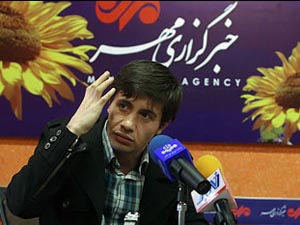 the group; Yaser grew up in the MKO camps in Iraq.
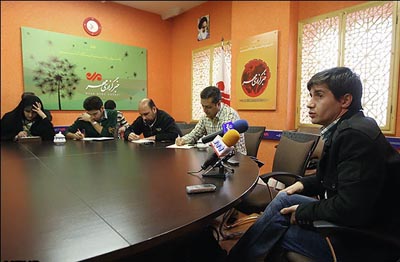 confinement. He was brought on trial and accused of being the agent of Iranian Intelligence Ministry!
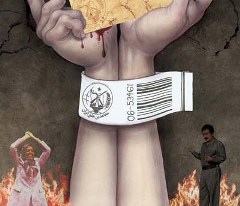 and PMOI) failed in their attempt to run away from a hospital near the group’s transient settlement facility, Camp Liberty, near the Iraqi capital.
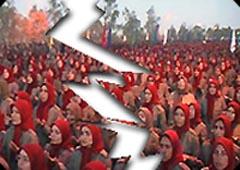 believers of hijab argue that It not only makes a woman feel confident and liberated, but encourages society not to see women as sex objects. They believe that Islam promotes sexual equality, and Hijab allows women to be an instrumental part of the society without being discriminated and looked down. Hijab can also prevent men from ogling look. What about Maryam Rajavi, the leader of the Mujahedin Khalq Organization, the MKO as an Islamic Marxist group? What is her stance about hijab?
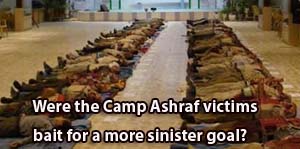 At that time, the MEK announced that 52 of its members had been killed. They published photographs of the victims along with their biographies and claimed that Iran had given the order to attack the camp and that Iraq had carried it out. Both governments denied any involvement and no evidence has been offered to contradict this. Weeks later Iraq announced that the death toll was 53, not 52 as previously claimed by the MEK. The revised figure was due to the fact that the 53rd victim had had his face so badly burned that it took a while to identify him as one of the MEK and not one of the attackers and to discover his true identity. Following this revelation the MEK published a documentary about the 53 in which a picture of Massoud Dalili was shown along with a sample of his handwriting in which he declares that he will never surrender to the enemy, the Iranian regime. In this documentary the MEK refer to them as martyrs.
 (MEK, PMOI) for twenty years, serving as the organizations representative to the United Nations and to the United States during his tenure. The group is largely obscured from public discourse, or more recently veiled in headlines describing them as political dissidents or refugees. To those more familiar with the group the debate tends to focus primarily on their nature. For many MEK is a dangerous terrorist organization, yet for others they are freedom fighters and the only legitimate alternative to the Iranian Government. They’ve been subject to several pieces suggesting they work as assassins for the United States and Israel. Masoud has published a book called Memoirs of an Iranian Rebel about his experience in the organization, which he very candidly describes in detail as a cult, and one that has long lost its strength and vibrance. He now focuses much of his work on the research and understanding of cults, terrorism, and cult behavior within those structures.
 in Ahwaz [ a city near border] were children who were playing soccer, chasing each other and speaking Persian. I noticed children’s playing in other cities too. I was really impressed … I thought when I was at their age I was experiencing war. Those days, most nights we were awaken by air raid siren and had to go to shelters. We had only two TV channels and a lot of passionate revolutionary slogans… basically I don’t think my generation can claim to have had a childhood.”
 the seven people who the MEK claim are missing from Camp Ashraf are in the custody of the Iraqis. Before this they had been on overdrive to claim that the 1st September attack on Camp Ashraf had been carried out by the government of Iraq. Both allegations have been repeatedly dismissed as completely unfounded by Iraq, but this has not silenced the MEK’s propaganda machine.