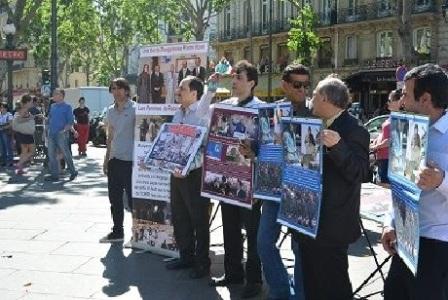
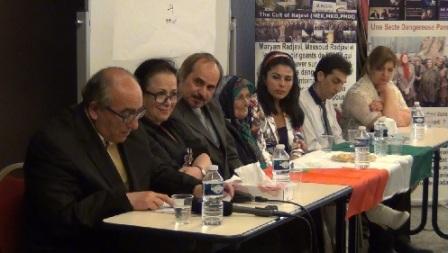
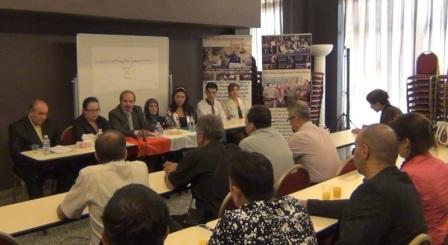
A number of former members of the Mujahedin Khalq Organization (the MKO) attended a meeting in Paris on June 21, 2014.
The meeting was organized by Yaran Iran Association. It was also attended by some Iranians residing in Paris.

A number of former members of the Mujahedin Khalq Organization (the MKO) attended a meeting in Paris on June 21, 2014.
The meeting was organized by Yaran Iran Association. It was also attended by some Iranians residing in Paris. MKO defectors addressed the audience and answered their questions.
The speakers, who had come from different countries in Europe, spoke of their personal experience of living in the MKO cult-like structure that according to them violated human rights, suppressed human emotions and forbid family ties. Their sorrowful memoirs of in-human practices of the MKO authorities impressed the audience.
They criticize the group’s fraudulent propaganda that is aimed to deceive cult members inside or outside Iraq noticing the annual masquerade held by the MKO propaganda arm in the Parisian suburb Villepinte in which the group launches its well-funded misinformation campaign.
Former members reveal that the MKO officials seek to prolong their stay in Iraq obstructing any effort to move Liberty residents to third countries. Based on defectors testimonies, the MKO leaders insist on keeping members in the dangerous critical Iraqi territory.
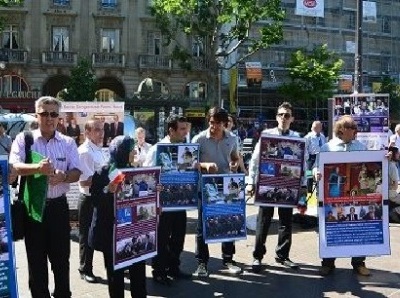
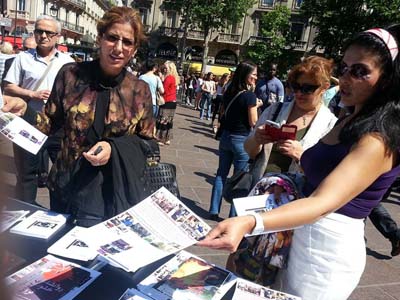
They criticized MKO’s policy to make alliance with the most extremist reactionary groups in Iraq and Syria. Following the conference, the attendees gathered in Saint Michelle Square, Paris. Books, flyers and Placards on the MKO crimes were distributed. Defectors explained true substance of the MKO and its cult-like terrorist history to French citizens and Iranians including passengers or France residents.
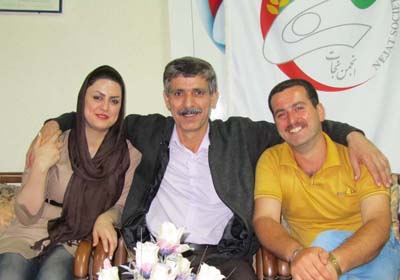
Former member of the Mujahedin Khalq Organization (the MKO) returned home after 25 years of imprisonment in the Cult of Rajavi.
Nejat Society Gilan office celebrated the reunion of Mr. Rajabzadeh and his beloved children who were barely 5 years old when their father left home as a an Iranian soldier to fight Iraqi Baa’th regime. Mr. Rajabzadeh was a war prisoner when the MKO recruiters deceived him to join their cult. Under the mind control system of the cult, he lost his youth and family.
While hugging his father, the son of Mr. Rajabzadeh, Mehran cried , "Shame on Rajavi who separated me and my sister from our father for 27 years! He made us live in grief and suffering."
Rajabzadeh’s daughter, Razieh hugged and kissed her father. She appreciated the efforts of Nejat Society for the return of her father.
Reza Rajabzadeh who could hardly ever control his tears said:" I’m sorry…I love my children…Shame on Rajavi who broke down a lot of families! I will not stop denouncing him and his cult unless all prisoners of Camp liberty are released."
Reza Rajabzadeh left the MKO about two years ago. After his release, He stayed in a hotel in Baghdad as he wanted. He was one of the active ex-members of the group who revealed the notorious safe house of Masoud Rajavi, Base 49.
Many defected members of the terrorist Mojahedin-e Khalq Organization (MKO, also known as MEK, NCRI or PMOI) are willing to surrender themselves to the Tehran government to return to Iran, a senior Iraqi
diplomat said.
"If the grounds are paved to facilitate their (MKO members) repatriation to Iran this can persuade other MKO members to do the same," Iraqi Ambassador to Tehran Mohammad Majid Al-Sheikh told FNA on Saturday.
He explained that 10 MKO members are currently settled in a hotel in Baghdad waiting to return to Iran, and said, "The representative of the UN Secretary General Ban Ki-moon has asked me to talk to the Iranian officials to facilitate the return of these MKO members to Iran."
The Iraqi ambassador pointed to an agreement between Iran and Iraq on extradition of criminals, and said, "This agreement will be implemented in the next several weeks and we are doing our best to implement it."
He reiterated that if Iran files a lawsuit against the MKO at the Interpol, the Interpol can take action and arrest the MKO members and hand them over to Iran according to the universally accepted laws on the extradition of criminals.
The last group of MKO terrorists at Camp Ashraf, now called Camp New Iraq, was evicted by the Iraqi government on September 11, 2012 to join other members of the terrorist group in the former US-held Camp Liberty, now called Camp Hurriya, near Baghdad International Airport where they are awaiting relocation to other countries.
The MKO, founded in the 1960s, blended elements of Islamism and Stalinism and participated in the overthrow of the US-backed Shah of Iran in 1979. Ahead of the revolution, the MKO conducted attacks and assassinations against both Iranian and western targets.
The group started assassination of the citizens and officials after the revolution in a bid to take control of the newly-established Islamic Republic. It killed several of Iran’s new leaders in the early years after the revolution, including the then President, Mohammad Ali Rajayee, Prime Minister, Mohammad Javad Bahonar and the Judiciary Chief, Mohammad Hossein Beheshti who were killed in bomb attacks by the MKO members in 1981.
The group fled to Iraq in 1986, where it was protected by Saddam Hussein and where it helped the Iraqi dictator suppress Shiite and Kurd uprisings in the country.
The terrorist group joined Saddam’s army during the Iraqi imposed war on Iran (1980-1988) and helped Saddam and killed thousands of Iranian civilians and soldiers during the US-backed Iraqi imposed war on Iran.
Since the 2003 US invasion of Iraq, the group, which now adheres to a pro-free-market philosophy, has been strongly backed by neo-conservatives in the United States, who eventually took the MKO off the US terror list.
The US formally removed the MKO from its list of terror organizations in early September 2012, one week after the then Secretary of State, Hillary Clinton, sent the US Congress a classified communication about the move. The decision made by Clinton enabled the group to have its assets under the US jurisdiction unfrozen and do business with the American entities, the State Department said in a statement at the time.
I am Abdulkarim Ebrahimi, 47, from Ilam, Iran. I left the Mujahedin Khalq Organization in 2012, after 24 years of imprisonment behind the bars of the anti-Iranian cult. I could manage to escape the MKO after
the relocation of the second convoy in Camp Liberty. I rushed to Iraqi Police station while MKO guards were chasing me. Finally, leaving the MKO security forces behind, I thrived to reach Iraqis.

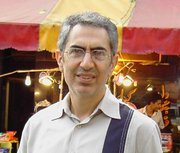
Before my escape, when I was in Camp Ashraf, I had several times asked for permission to leave the organization but not only the MKO leaders refused my request, but also they verbally abused me, humiliated and mentally tortured me.
In 1994, after 5 years of membership in the group, together with a large number of other members, I was imprisoned by the cult authorities, under the pretext that they didn’t trust us. We were jailed in a prison in Camp Ashraf where we were physically and mentally tortured. I recall one of my fellow prisoners whose head had been entirely swelled due to severe beatings.
I entered the MKO in 1989 after I was deceived by the phony promises of the group. As soon as I arrived in the MKO, I found myself as a hostage in a inhumane cult where I even didn’t have the right to think freely. Any kind of socializing with others was forbidden as a “plot”. Members were under a 24-7 controlling system that forced them to attend daily and weekly sessions of inquisition. During these sessions members had to confess their thought and dreams, even sexual ones, in front of others. I myself was humiliated and verbally abused in these meetings several times.
The leaders of the MKO – who all the time claim that Camp Liberty is like a prison – are the main people who turned the MKO Camps into a prison. The MKO prison is so exceptional that its prisoners – the same members – are not allowed to contact their families, either by phone of by letter. They have no access to the Internet and other mass-media. They are forbidden to visit their loved ones. They have no news of the outside world but prisoners in the whole world, even under the worst dictatorships, at least are allowed to visit their families or even take a few days off to go home.
The MKO camps have been turned into a horrible jail because: relations and conditions are very oppressive, and tyranical, under cult-like practices members are manipulated, they are kept in an absolute ignorance, celibacy is obligatory, children are separated from their parents, emotional relations are forbidden as well as sexual relations, there is no access to mobile, Radio, TV, newspapers and the Internet. News, books and films are filtered by the cult authorities.
Therefore, I ask the United Nations Organization and the families of Liberty residents to try their best for salvation of my former friends who are still taken as hostages in the cult of Rajavi. In order to release them, the presence of residents’ families in Iraq is vital.
By Iran Fanous
A number of former members of the Mujahedin Khalq Organization issued a statement to seriously condemn “forced and useless hunger strike” in Temporary Transit Location; Camp Liberty. They considerMaryam and Massoud Rajavi- leaders of the group as responsible for the lives of imprisoned residents of the Camp.
Former members of the MKO notify that in the MKO no activity is done unless it is ordered by the group leaders. “In fact, all political and propaganda affairs including self immolations and hunger strikes are basically organized acts and actually under the order of the leadership and members are due to execute them,” the signatories of the statement reveal.
These defectors of the cult of Rajavi who base their allegation on what they witnessed and experienced in the MKO warned about the seriously poisonous atmosphere of the organization where members are deprived from their basic rights and even their power of thought and freewill.
They emphasized that the forced hunger strike in the MKO is “a significant example of violation of human rights” thus; they urged the international community to take action against the authorities of the MKO in order to prevent a human disaster in Camp Liberty. They also asked political activists and Iranian nation to condemn the atrocities of the MKO leaders asking,” Why Massoud and Maryam Rajavi do not go on hunger strike?”
Nejat Society
An Interview with a former member of Mojahedin-e-Khalq, Massoud Banisadr
Masoud Banisadr was an active member of the controversial Iranian opposition group Mojahedin-e-Khalq
(MEK, PMOI) for twenty years, serving as the organizations representative to the United Nations and to the United States during his tenure. The group is largely obscured from public discourse, or more recently veiled in headlines describing them as political dissidents or refugees. To those more familiar with the group the debate tends to focus primarily on their nature. For many MEK is a dangerous terrorist organization, yet for others they are freedom fighters and the only legitimate alternative to the Iranian Government. They’ve been subject to several pieces suggesting they work as assassins for the United States and Israel. Masoud has published a book called Memoirs of an Iranian Rebel about his experience in the organization, which he very candidly describes in detail as a cult, and one that has long lost its strength and vibrance. He now focuses much of his work on the research and understanding of cults, terrorism, and cult behavior within those structures.
Richard Potter: How long were you active in MEK?
Masoud Banisadr: I left MEK 1996. Before that I was the representative in the United States and the United Nations.
You were only in the political arm?
Yes.
You would have joined in 1976 when it was a more political guerilla movement?
Yes at the time I joined them I was a PhD student in UK in New Castle University. I was married and I had a little daughter. Of course I married young, so everything was very fast. We married in UK far from Iran, but the only source of news we had during the Iranian revolution was from MEK. So because of the past history and the number of martyrs the MEK had against the Shah we trusted them. The slogans they gave were about freedom and democracy and equal rights, women’s rights, minority rights. All destructive cults are like some lizards and can change colors very rapidly to their surroundings.
How did this change?
What happened in 1981 is that Massoud Rajavi (The head of MEK until 2003. Currently believed dead or in hiding) saw that he had attracted so many students and he thought he could repeat the Bolshevik revolution of Russia in Iran. So what he did was he suddenly on 20 June 1981 asked all members and supporters to come to the streets of Tehran and overthrow the new establishment. MEK says that 500,000 people came to the streets. They failed. They failed and they couldn’t do anything and from the next day they changed into a clandestine organization. Between the summer of 1981 the MEK went through many terrorist actions. They bombed the Islamic revolution party buildings. They killed the new President and Premier of Iran, and then they killed at Friday prayers in different cities through suicide operation, they killed different imams through suicide operations. They themselves claim that within one year that they killed almost 1400 people, high officials and supporters of the new establishment in Iran. At the same time they claimed 2000 of their members were killed in street clashes with the Iranian Revolutionary Guard. In Iran what they were doing was what they called “heroic terrorism operations” later they thought the word terrorism had a bad connotation, especially in the west and they changed it to heroic actions. Most of their supporters in Iran were those who joined this group because of its peaceful nature. For the democratic liberal and pro social justice nature, so they were not ready to change into terrorist or even guerrillas. People are ready to vote for a party, but not to fight for that party.
You refer to MEK as a destructive cult, when do you believe they transformed from a political group or a guerilla group to a cult?
What happened was within Iran they were left losing 99% of their member. Only 2,000 to 3000 members left in Iran. Most of them were gone because of change of policy from peaceful demonstration to terrorist activities and street fighting. Even those who could become radicals were either killed in street clashes or by execution by the government. They lost the battle in Iran. Outside of Iran they were portraying themselves as the democratic alternative to the Iranian government. Two of the most important allies of theirs were ex Iranian President Banisadr and the Kurdish democratic party of Kurdish Iran. These two left the National Council of Resistance in 1984, suddenly this coalition of Rajavi and others turned into the pseudonym MEK. In 1983 they could get support from the labor party of UK and the socialist party of France, but after this they did not have it anymore. MEK was on the verge of disintegration, so he had to do something, which is why I think he did what was called the ideological revolution, which is when it became a destructive cult.
You’ve written about the organization forcing you to divorce your wife at this point, can you elaborate?
At this time they were telling me that my wife was what they called “revoluted”- meaning that she had accepted the ideological revolution and she was now a disciple of Mr. and Mrs. Rajavi and if I wanted to leave the group I had to leave my wife and my children as well. This was my main problem. It wasn’t just leaving the group it was leaving my children and the love of my life. I tried to rationalize it and I tried to stay in the group. Then there was some time later when they asked me to divorce my wife, again it was the same problem. Then I was in the United States and everything was wrong and slogans were wrong and meaningless, everything they said was meaningless.
How did you rationalize all of this?
There is an experiment where they put a live frog in a pot and they turn the heat up degree by degree. Outside the pot is cold, inside the pot is warm. The frog won’t jump out of the pot. It can but it won’t. It’s because the outside is cold. But when it’s realized that it is boiling and it is cooking the opportunity is gone because all of his muscles have been cooked. This is what happened to us. When the ideological revolution changed and we could see the pot was boiling, all of our muscles were cooked. All our self confidence or individuality that would help us jump out of the pot were gone.
MEK was originally aligned with some of the Kurdish groups but later on there was a great deal of fighting between MEK and Kurdish groups. What caused this change?
After the gulf war when Saddam lost the war the Kurds in the north and Shia in south thought they could revolt against Saddam Hussein and get rid of him. Unfortunately the US didn’t help and this is why they lost. Since Saddam’s army wasn’t in good shape after the war they asked MEK to attack some of the Kurdish guerillas in the north and MEK committed many atrocities. Of course then I was outside of Iraq and I couldn’t believe that we did this. After I left the group and I met other who left I realized it was true. What we were told was we were fighting Iranian revolutionary guards who had Kurdish guards, and this is what I was believed. When the accusation was brought up at the UN or anyone I would deny it vehemently, but when I left the group and met ex MEK from that war I realized this wasn’t an accusation, but a fact. They say they even killed women and children.
Saddam was probably one of the only allies in the Middle East MEK had at that time, no?
No. At this time Saudi Arabia and the United Arab Emirates were helping as well. As a matter of fact, Rajavi at one juncture traveled to Saudi Arabia and met the king. In MEK they showed us a video of him meeting the king. It was secret, the KSA and UAE support. Everyone knew about Saddam, but even within the group they didn’t speak about KSA or UAE. I saw the video when I reached the highest rank men could go in MEK. When MEK had their last battle, Forough Javidan, which means eternal light, the plan was that MEK, with the help of Saddam Hussein, would take part of Iran and announce the government order over it, calling it the democratic Islamic government of Iran- They’d go and capture western Iran and establish a government and immediately Saddam Hussein would recognize it and Saudi Arabia, Jordan and the United Arab Emirates would support it, and there were others. They were hoping Kuwait would join and the United States could be pressured to acknowledge them and they could create a situation of pressure on Iran like North and South Vietnam, or Korea. This was their tactic.
This one of the bloodiest incidents during this period, no?
They failed. They lost a third of the members. As a matter of fact I was in that battle. I lost some of the muscles in my right soldier because I was shot. Of course, we were not trained, not for that battle. They said everyone had to attend, even representatives who weren’t in Iraq. So I had to go back to fight. I had no military training but I had to go. Rajavi wanted everyone to attend but himself and his wife.
I’m sorry to hear about this
It was very horrible. There were 15 students who were from the United States, they were supporters. They were brought to Iraq and in the same night they were moved to the battle field. Because of my political rank I was a commander even though I had no military background. I didn’t know anything about fighting. Only a few days before for the first time I saw a machine gun, and I only shot it once. So in the first battle I almost lost my life, I was shot and went unconscious and was take back to the hospital. Unfortunately I learned all 15 died because they didn’t have any training, and because it was done so quickly no one asked them their names and nothing was recorded. I didn’t even know their names. It was horrible
How did you eventually get out?
In 1996 Maryam Rajavi (Wife of Massoud Rajavi and current head of MEK) was speaking in London and they asked me to come and mobilize supporters, and talk to British politicians and arrange meetings for Mrs. Rajavi, including Margaret Thatcher. So in London after five or six years I met my daughter. Before that she was 13 and now she was 18. I was faced with a lady. Emotions and feelings are very important in destructive cults. They isolate you from your loved ones, so you don’t turn your emotions to your loved ones. In London I could see my daughter and my sister and my old friends. From early morning to midnight I had to see old friends, ex-supporters of MEK, and answering thousands of questions which internally I had no rational answer for any of them. So these things, my feelings between my friends and family helped me change. And also luck. I had an accident and back problems, and I was so active in London that I had to go to the hospital. My back gave out. Fortunately for me MEK was very busy then for Maryam Rajavi with different meetings, so they didn’t care about me. If it was another juncture they’d make sure someone was with me, because MEK never leaves a member without a chaperone, always at least two with each other they watch and look after each other. So in the hospital I was alone for the almost a month and I could see normal relationships of people with each other. There was a guy beside who had an accident and I was helping him to shave his beard, or to feed him and so on, and this revived my individuality and my humanity and self confidence. All gradually it came back. When it came that I left the hospital I left MEK. I didn’t reject them fully yet, but I realized I couldn’t be with them anymore.
There are many who believe MEK serves as proxy for the West and that they are allied, do you believe this?
I don’t think so. Another problem MEK has is that Americans and Europeans know MEK has no support. In the early eighties there was an illusion of support but it was realized there was no support. There are no demonstrations for MEK and no one comes to support them. Even in Iran anyone who hates the government, even the old supporters, if you ask them they’ll say MEK is worse than the Mullahs. Western governments know this. Would the US repeat the same mistake they made in Afghanistan by supporting MEK where in Afghanistan they supported the Taliban but now they fight them. All of this aside it isn’t said that they don’t use MEK, because they do. As long as there is a bad relation with the United States and Iran they will use MEK. The Israelis, they also use MEK very much. But it doesn’t mean that even the Israelis trust them.
There was an accusation that the US was training MEK in Nevada to be used as assassins. Do you believe this?
No I don’t believe this. What is the average age of MEK members now/ I think it is about eighty. What do you want to do with people this old? I don’t think so. Probably not even spying. The only use they might have for them may be in relation to some terrorist activities in Thailand and in Europe where they say Iran or Hezbollah are committing terrorist attacks against Israeli embassy or the personnel of the Israeli embassy. Probably they could use MEK to discredit the Iranian government or even Hezbollah because Politically I don’t believe they use these tactics at this point, it would be political suicide for them. There was a story in the United States that came to the media and vanished about someone who was going to assassinate the Saudi ambassador in the United States. It’s possible they can create this news with MEK members to work against the Iranian government, but no real action.
Richard Potter, Mondoweiss
More Information on:
Link to Research Institute on Destructive Cults (RIDC)
About Richard Potter
Richard Potter is a 27 year old Social Worker and writer from Pittsburgh, PA. His work has been featured in Vice, Your Middle East, and Rohingya Blogger.
Discussing the role of the Mujahedin-e-Khalgh Organization in the Iraqi imposed war on Iran;
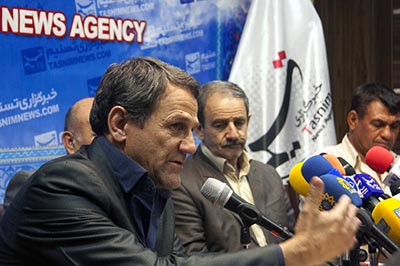
Four former members of the Muhajedin-e-Khalgh Organization known as MKO in a press conference in Tehran shed light on the role of the MKO in eight years of Iraqi war against Iran in the 1980s. The former MKO members said that since the beginning, the leaders of the organization were looking for a source of support for the group and the Iraqi-impos
ed war provided them with the chance.
The press conference has been held as Iran is marking the sacred defense week which commemorates the 33rd anniversary of the beginning of the Iraqi imposed war on Iran back in 1980.
The group is notorious for carrying out numerous acts of terror against Iranian civilians and officials, involvement in the 1991 bloody repression of Shia Muslims in southern Iraq, and the massacre of Iraqi Kurds in the country’s north under Saddam.
The last group of MKO terrorists at Camp Ashraf was evicted by the Iraqi government on September 11 to join other members of the terrorist group in the former US-held Camp Liberty, now called Camp Hurriya, near Baghdad International Airport where they are awaiting relocation to other countries.
I went to Camp Ashraf from America
Arash sametipour was living in the United States when he first heard of Camp Ashraf. He went there, he was trained and finally, one morning he entered Iran crossing Southern border. “The first thing to attract my attention
in Ahwaz [ a city near border] were children who were playing soccer, chasing each other and speaking Persian. I noticed children’s playing in other cities too. I was really impressed … I thought when I was at their age I was experiencing war. Those days, most nights we were awaken by air raid siren and had to go to shelters. We had only two TV channels and a lot of passionate revolutionary slogans… basically I don’t think my generation can claim to have had a childhood.”
My interview with Arash Sametipour was on the phone. He lives in Netherlands so we were not able to look in to each other’s eyes. It was too difficult for me to ask questions without knowing enough about his mental conditions. I knew I had to call him a “terrorist” some time during the interview but I didn’t know that he who is now trying his best to “fight violence”, regarded such an attribute as “fair”.
“In the morning you crossed the Southern border to enter Iran; did you know that you were officially going on a mission that would turn you in to a terrorist?” I asked him. He replied,”
Arash was not willing to speak of details of the mission he had been trained for but he didn’t disagree my hypothesis when I said,”let me suppose that you were going to Iran to kill someone or technically to hit someone."
“On that day I was in the place I was supposed to be just like previous days. But that day was different from other days. I was terribly tired. My country-fellow men may not understand what I mean. It may be a little hard for them to accept that there was no motivation, there was only tiredness. I just wanted it to finish… I remember the exact words I told God:”Finish it. Please finish it.”
Arash says that an hour after saying the “prayer”, he is arrested by the Iranian Police. The cops fail to search his body completely so at the Police station, he manages to get the grenade he has with him and eventually releases the trigger.
“The moment I released the safety lock, I wondered what was going to happen. Was it the end? Would everything go dark? Or would I be born like a baby once again? Right away, my mother’s image emerged before my eyes.”
I asked him if he had talked to his mother about the path he had chosen, before joining the MKO.
“My mother was seriously against it. My family had immigrated to the United States in 1995. We all had Green Cards and soon we were qualified to receive American citizenship. I was a student and a pretty good future was waiting for me… The moment I released the trigger the image of my mother was so real to me that I forget to take the grenade near my chest – we were trained to keep the triggered grenade before our chest – but I was struck dumb by my Mum’s image , so I survived the explosion.”
Arash Sametipour was taken to hospital after he exploded the grenade in his hand. He lost a hand but doctors succeeded to keep his seriously wounded leg.
“Did the medical team of the hospital treat you with discrimination or hatred”?, I asked him.
“Well, it was and is natural. Iranian people have not forgiven the MKO yet but my medical team did their job well without any discrimination. After I was discharged from the hospital I was nearly sure that I would be sentenced to death but the then administration was reformist and the state was willing to show a moderate image. I heard that the MKO members were granted amnesty at that time. I was lucky that I was sentenced to life imprisonment. It was later reduced to 8 years and according to the law if you commit a crime for the first time you will be forgiven after you serve half of your conviction.”
“I Become a Teacher”. Arash sametipour has two important occupations now; he is awaiting the birth of his baby and meanwhile he is writing the book of his memoirs. He has his own weblog where he frequently writes of his memoirs and his daily routine.
I asked him who joined the MKO at the age of 21, “if 21 years later, your son come to you saying he has reasons to take gun and fight a government that he feels it should be reformed, what you tell him?”
“I’ve thought about it a lot. I guess if I am able to convey what I endured in the past, firstly to my child and secondly to the coming generation, they will be unlikely to repeat my experience.”
He says that if he were able to get back to the past, he would become a teacher rather than “an armed fighter against a government."
“I was not a person to change the history. I remember the words by Samad [the Iranian writer] ‘we thought everyone was in danger there but we went saw that only we were in danger!’ If I get back to Iran someday, I will become a teacher maybe I could pass my experience and the story of my life to the future generation in order to make them aware of this part of the history in which my generation and I lived our life.”
Iran; prime victim of terrorism
Shedding light on the terrorist nature of the Mujahedin-e-Khalgh Organization;
Two former members of the terrorist MKO at a press conference in Tehran have elaborated on the terrorist
nature of the group which has a long history of hostility and terrorist attacks against the Iranian nation. Ebrahim Khodabandeh and Maryam Sanjabi had been working for the MKO for over 20 years before escaping from the group’s camp in Iraq almost 10 years ago.
The press conference comes only days before the anniversary of the 1981 bombing in Tehran which killed scores of Iranian officials including then Prime Minister Mohammad Javad Bahonar and President Mohammad Ali Rajaei who had been elected only three months before. The MKO claimed responsibility for the attack.
The MKO – which the US removed from the list of its terrorist organizations last year- fled Iran in 1986 for Iraq, where it enjoyed the support of Iraq’s executed dictator Saddam Hussein, and set up its camp near the Iranian border. The group is notorious for carrying out numerous terrorist acts against Iranian civilians and officials, involvement in the bloody repression of the 1991 Shia Muslims in southern Iraq, and the massacre of Iraqi Kurds in the country’s north under Saddam.
Even after the execution of Saddam Hossein the terrorist group still continues its acts of terror against the Iranians under the support of certain western powers; Iranian security sources say the assassination of a number of Iranian scientists is the result of the direct cooperation between MKO and the US-Israeli intelligence services. Last year the US and Canada joined the EU in removing the MKO from their list of terrorist groups. Iranians were shocked by the decision, as was anyone who favors peace in the Middle East.
Since its establishment, the Islamic Republic of Iran has been targeted by different terrorist groups inside the country that according to experts has made it the prime victim of terrorism in the world.