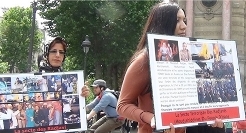
A day before the resumption of negotiations in Geneva on the Iran nuclear issue, the head of security Department of Geneva ordered the Mujahedin Khalq who were on hunger strike to evacuate the Place des Nations.[1]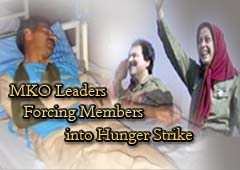
The negotiations went on and resulted in an agreement between Iran and the 6 world powers. All sides hailed the deal calling it the first proper move towards the peace.
Police spokesman talked about the day that the hunger strikers were asked to comply with the laws and authorities.
“Shortly after the arrival of the press, a striker got sick. An ambulance was called. A policeman boarded to check the identity of the patient, who was yelling. His comrades were then rushed to the police shouting "fascist!" And two men jostled. Another striker suddenly dropped himself on the road on purpose paralyzing traffic. “[2]
The sight indicates the show of brainwashed members of a broken cult-like group who fell out of favor from international community and are ready to hunt an opportunity for a big show-off.
Hunger strike is among the MKO cult leaders’ tactics to get itself on the scene. In different phases and under different pretexts Rajavi ordered members to go on hunger strike for its political gain and its hidden agenda and to launch its propaganda campaign.
This latest hunger strike is being held under the pretext of saving the lives of the seven allegedly missed residents of Camp Ashraf, who the organization claims to be detained during the Camp Ashraf September clashes and hold by the Iraqi security forces somewhere in Baghdad.
Iraqi authorities have repeatedly denied involvement in the attack, in which camp residents also went missing.[3]
The question here is that if the lives of members are really important for the cult leaders why do they order hundreds of members to put their lives in danger? Whoever is familiar with the cult practices and whoever has the experience of living within the group knows well that the members are not allowed to do anything without the approval of its leader.
A number of former members of MKO condemned the forced hunger strike through a statement and hold Rajavi accountable for the lives of the imprisoned Camp Liberty residents. The statement reads:” “In fact, all political and propaganda affairs including self- immolations and hunger strikes are basically organized acts and actually under the order of the leadership and members are due to execute them,” [4]
Although the 95 days of hunger strike with no death report seems weird to the outside audiences as the critics notify it a propagandistic show in which the participants attend in turns to be filmed and photographed, yet the victimization of a number of the group’s dissidents and rank and files is not far from possible to make it believable.
Based on the reports of the group’s website several members have reached the point of no return. Maryam Rajavi through a fabricated statement asked” friends of Camp Ashraf and PMOI members imprisoned in Camp Liberty, who are in a critical condition and close to death in the cities of Geneva, Berlin, Ottawa and Melbourne, to end their hunger strikes…”, yet she didn’t mention the Liberty residents – who are the main participants of the strike to end their fasting. This shows the real intention of the cult leaders to use members as fuel for their propaganda machine. [5]
Rajavi as a leader of a destructive cult who is being ignored by its masters may make more dangerous decisions to victimize more of its followers.
This is the real threat of a cult and a human rights disaster that is being ignored by the west.
It is another example of the double standards within the US political stands. Just as terrorism, human rights is also a matter of geography, and even more so, of political interests.
The US has a legacy of saving the whole world through their so called humanitarian efforts; they did that in Korea, China, Guatemala, Indonesia, Cuba, Laos, Vietnam, Cambodia, Grenada, Lebanon, El Salvador, Nicaragua, Panama, Libya and Iraq and more recently in Syria under the pretext of which it pushes its warmongering efforts and justify its military actions. [6]
Considering the concrete evidences of human rights abuses within the destructive cult of MKO reported by RAND and HRW and the testimonies of several former members of the cult who managed to escape the group, along with the deteriorating conditions of the Liberty residents, why don’t the US put forth and save these individuals’ lives who are under the threat of being attacked from outside or being victimized by the cult leaders’ themselves. If the US is capable to save nations why doesn’t it save the roughly 3000 enslaved members – striving for a free life of a bankrupt, desperate cult?!
By: A. Sepinoud
References:
[1] Gabus, Laure, Barazzone déplace les dénonciateurs du camp d’Achraf à l’Ariana, Tribune de Geneva, November19, 2013
[2]ibid
[3] al-Salhy, Suadad, Iraq says no success tracing killers of Iranian dissidents,Reuters, November26,2013
[4] https://www.nejatngo.org/en/posts/5504
[5] Nejat bloggers are either former MKO members or have a family member who is currently held in Camp Ashraf. They have suffered deeply because of Massoud Rajavi’s crimes. While the Nejat Bloggers recognize that citing sources of information is essential ,we, as a society feel so strongly against the MKO that we have agreed to not include the group’s websites or links in our articles because we consider it as kind of publicity for the cult.
[6] Jacob, Anthony, After Iraq, US plans to save Syria!, PressTV, September 4, 2013
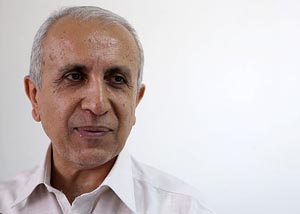 said in his latest speech to his followers in Camp Liberty in Iraq: “whoever doesn’t like to stay can get lost and go away”. He then denounced as traitors all those who choose to leave him, including those who do not give him their absolute obedience.
 was transferred to the Camp Ashraf and broke all family ties for 9 years without her family knowing where she was.
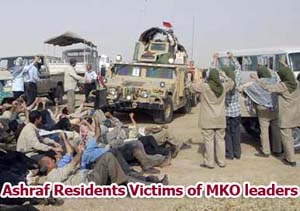 She has further added that “MKO leaders’ fear of devastation of their group has led them to use Ashraf and Liberty residents as human shields to protect their own lives. That is why the group has resorted to lies, deception and suppression of own members.”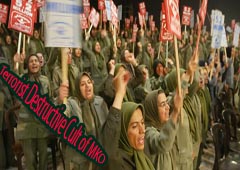
 Temporary Transit Location (TTL), following the second deadly attack on 15 June. UNHCR reiterated the urgent need for enhanced physical protection, asking the Government of Iraq to do everything in its power to guarantee the security of the residents.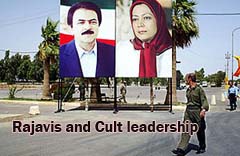
 at a camp in Iraq of human rights abuses, an allegation the movement dismissed as baseless.