
An interview with Batool Soltani on MKO self-immolations – Part 37
Sahar Family Foundation: One of the interesting points you referred to was the organization’s insistence on regular confession sessions of cleansing even in the course of the missions. I am interested to know how they justified it when on a mission.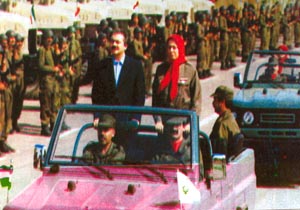
Batool Soltani: Any operation team was composed of two or three depending on the nature of the operations. One was in charge and he was the one to arrange and run the cleansing sessions. Even in his/her absence, other members had to sit by themselves to conduct it. They insisted on its performance since it was much necessary when members were out on mission in a free world among people and just a few steps away from the adversaries.
In the camp there were no enemy and consequently no fear. But out of the camp there always existed a potential threat that could lead to an influential demoralization. When among the society that the members were long away from, the felt nostalgia could obsess them with the thought of craving to be with their family and starting a warm, pleasant life just like other people. The temptation could easily erode their confidence in the organization to encounter it. That is where they needed to be cleansed of such temptations that could diminish their fighting morale. I think we have already talked enough about the issue.
SFF: Did Massoud have any contact with the teams while in isolation?
BS: before their departure, they would once meet with him which worked as a factor of encouragement. He would talk to them on the phone or received them individually in the presence of Maryam where they gave their pledge of loyalty to the red-line and the organizational principles and that the enemy would never succeed to have access to anything out of them. The emphasis was on Ahmad Rezai as the archetype they had to follow. Then he would say, ‘now move to show what you will give to the enemy and what you’ll take’. These meeting were really instrumental and some looked at it as their unforgettable memories and a matter of honor.
The impact of the meeting was enough to encourage and motivate them to the end and to risk their life for the accomplishment of the mission and the will of leader. The head-team of Lajevardi’s assassination, for instance, had a meeting with Maryam where he, Ali-Akbar Akbari, promised her to shot him just between his eyes. It was Massoud’s skill to instigate and provoke members and there were times when they would kneel before him crying and begging to be sent for the operations. He knew how to prepare them psychologically and if you could listen to his speech delivered before the operation Eternal Light, you would feel his charismatic influence in provoking three-four thousand forces, as he could well justify the failure of the operation.
SFF: Was the age of members of any importance in selecting them for the operations?
BS: Not very much. The average age of the members was 40 or younger. However, it was physical readiness rather than the age that could be counted. A physical test well indicated the degree of members’ readiness.
SFF: In this phase of operation we encounter the arrest of Marjan Malek and the organization’s contradictory reactions. Do you have anything more to add?
BS: At first, the organization thought she had been killed. So it began praising and glorifying her daring deed in its official gazette, Mojahed. Then it was surfaced that she was alive and arrested and it was brought into the Leadership Council to start advertising her collaboration with the regime’s information system. It was immediately put into action and her pictures were removed from the gazette. To justify her published disclosures about the organization, the organization tried to convince the lower cadres that she had failed to stand and resist the regime’s pressures and so had surrendered. Interestingly, the organization never mentioned her team-mate, Akbari, and evaded questions concerning him.
SFF: How successful was the organization in its ‘operations of ultimate’?
BS: They proclaimed them successful because of their wrong evaluation of Iran’s internal climate. They were under illusion of having people’s support which led them reckon on a 90 percent success. It was what they said to the teams to ensure them that they would certainly return to the camp. Actually, less than ten percent would return.
SFF: Why it was so?
BS: It was clear from the very beginning that they wouldn’t because there are reasons to justify. Imagine, how is it possible for a team going to a crowded bazaar to retreat while it is surrounded by crowds of people and police forces? Actually, the organization never reckoned on their return but on their demise; martyrs that benefited the organization for propaganda.
SFF: How they evaluated Iran’s social and security atmosphere?
BS: Their appraisal of Iran’s security and police apparatus was not realistic. Unlike the organization’s cautious considerations about the past regime’s security and police apparatus advertised to be highly cunning and sophisticated, it underestimated the capacity and potentialities of the present regime. While the organization was well aware of the fact that no sophisticated apparatus was needed to hunt one or two penetrated teams and that a simple but exact inspection and scrutiny by the police could lead to betray the teams. It was just what happened to Malek and her team-mate. Furthermore, the organization insisted on the social backing and inspirited the teams that they could reckon on people’s widespread protective umbrella to hit and escape; it was what it would say to lower ranks and operation teams but it was clear for higher layers and the Leadership Council that the teams would never return.
SFF: How they broached the issue of human shield in Auvers-sur-Oise?
BS: In Auvers, they have to abide by the rules of the host country but they run underground establishment. Their surface political struggle necessitates it to be organized and it acts according to legal regulations unless the red-lines are broken, that is to say, the sanctuary of the leadership is violated. The consequence will be something like the 17 June immolations. However, as I was not in Auvers lately, I cannot tell what approaches they are focusing on at the present. But, be sure that such activities never cease within Ashraf; the pass of time will show how they will put them into action in European countries.
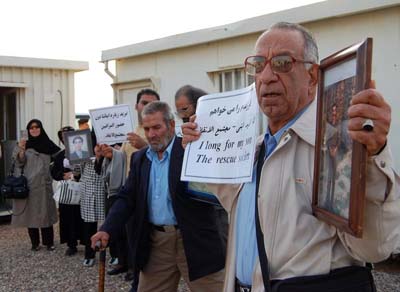
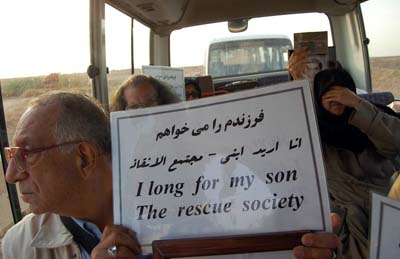 Iraq to meet with their children who are members of the organization in Camp Ashraf, although they have undergone long separations.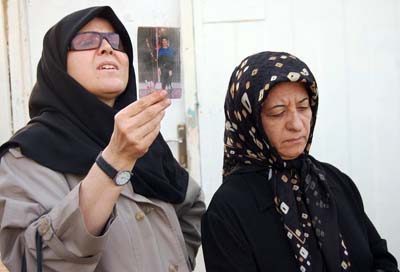

 Sahar Family Foundation: Ms. Soltani, you have put your finger on an issue worthy of note, that is, victimizing insiders and sending them to their death. Did they really theorize such issues for the insiders with concretized exemplars from the outside?
 Rajavi believed there was no need to let the lower body be enlightened about the matters discussed in top levels which could mount unnecessary tensions. It was enough to move on a slow path or effusive acts like that of the June 17 immolations. What was of the significance and vital for the organization was to keep rank and file in readiness and ripe for suicide operations through justifications that could be embedded in them from the top. I tell you for sure that if the subordinate members knew the truth and what they plotted at top layers, half of them would detach from the organization; their role was to materialize the chimeras of the leaders. In contrast to them, the higher echelons had the responsibility of constantly testing the inferiors’ loyalty and readiness and lay the groundwork. Even they would be equipped with the prerequisite means of suicide in a practical test to calculate reactions.
 its various forms and to fully eradicate it. Meanwhile, the Americans have learned many lessons and have been aware of the inevitable costs of interacting with terrorist groups yet there have remained many more lessons to be learned. The first lesson to be learned by the US is the fact that terrorism cannot be used as a lever and threat for establishing democracy in other countries.