

There are rumors that Trump administration might be considering the Mujahedin Khalq Organization (the MKO/MEK/the Cult of Rajavi) as an option for regime change in Iran. Actually, there are certain figures in the administration who advocate for the group ardently. Western supporters of the Cult of Rajavi are perceived at the lavish so-called “grand gathering” the group launches every year in Paris.
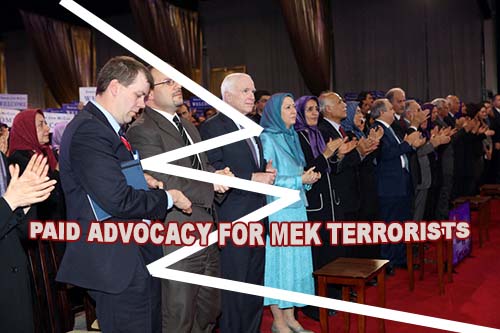
Many retired politicians, former Congressmen, and former military officials and former diplomats have sponsored the MKO. The group pretends to embrace the rhetoric of democracy, but both its violent past and its cult-like behavior contradict the claim. Moreover, the MKO’s supporters claim that they speak at its annual conference in Paris because they want to embrace the cause of the group while five-digit speaking fees seem to be their substantial motivation to appear at the rally of a formerly-designated terrorist group.
F.W. Burleigh of Western Free Press, considers the move by these politicians as the West’s ‘’new mistake’’. “It’s hard to find anything positive on the internet about the PMOI/MEK that wasn’t generated by NCRI’s propaganda machinery,” He writes.” Even Wikipedia slams it as a cult built around the personality of Maryam Rajavi and her husband Massoud, who disappeared in 2003 and was recently declared dead.” [1]
Burleigh describes how the Cult of Rajavi was established around his personality in the group’s ideological container Camp Ashraf, Iraq. “The NCRI/MEK’s claim that it will be the champion of freedom, democracy, and human rights in a future Iran needs to be examined against the history of the mini-societies that it has already created where it enjoyed total control, most notably at former strongholds in Iraq where a social order based on the MEK/Rajavi ideology was established,” He asserts. “These were MEK laboratories for a future Iran, particularly at a huge self-administered base called Camp Ashraf.” [2]
Galen Carpenter of the National Interest also denounces the MKO as a terrorist group that should be avoided by American politic men. “The MEK’s history should cause any sensible U.S. administration to stay very, very far away from that organization,” He writes. “The MEK is a weird political cult built around a husband and wife team of Massoud and Maryam Rajavi. It has been guilty of numerous terrorist acts and was on the U.S. government’s formal list of terrorist organizations until February 2012. The group did not even originate as an enemy of Iran’s clerical regime. It began long before that regime came to power, and its original orientation seemed strongly Marxist. The MEK was founded in 1965 by leftist Iranian students opposed to the Shah of Iran, who was one of Washington’s major strategic allies. And the United States was very much in the MEK’s crosshairs during its early years. During the late 1960s and throughout the 1970s, the MEK directed terrorist attacks that killed several Americans working in Iran.” [3]
But why has such a notorious violent cult been able to foster support among US high profiles? Carpenter clarifies the case: “The MEK has spent hundreds of thousands of dollars cultivating their support, and such gullible (or venal) Americans continue to tout the organization as a genuine democratic movement with strong support inside Iran. The extent of the financial entanglements is deeply troubling. Many prominent American supporters have accepted fees of $15,000 to $30,000 to give speeches to the group. They also have accepted posh, all-expenses-paid trips to attend MEK events in Paris and other locales. Former Pennsylvania Gov. Ed Rendell confirmed in March 2012 that the MEK had paid him a total of $150,000 to $160,000, and it appeared that other “A-list” backers had been rewarded in a similar fashion. Needless to say, accepting such largesse from a highly controversial foreign political organization—and one that was still listed as a terrorist organization at the time—should raise justifiable questions regarding the judgment, if not the ethics, of the recipients.” [4]
Definitely, the recipients of the hefty sums of the MKO, have a very poor judgment about the national interests of their own country as well as the aspirations of the people of their hostile country, Iran.
Burleigh has his own argument. He describes a future Iran under the rule of Maryam Rajavi. “Americans, however, should pause and look into the historical rearview mirror,” He warns. “It gives a lesson of unanticipated consequences for using holy warriors in the cause of Allah to achieve Western goals. If using PMOI/MEK/NCRI is part of an emerging strategy to overturn the Iranian theocracy, as Gingrich implied in his Paris speech, the world may well end up with Maryam Rajavi ruling for life over an Iran that she and her followers have transformed into one vast Camp Ashraf.” [5]
He misses to notice that the Cult of Rajavi can hardly ever find the minimum base among Iranian people. The Iranians loathe the MKO. As Galen Carpenter assets this is not mere speculation. “The MEK aided Saddam Hussein’s war against Iran in the 1980s, and even Iranians who detest the clerical regime regard the MEK as a collection of odious traitors,” He states. [6]
Mazda Parsi
Sources:
[1] Burleigh, F.W., Iran and the Holy Warrior Trap, Western Free Press, July 23, 2017
[2] ibid
[3] Carpenter, Ted Galen, This Group Hopes to Push America toward Regime Change in Iran, National Interest, July 17, 2017
[4] ibid
[5] Burleigh, F.W., Iran and the Holy Warrior Trap, Western Free Press, July 23, 2017
[6] Carpenter, Ted Galen, This Group Hopes to Push America toward Regime Change in Iran, National Interest, July 17, 2017
 become so tired that they fall asleep as soon as their heads touch their pillows.
 Cult of Rajavi) is plainly clear to a large number of people regardless of their political viewpoint. Ben Davies is an analyst and writer, formerly filming in Syria in 2013 with the primary focus on the Middle East, with an emphasis on Syria, Iraq and Iran. He is an anti-Bashar Assad and so an anti-Iran journalist –although he introduces himself as independent in his website. His emphatic focus on Syria, Iraq and Iran has led him to the case of the MKO. In August 2014 he wrote a probed article on the group and its support for the Syrian opposition titled “Revolt Without Rajavi: Syria’s Opposition Must Not Embrace the MEK”.