
Recent suicide attacks in Belgium capital, a park in Pakistan and a stadium in Iraq have resulted in dramatic loss of lives. All attacks were operated by the extremist terrorist suicide bombers who left their own life behind to take the lives of a large number of innocent people.
What makes a person to commit a suicide bombing?
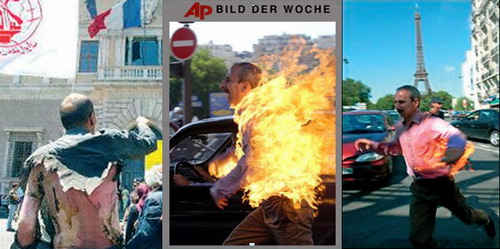 To understand the motives behind suicide bombing many people try to excuse or approve it. It seems easier to assume that suicide bombers are just malicious characters who hate their victims but terrorism is not a simple phenomenon with easy explanations. Actually a wide variety of motives and factors are involved. For analyzing these motives and factors the Mujahedin khalq Organization (the MKO) is a significant example of such terror acts. The group may be one of the first role models of suicide bombers for extremists through the history.
One may also think that suicide bombers are crazy or psychopathic or that they lack moral feelings but most terrorists are not psychologically deviant and do not operate outside the normal rules of behavior, but are instead ordinary people from ordinary backgrounds. A glance at personalities of current and former members of the MKO indicates that the majority of them are from average Iranian families with religious or/ and honorable backgrounds. Most of them are smart, university educated individuals with intellectual tendencies.
Nonetheless, the crucial point about them is that they believe that their violent actions, while somewhat regrettable, are justified and noble. Moreover, their emotional commitment to their cause and their comrades and particularly their leader is revealing of normal human psychology. Often their actions do not ultimately stem from hatred, but rather from love of their leader and from absolute obedience to the orders of the leader. But, how leader can convince such people to commit the most atrocious acts?
In case of the MKO, in better words “the Cult of Rajavi”, the leader Massoud Rajavi manipulated his rank and file with a very complicated methodology of indoctrination. Massoud’s followers were indoctrinated that killing the innocent is inevitable consequence of fighting for the cult’s cause. Members of the cult of Rajavi were manipulated that these missions were the only way to fight for their leader. They were then glorified as martyrs.
Although the realization that MKO terrorists view themselves as soldiers engaged in a just war does not legitimize their cause or methods, it does provide some insight into their motivation. The MKO’s history is overwhelmed with suicide bombings, self-immolations and swallowing cyanide capsules just because these acts were wisely indoctrinated in the minds of members.
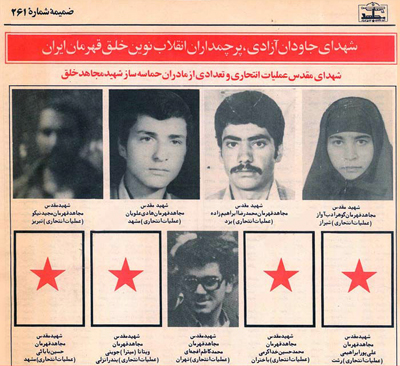 After the 1979 revolution in Iran, when the MKO began to fight the newly established Islamic Republic government, the MKO suicide bombers assassinated dozens of the Iranian officials and civilians. The suicide bombers were glorified in the group’s journal as suicide martyrs.
More than two decades later, suicide was repeated in the MKO history in a much more horrifying form: self-immolation. Following the arrest of the group’s co-leader Maryam Rajavi by the French Police, a dozen of the cult followers set themselves on fire in European cities to protest the arrest of the co-leader. These horrific acts in the heart of Europe revealed one important issue: The MKO is a destructive cult of personality. Self-immolators showed that they do not follow their leaders but they worship them. This was the very consequence of Massoud Rajavi’s methodology in his modern slavery.
Today, the IS and other extremist groups should be watched and destroyed but groups like the MKO seems to be more threatening because they freely have bases in Europe with hundreds of brainwashed slaves who are ready to scarify themselves for their leaders despite the group’s propaganda for human rights and democracy.
Mazda Parsi
UN Watch; the Geneva-based NGO invited Mr. Davoud Arshad to its human rights meeting, No to terrorism & Cults website reported.
The meeting held on Tuesday March 15th, 2016 and representatives from most of the countries all over the world participated the meeting.
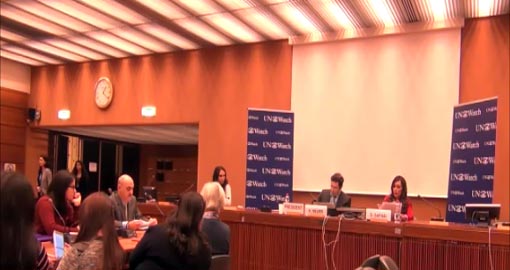
Mr. Davoud Baghervand Arshad who is the former high ranking member of the Mujahedin-e Khalq terrorist cult participated the meeting.
Mentioning the human rights abuses in the world, Mr. Arshad referred to the human rights abuses within the terrorist cults such as the MKO terror cult under the leadership of Masud and Maryam Rajavi based in Auver Sur d’Oise ; Paris.
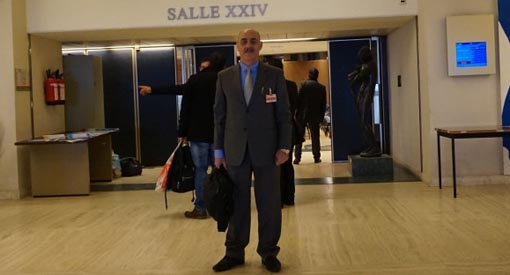
Mr. Arshad noted the recent horrifying report published by Guardian Newspaper on how ISIS recruits, indoctrinates and trains children as prospective terrorists and stated:
“At the present time shocking news of ISIS abusing human rights especially children’s rights publishes. Still I should indicate the fact that Mujahedin- e Khalq Organization under the leadership of Masud Rajavi is the godfather of ISIS. The crimes that ISIS is committing in 2016 have already perpetrated by the MKO in 1981.” As an example Mr. Arshad stated the recruiting and brainwashing of a 13 year old girl called “Gohar Adab Awaz”. Gohar was trained by the MKO terror group as a suicide bomber of a mosque in Iran.
“Later on the MKO separated children from their parents forcibly to be grown up and indoctrinated in the cult’s orphanages in Europe and US, as it had already separated spouses. The group’s plan was to use the brainwashed children in Iraq. The MKO killed some of these children who refused to take part in the war. The cult then registered these killings as suicides. To name some I can refer to Alan Mohammadi, Yaser Akbari and Marjan Akbari. Several youngsters were transferred from Europe to Iraq without their parents to be aware of the process. For instance, Zeinab Husseinnejad who as a child was studying in Paris. She was moved to Iraq and is held hostage by the cult now for many years.”
Mr. Arshad then referred to the threat of human rights abuses committed by the terrorist cults as being global in comparison with the human rights abuses in different countries which is restricted to that specific region and its people:
“.. We are all familiar with terrorist cults such as ISIS .. The human rights abuses within the cults can transform humans to monsters who are capable of shaping incidents like that of Paris terrorist attacks or terrorist incidents we are facing with in our country for many years.
We should not compromise with this terrorism which is a global threat. Leaders of these terrorist cults shouldn’t be allowed to reside and be active freely in Europe. They should be brought to justice. They should be held accountable because of the abuses of their own members and because of the crimes and terrorist activities they have committed in their own countries and elsewhere. Like Masud and Maryam Rajavi."
“Ladies and gentlemen currently many friends of mine are held hostages by the terrorist Cult of MKO in Iraq and Albania. They are helpless.” , Mr. Arshad reiterated.
Anne KhodabandehAnne Khodabandeh (Singleton) British journalist, Director of Open Minds cultandterror.com former Mojahedin Khalq activist, says their transfer poses potential risks not only for Albania.
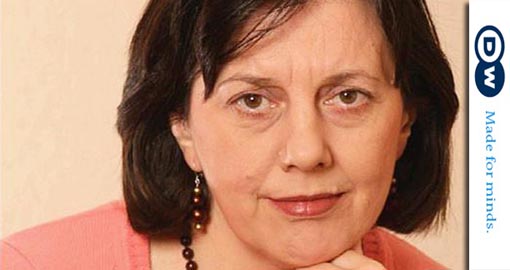
Deutsche Welle: Ms. Khodabandeh you are of the opinion that Albania’s agreement to take a further number of Mojahedin is associated with some risk. The international media talks about another 2,000 more Mojahedin going to Albania. What risk do they pose?
Anne Khodabandeh: There are many other NATO countries where the MEK could have gone, but only Albania agreed to accept the refugees. It would have been much better to have distributed the refugees among several countries instead of leaving Albania to take the whole burden. However, the move is very welcome since these people have to be moved somewhere for their own safety. Now they have a better chance of escaping their past and starting new lives as ordinary civilians.
The actual risk to Albania will be if the MEK is not disbanded as a group. Disbanding means that each refugee should be treated as an individual. They must be de-radicalised and then integrated back into normal society as ordinary citizens with homes and jobs and families. The MEK must not be allowed to re-organise as a quasi-military group. Clearly, Albania is not as strong as western European countries in this respect and so the process will be more difficult. But if it is done, then the country can take full credit for doing something not even the USA or the European Union could achieve.
DW: In one of your articles, you write that this is the relocation of terrorist group into Europe. Do you really think that a terrorist risk to Europe could come from Albania?
AK: It is important to remember that every member of the MEK who is relocated into Albania has been radicalised to the core. They have been undergoing terrorist training for up to thirty years in Iraq. They will not suddenly change just because the MEK name is removed from a list of terrorist groups or if they physically move to another country. They are still terrorists. Many have been highly trained by Saddam Hussein’s former Republican Guards Corps in specialist activities – from bomb making and terrorist strategies, to intelligence gathering and torture. The MEK is credited with inventing the suicide mission back in the 1970s.
DW: What do you think Albania should do?
AK: It would be a mistake for the Albanian authorities to dismiss the MEK as a defunct force simply because many of its members are old or ailing. They may not be a fighting force but they certainly have transferable skills and experience in terrorist training and logistics. These could be very useful to other terrorist organisations. The MEK has people who are experts in money laundry, people trafficking, fraud and corruption.
The location of Albania in the far south east of Europe makes it attractive as a gateway country into Europe. Without scrupulous vigilance the MEK camp could become a staging post for other terrorist leaders and commanders as well as acting as a terrorist training base.
DW: After the Mojahedin was removed from the list of terrorist organisations they could be said to be seen as allies of the Americans as they fought against Saddam Hussein. Is this fact not sufficient to exclude the possibility that they may pose a risk?
AK: The MEK have never been considered as actual allies by any western government. These governments may have benefitted from the MEK’s violent anti-Iran activities and have turned a blind eye to the support given to the group by various interest groups, but the MEK has never had governmental support except from Saddam Hussein. He paid and trained the MEK in terrorism for regime change in Iran. Expert US and EU assessment still regards the MEK as a ‘potential’ threat to Western interests.
DW: It is said that the Mojahedin Khalq helped in the fight against terrorism, why doesn’t the government in Iraq want them in their country?
AK: The MEK, referred to as Saddam’s Private Army, was responsible for the deaths of 25,000 Iraqi citizens, particularly among Kurds in the north and Shia populations in the south. For this reason, the group has many enemies in the country and their safety cannot be guaranteed.
After Saddam’s ouster, the MEK declared itself a friend to the US army and was disarmed. Over several years, Iraq’s security forces have gathered information which shows that the MEK still poses a threat to peace and stability in the country through its active support and help for insurrection forces linked to both Al Qaida and more recently Daesh.
DW: In Albania until now, they have live peacefully. Why could they be a threat to Albania right now?
AK: It is known that the MEK leaders Massoud and Maryam Rajavi are planning to establish a safe haven for themselves in Albania along with the majority of the members. They want to recreate the closed society which they have used elsewhere – in Iraq, North America and Europe – that allows them to operate outside normal legal constraints. In Albania they seek to exploit the relatively weak state of the country’s governmental, security and social institutions in order to establish an extra-judicial enclave of their own.
DW: In Albania the Mojahedin Khalq live as political refugees. As such they are included in the legal framework of the country.
AK: It is not possible to be both a political refugee and a member of a terrorist organisation. At present, because the MEK has not been disbanded, each person who arrives in Albania is still a de facto member of the MEK terrorist group, regardless of the status under which they were transferred. Their refugee status is nullified as long as they are living in MEK accommodation and obeying MEK rules. The Albanian authorities must not ignore the fact that these people are victims of cultic abuse and are living in conditions of modern slavery. No ordinary member is allowed to make independent contact with the outside world. The MEK leaders claim to represent the views and wishes of the entire membership but when they arrived in Albania about 200 of them left. This is something which humanitarian organisations, both international and local, need to urgently address. The MEK must not be allowed to close the doors against the outside world and must not prevent the people transferred from Iraq from contacting their families and the outside world.
DW: You were once a Mojahedin activist. Why did you leave them?
AK: Yes, this happened [recruitment and radicalisation] when I was in university after the Iranian Revolution in 1979. I was young and naiive. They said they were fighting for human rights in Iran, but as I got deeper inside the organisation, I saw the atmosphere of fear and secrecy. I realized they were not fighting to liberate Iran from tyranny, as they claim, but only working to save the leaders. So, I left.
British expert, Anne Khodabendeh, director of the popular online platform cultsandterror.com Open Minds, herself a former activist of the organization the Mujahedin, launched a campaign in 2001 to help the victims of the cult. In 2011 she published the book ‘The Life of Camp Ashraf’, named after the main Iraqi base of the Mojahedin Khalq. Today she works as part of the Prevent Strategy to prevent radicalization and violent extremism in Britain.
The original interview is Albanian which is Translated by Iran Interlink

Mir Bagher Sedaghi
……………….gasse26
2500 Biel/ Bienne
Switzerland
Orthodox Cathedral of Tirana
Rruga Deshmoret e 4 Shkurtit
Tirana 1001, Albania
Your Beatitude,
My name is Mir Bagher Sedaghi, a long serving member of the Mojahedin Khalq cult (aka, MKO, MEK, PMOI, …) who has now left this organization. I have been informed that the Rajavi cult has been trying to organize a meeting in your central church in Tirana under the pretext of “defending the lost rights of women”. I was delighted to hear that due to the whistleblowing of the local media during the last month the governmental officials have intervened and the show has been cancelled.
As a victim of this anti-women and anti-family cult I am happy and thankful to the Albanian officials who have stopped this misuse of Women’s Day.
Your Beatitude,
I have spent nearly 20 years of my life with this cult in Iraq. The cult leaders have denied us the right to marry, and the right to contact our families. My brother Mir Vaghef Sedaghi, who is still trapped in Rajavi cult even though he has now been transferred from Iraq to Albania, has not had any contact with our mother or father for over 27 years.
During the time I have been with Mojahedin Khalq I have witnessed their constant encouragement of violence. Their teachings included how to carry cyanide pills and how to break them in our mouth to kill ourselves and of course trained us how to effectively and efficiently kill others. This is no more than a violent terrorist group which has claimed the lives of thousands of civilians in Iran using indiscriminate bombings and mortar attacks. This is not an organization which would even remotely support the rights of women, even though it is now desperately trying to portray itself as such in your country.
Your Beatitude,
Critics and ex members of this cult know many women who have testified that they have been raped by the cult leader Massoud Rajavi. The related documents are available and many of these women are willing to testify in person in any court of law.
I would ask you to be vigilant and take care not to tarnish the reputation of the good church of Albania by letting these dirty inhuman people misuse it. This cult of course is hated by the majority of Iranians inside and outside Iran.
Other ex-members of this cult, like me, are more than happy to help should the church of Tirana like to know more or to receive documents and evidence.
Yours sincerely,
Mir Bagher Sedaghi,
Switzerland 09,03,2016
Can Albania Meet its Obligations and De-radicalize an Influx of Terrorists into Europe?
Situated on the east of Europe, Albania applied for membership of the European Union in 2009. As the poorest country in Europe and designated the most corrupt, there is a lot of work to be done before this country of 3 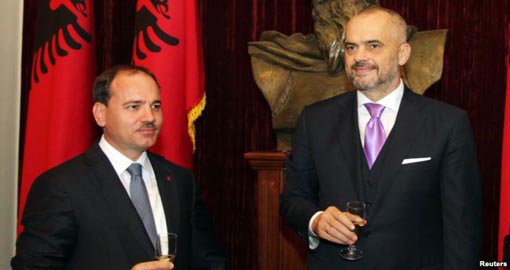 million people is accepted into the Union. A recent visit by US Secretary of State John Kerry does indicate that this work is well underway. But Albania’s efforts to reform and strengthen its political, security, judicial and civic institutions after years of dictatorship, could be drastically undermined if the country ignores or underestimates the threat posed by the arrival of the Mojahedin Khalq (MEK) from Iraq.
Albania is the target location for the transfer of the notorious terrorist organization Mojahedin Khalq into Europe. Currently based in Iraq, the MEK is now being transferred to Albania under a deal struck with America in 2013.
Since the 1980s the MEK were paid and trained in terrorism by Saddam Hussein to effect regime change in Iran. After his ouster in 2003 the MEK aligned itself variously with the US army – during Senator Kerry’s visit to Albania, the MEK was described as “a group that has supported the US in military operations in the Middle East and in its fight against terrorism” – as well as former Saddamists headed by Ezzat Ibrahim and more recently Al Qaida insurgents and Daesh in Iraq. Each successive government of the newly sovereign Iraq tried repeatedly to evict the group from their country, but the MEK leader Massoud Rajavi – himself a fugitive from justice – ordered his followers to put up violent resistance.
Even if they would agree to go willingly, the United Nations refugee agency has struggled to find third countries to take them in. It seems that, although Western countries have benefitted openly from the MEK’s sometimes violent anti-Iran activities, and found the group particularly useful as a thorn in Iran’s side through the period of nuclear negotiations, the MEK is deemed too dirty for them to willingly host any of them even as refugees.
In an attempt to encourage other countries to take some of the MEK, former Secretary of State Hillary Clinton persuaded the then Albanian Prime Minister Sali Berisha in 2013 to take just over 200 MEK members on humanitarian grounds. That process got underway, but in 2016 Albania is now expected to take up to 3,000 MEK after the President of Romania, Traian Basescu, refused to take them in 2014.
This agreement has attracted surprisingly little attention from either inside Albania or even from a world media sensitive to terrorism and organized crime. The reason is partly because the transfers are taking place in small groups of around twenty at a time in a piecemeal fashion as the UNHCR is forced to defer to Massoud Rajavi’s demands in order to circumvent threats of violence. Rajavi hand-picks the members he allows to be transferred, many using false identities. He ensures that each group of ordinary MEK members is accompanied by minders and enforcers to keep them under control and prevent them breaking loose. In order to accomplish their mandate to remove the MEK from Iraq, UN officials have had to accede to transferring the refugees under such conditions even though it reinforces the concept that the members belong to the MEK in conditions of modern slavery.
Once they arrive in Albania, the MEK leadership takes charge of the transferees. Although the US made a donation of $20 million to the UN refugee agency to help resettle the MEK, and according to a State Department official the US has provided the Albanian government with “security and economic development assistance, to help the country build up its physical capacity to house the refugees”, none of this benefits the individual refugees. In Tirana the MEK has purchased an abandoned university campus into which it has corralled the new arrivals and recreated the conditions of isolation and cultic control which have always prevailed for the membership. What started out as a humanitarian gesture has turned into the mass relocation of a terrorist group to Europe. The MEK has created a de facto enclave in Albania which is outside the law, just as they did in Iraq.
This has put the refugees out of the reach of the Albanian authorities and because they are not free to mingle with Albania’s citizenry, the influx of over a thousand trained terrorists has cleverly avoided detection and therefore controversy.
However, even though it appears that the MEK are somehow quietly contained, the citizens of Albania are entitled to ask whether the new refugees pose any actual threat to their civic life, to their security and to their ambitions to accede to membership of the European Union.
To answer this, we must ask why the Iraqi government is so desperate to expel them and why other Western countries are so extremely reluctant to accept them.
As a violent criminal organization, the MEK thrives where the rule of law is weak – in countries like Iraq and Albania which are emerging from past turmoil and troubles. In such conditions the MEK can be dangerous through criminal activity and violence.
As expert propagandists and manipulative persuaders, the MEK leaders have no problem making connections with and bribing government officials, power brokers and media types – let’s be clear, the MEK has always been well financed. Former MEK have also reported that the MEK leaders are already vigorously pursuing links with Albania’s mafia-like gangs. The MEK will work with these gangs for mutual benefit as they did with Saddam Hussein’s regime. In the long run, if the MEK organization does become established Albania – with the quiet collusion of political circles who benefit from the cult’s track record of terrorism – they will be better placed to do from Tirana what they can’t do from Paris.
The CIA characterizes Albanian corruption as a ‘transnational’ problem involving drugs, money laundering and illegal aliens. In this sense it is the very location of the country which makes it attractive to international criminal organizations and thereby creates huge problems for law enforcement agencies. Albania essentially acts as a gateway into Europe from the rest of the world.
Now, while the various routes to Turkey, Syria and Iraq are under stringent scrutiny, terrorist commanders from any mercenary group can slip beneath the radar and seek training and logistical support in Tirana. What better location to establish a clandestine terrorist training camp than in Albania? It is in Europe, but not in the EU and therefore not so open to scrutiny by the international community.
With the changed political mood following the nuclear deal between Iran and the P5+1, the MEK is looking for new friends and benefactors. The group has already aligned itself with the Syrian Free Army and has offered to help the Saudis fight against the Shias in Yemen. The MEK has over forty years of experience in terrorist activities. The real danger posed by this group is not only that they can re-arm themselves in Albania, but they can invite other groups in for training.
The worry is that the MEK has branched out and is open to do business with any terrorist group.
It is impossible to ignore the fact that MEK members are radicalized to the core. They are not ordinary refugees. Enough of them have been trained in Iraq by the former Saddam regime for terrorist activities as well as forgery, intelligence, military operations and even torture methods, to make them extremely dangerous. Above all, the nature of the MEK leadership style is cultic. This means the followers are not able to resist the orders of the leaders even if they wanted out. So there is a danger they will be used for a variety of criminal activities without their real consent. There are already examples of people trafficked by the MEK from Albania to Western Europe and used for money laundry activities in Germany.
However, the refugees could also be described as extremely vulnerable. Another reason they have not attracted attention is that the MEK can easily be dismissed as a defunct fighting force; the average age of its fighters is sixty years old and many of them are ailing with mental and physical disease after years of punishing training in the Iraqi deserts. But while this is true of the majority, there are still many among them who are expert terrorist recruiters and trainers, people who know how to train others for suicide missions; strangely transferrable skills in today’s world of global terrorism.
Not all the members who arrive in Albania do stay with the MEK. There is a growing community of formers – around two hundred to date – who have turned their back on the group and want to return to their families and to normal life. Interestingly, it is from this pool of former members that the US has carefully selected a quota of eighty individuals to be given asylum in America. They have undergone rigorous interviews to ascertain that they have completely rejected the MEK and so no longer pose any danger. Some others have been accepted by other European countries under the same conditions but the rest remain in Albania under conditions of hardship.
With the stakes set very high, Albania’s authorities will need to stop this organization from covertly establishing a terrorist base in Europe. The first step would be to remove the MEK members from the source of their radicalization. If this doesn’t happen, the problem will simply have been moved instead of being solved.
The authorities in Tirana can ensure that all the newly arrived refugees are treated as individuals, not as belongings of the MEK leader. They should be given protection and helped with accommodation and financial support as people entitled to determine their own future paths. Experience in Iraq has already shown that once these people are physically removed from the coercive atmosphere imposed by the MEK leaders and reinforced by their peers, they very quickly find that their commitment to terrorism evaporates and the de-radicalization process can begin.
De-radicalization is greatly helped when they have contact with their families. There are numerous examples of former MEK who managed to leave the cult and establish new and successful lives. Some now live in various western European countries because they have family there who have been able to help them. Some have returned to Iran – even though Iran doesn’t want them back – where they have been granted amnesty and lead normal lives under the supervision of the UN and ICRC. Some others now live in Iraqi Kurdistan and have transferred their family assets there from Iran there so they can set up in business.
Once they are out of the ‘pressure-cooker’ of the cult their lives can be sorted out through humanitarian organizations. As a Red Cross official told the authors, ‘As individuals, three thousand is nothing, we sort out millions every year. But as a group, neither us nor any other organization can deal with or help them.’ It is a choice the Albanian government cannot ignore, for to do nothing is to risk everything.
Massoud & Anne Khodabandeh
Co-authored by Anne Khodabandeh
Mr. Ashur Varshi, 46, is the most recent defector of the Mujahedin Khalq Organization (the MKO). He escaped Camp Liberty a few weeks ago. He is residing in a hotel in Baghdad now, in company with other survivors of the  MKO. He is in contact with his family.
Varshi joined the MKO 27 years ago. As a 19–year–old teenager his ideal was the overthrow of the Islamic Republic through armed struggle. But ultimately, the totalitarian and manipulative system of the group made him leave it. ”After 27 years of companionship with the group, I was threatened to death (by Alireza Budaqchi under the pseudonym of Ahad) just because I had said that the leader’s arguments were not realistic,” Varshi writes. “He [Ahad] used to pressure me to praise the leader’s words.”
Ashur who was labeled an anti-leader agent, was eventually supervised all the time. ”There was an absolutely suppressive atmosphere,” he recounts.” I was repeatedly summoned by them; and I was faced with mental torture in order to stop criticizing the group.”
As a dissident member of the Cult of Rajavi, Ashur was brave enough to question the leaders for their dishonesty but the answer was more punishment. ”with each punishment, I got more assured that the MKO was not the same group I once had joined for struggle, so I admitted any danger and pressure.’’
He paid a heavy price for the disagreement he voiced against the group leaders. ”I preferred to be bombed, to be attacked by missiles everyday instead of talking with a bunch of brainwashed torturers,” he states.
Ashur Varshi warns the Iranian youth to be careful about Rajavi’s propaganda.”Now, I see that what I’ve been told in the group was not the truth,” he regrets the years he lost inside the bars of the Cult of Rajavi.
But, he is hopeful. “I’m free now”, he writes.” I do my choirs and I’m in contact with my family. I want to leave the past behind and begin a new life.”
The second part of the series on the assassinations committed by the MKO authorities, contains the elimination of another high-ranking member of the group named “Mehdi Katiraei” whose pseudonym was “commandant Sasan”.

Former member of the MKO, Mohammad Karami introduced Mehdi Katiraei in his interview with Mardom TV: “He was the deputy commandant of the June 20th protest which marks the start of the MKO’s armed struggle against Islamic Republic. He was then in charge of training partisans in Iraqi Kurdistan.”
After the so-called ideological revolution that turned the MKO into a destructive cult, Katiraei was a member of the group’s political office. Like Ali Zarkesh, he was opposed to the establishment of the National Liberation Army. “He was strictly against the establishment of the NLA so Massoud Rajavi was very angry with him,” says Mohammad Karami.” Because of his critics against the group’s strategy, he was demoted to rank and files.”
Then, Mehdi was brought to trial and sentenced to death by Massoud. He was imprisoned in the SouthWestern side of Camp Ashraf. Later, Massoud Rajavi launched his Eternal Light operation against Iran. It was a great opportunity for him to get rid of dissatisfied members such as Ali Zarkesh, Majid Hariri, Mehdi Katiraei and many others.
During that catastrophic operation, Mehdi was shot to death from behind.
In a dictatorship maintaining of absolute power requires one important action: elimination of opponents. As a totalitarian cult of personality, the Mujahedin Khalq Organizaion (the MKO) could not survive for over three decades without eliminating the opponents and critics inside the group. According to various reports and testimonies, there have been numerous cases of assassination of dissident members of the Cult of Rajavi. Some of these assassinations were then reported by the group’s media as suicide or even martyrdom.
These series of editorials will cover certain cases of internal eliminations in the MKO which are more significant in the group’s history and have been confirmed by several witnesses although there must be many more secret murders in the cult that few people might know about them.
 |
| Ali Zarkesh Yazdi in prison before revolutions |
Ali Zarkesh might be the most important figure in the MKO whose removal from the group has been very controversial. Ali Zarkesh was the second person of the MKO and actually Massoud Rajavi’s rival. In 1986 Zarkesh was sentenced to death penalty by Massoud and Maryam Rajavi.
. Mohammad Hossein Sobhani, former member of the MKO, wrote a book on his life in the MKO, titled “Dark Days of Baghdad” in which he recounts the case of Ali Zarkesh in details. According to the book, Zarkesh’s death sentence was then reduced to imprisonment.
As Massoud Rajavi wrote in a letter to one of the group’s high-ranking member, Saeed Shahsavandi, Zarkesh was punished because he had “repositioned”! What kind of repositioning deserves death punishment?
Based on the testimonies of former members the answer was never revealed. But again based on facts witnessed by former members, Zarkesh criticizes Massoud Rajavi’s armed struggle policy for it doesnot result in the overthrow of the Islamic Republic. He is against the establishment of the so-called National Liberation Army (Saddam’s Private Army) because he sees it as a mistaken failed strategy.
Despite his opposition against military invasion, Ali Zarkesh is treated as an ordinary soldier in the MKO’s military operation across Iranian borders “Eternal Light” (Forough Javidan). He is simply killed in that disastrous operation in which a large number of the group forces were sent to death.
Morgan-Davies, daughter of the cult leader, said she wanted to escape from being the “non-person”. She was under her father who “was just obsessed about control”. Morgan was the “slave” daughter of the Maoist cult leader Aravindan Balakrishnan who jailed her for 23 years for her imprisonment and repeated sex attacks on two followers, according to the Guardian.[1]

Every day, the world comes across revelations about abusive cults that indicate how much the world is exposed to the threat of cults. The most crucial characteristic of a destructive cult is its power to isolate people from the free world. In the isolated atmosphere of the cult, leaders have the opportunity to commit the most horrific abuses against their victims.
The No Exit report of the Human Rights Watch on the human rights abuses committed in the Mujahedin Khalq Organization, published in 2005, presents various examples of violation of human rights under a strict cult-like control. 2[]
Prior to the HRW’s report, Elizabeth Rubin visited the group’s then headquarters in Iraq Camp Ashraf in 2003. Eventually, she wrote a detailed report for the New York Times under the specific title “The Cult of Rajavi”. She described the camp as “a fictional world of female worker bees” and “a factory in Maoist China”. [3]
The above mentioned reports and many other reports and evidences on the life inside the MKO point out common features of cult leaders that aid them abuse their victims. As Morgan Davis told reporters about her father, “The people he looked up to were people like Stalin, Mao and Pol Pot and Saddam Hussein.” [4]
One of the victims of years of sexual abuse by Balakrishnan, also said she was “traumatized, shocked and horrified at what he habituated me to and against which I had no defense. I will live with this torment for the rest of my life.” [5]
The other rape victim described Balakrishnan as “such an evil force” and said she suffered fear and nightmares. “He wreaked havoc on every part of my life before and after I left,” she said. “He literally shattered my life.” She said she had never managed to fully rebuild her family relationships. [6]
This is the very characteristic of the leader of the MKO too. Although Massoud Rajavi tries to cover the abusive nature of his cult under the mask of a pro-democracy political organization, he is usually symbolized by dictators including Polpot and Saddam Hussein. Professor Paul Sheldon Foote from California State University writes: “the During the American hostage crisis, the MEK participated and called for the executions of the Americans. Rajavi is anti-American, anti-imperialist, and anti-capitalist. His aim is to become the Pol Pot of Iran, even if the MEK must become a tool of the American government to achieve his aim.” [7]
Massoud Rajavi’s similarities with other dictators originates from his cultic attitude towards his followers. Thus, his character can also be compared with that of Aravindan Balakrishnan and other cult leaders like Ziona who is another example of such cult leaders whose greed for women is endless. He rules a polygamous cult in India.
Ziona, 70, is the head of a local Christian religious sect”Chana”, which allows polygamy and was founded by his father Chana on June 12, 1942. The sect believes it will soon be ruling the world with Christ and has a membership of around 400 families. Ziona has 39 wives, 94 children, 33 grandchildren and 14 daughters-in-law. Ziona is feared and worshiped by all in the village. What’s even more strange is that Ziona’s followers firmly believe that he will one day rule the earth with Jesus. [8]
Now, let’s get back to Massoud Rajavi. He runs a polygamous cult, according to the testimonies of former female members of the MKO. Batoul Soltani is one of the female victims of Massoud Rajavi whose revelations about abuses committed in the cult has become a credited source for cult experts. . This is Wikipedia’s account about this victim of the Cult of Rajavi:
“Batul Soltani (born in 1965) is an Iranian politician who is former member of the leadership council of the People’s Mujahedin of Iran (PMOI. Soltani is a political activist and critic and a former twenty-year member of the Mujahedin leadership council. In December 2006, she escaped from the Camp Ashraf. In interviews regarding the Rajavi cult as an example of cultic behavior and mind manipulation. she has spoken about the sexual exploitation of the women in this cult after the her escape. She continued by pointing to numerous cases of Rajavi’s exploitation of the women of this cult and said: “Massoud Rajavi was using many of the divorced women in this cult, who had been forced to separate from their husbands to satisfy his sexual desires.” [9]
Batoul’s shocking revelations about what is going on inside the MKO camps is available on Nejatngo website in details. Her bitter experience of living in the Cult of Rajavi is confirmed by other female defectors of the group including Zahra Mirbagheri and Nasrin Ebrahimi who also left the group in the past decade.[10]
Isolated from the outside world, Massoud Rajavi tries to keep his victims as non-persons whose rights and even whose existence are ignored. The news of violation of human rights, sex abuse, child abuse, manipulative control and etc. in cults, as recent as 2016, is a warning for the world community that the threat of cults is not over. More than three decades after the tragic ending of the cults in Jonestown, Guyana and the Waco, Texas the authorities of countries should still beware of such a menace. They should be even more cautious than before because these cult members who have been under severe mental abuse have the potential to simply turn into extremist terrorists like Al Qaeda and ISIS.
Mazda Parsi
References:
[1] Booth, Robert, Maoist cult leader jailed for 23 years as ‘slave’ daughter goes public, The Guardian, 29 January 2016
[2] https://www.nejatngo.org/en/posts/79
[3] Rubin, Elizabeth, The Cult of rajavi, the New York Times Magazine, July 13, 2003
[4] Booth, Robert, Maoist cult leader jailed for 23 years as ‘slave’ daughter goes public, The Guardian, 29 January 2016
[5] ibid
[6] ibid
[7] Sheldon Foote, Paul, American Demons, paulsheldonfoote.blogspot.com, November 13, 2011
[8] ZeddMonsang, Strange polygamous Christian Cult, The More the Merrier!, The Zephyr Diaries
September 29, 2012
[9] Wikipedia
[10]https://www.nejatngo.org/en/tag/womens-rights-abuse-by-mujahel
Following the recent trip of the third group of Liberty residents’ families to Iraq, the Iraqi mass media widely covered the news of the event.
Iraqi newspapers and websites published reports on grieves of families of residents, who are not allowed to visit their loved ones taken as hostages by leaders of the Mujahedin Khalq Organization (the MKO/the cult of Rajavi).
Iraqi official newspapers such as Kul al Akhbar and news websites like Babil News, Ketabat fil Mizan and Wikileaks Baghdad published letters written by the families and reported on their efforts to visit their loved ones in Camp Liberty.
In a full-page report, Kul al Akhbar reported on the activities of the picketing families in front of Camp Liberty, interviewing some of them. The report included photos of the picketing families under the title: “A number of Iranian families told Kul al Akhbar the tragic story of their grieving children.”
“Parents who are awaiting the visit of their dear ones despite all troubles”, the report describes the families. “Who help their desires come true?”
The newspaper calls Iraqi Government, the United Nations and all human rights bodies to pressure the MKO leaders to evacuate Camp Liberty.
Kul al Akhbar reported that in Camp Liberty human rights are violated; people are terribly deprived of freedom. Hostages are not allowed to contact their families and families – who come from different towns of Iran- are not permitted to meet their children even for an hour. Instead, families are verbally abused and attacked by the brainwashed members of the group.