Maryam Rajavi is not a democratic opposition leader but she is the evil hand to run the dictatorship of her husband’s cult of personality

Leila is the Youngest child of Rahim Kayukan. She was born in 1979, two years before his father, Rahim would leave the entire family behind to join the Mujahedin Khalq Organization, in September 1981. When Rahim left the family other siblings of Leila, Mozhgan, Mehran and Mosen were respectively, 13, 10 and 4 years old. At the time, their mother, Behjat Sediqi was 32 years old and since then she has never been contacted by her husband.
For four decades, Rahim Kayukan has been a member of the Mujahedin Khalq and is in the group’s camp in Albania now. He is one of the thousand Iranians who are kept under the cult-like structure of the Mujahedin Khalq. Rahim was a flight technician of the Iran National Airlines when he was recruited by the MEK. What has stopped Rahim from contacting his wife and children during these long years?
It may seem strange how intelligent people can get caught up in such a bizarre and dangerous cult like the MEK. But the fact is that cults target individuals throughout their life spans and across all socioeconomic groups and backgrounds.”Regrettably, it is impossible to quantify how many people are involved in potentially damaging cultic religions or similar ideological commitments,”Doni Whitsett & Stephen A. Kent assert in a paper on”Cults and Families”.
The authors of the article, referring to a large number of comprehensive books and researches on the issue, attempt to raise the awareness in ways that facilitate the ability of professionals to evaluate the impact of cults on some people who get trapped in these cults. They focus on both families within the cults and families outside of cults that are impacted by the cultic involvement of one or more of their members.
According to Whitsett and Kent,”A frequent consequence of cult involvement—and one that may have dramatic implications for diagnosis and treatment of former members—is the assault that these groups make upon family units among their adherents“. The evidence is officially published on the MEK-run websites from time to time, particularly after, each family member of the MEK adherents try to call on human rights bodies and file appeals against the MEK leaders.
In case of Leila Kayukan, her recent testimony in court made the MEK propaganda agents assault her family by accusing her of being dishonest about her father. This is an official position taken by the MEK vitrines in the social media which is exposed to the outside world. Not mentioning the way they treat members and their families inside the isolated camps of the Cult of Rajavi.
The authors of”Cults and Families”, believe that cult leaders use several factors to break the bonds between members and their families.”These factors include intensive resocialization into the new, deviant beliefs and behaviors; the demonization of people’s pre-cult lives; intense punishment and shaming regimes; restrictions on exogenous social contacts; heavy financial and time commitments; and constant demands to value group commitments over family considerations.”
According to the article, cult leaders impose various regressive techniques on their members that interfere with their ability to critically assess their situations. Authors also assert that the most virulent forms of regression.This kind of treatment demonstrate the disordered personalities of the cult leaders. however, probably reflect the disordered personalities of some leaders. They present several examples of cult leaders who suffer from various forms of psychological dysfunction.
“Many groups attack the formation of parent–child bonds by geographically separating children from their parents,”they state.”For example, various Eastern-based religious groups operate educational facilities back in their home countries, and often Western followers send their children to these overseas facilities for schooling. Consequently, children and parents see each other very infrequently, as distant strangers assume child-rearing and educational responsibilities. The children, therefore, cannot rely upon their parents in times of need.”
In addition to children like Leila and her siblings, there have been many children who were taken to the MEK camps by their parents but later on they were separated from them. then distanced from them. The number of children who have been separated from their parents by the MEK leaders mount to over 700. In just one cargo, over 300 children were separated from their parents in Camp Ashraf and were transferred via Jordan to Europe in 1990. The horrible fates of these children should be considered as cases of child and teen abuse.
Moreover,”similar threats to those directed against parent–child relationships also exist against spousal relationships”. The authors of the paper suggest,“In highly restrictive groups, strong marriages challenge leaders’ ability to control and receive the constant attention of the two partners. Moreover, couples are likely to establish private confidences—to share intimate feelings, dreams, desires, and perhaps doubts—all of which threaten paranoid leaders and evoke envy in those who have narcissistic and borderline personality disorders.”Therefore, forced divorces and mandatory celibacy in the MEK are definitely the sign of Massoud Rajavi’s personality disorders.
Thus, Rahim Kayukan and hundreds of his peers are trapped in the Cult of Rajavi. They are not allowed to talk and even think about their family. They are under daily pressure to denounce any relationship with the world except with the orders of the leaders Maryam and Massoud Rajavi. This is always mentioned in the testimonies of former members of the group and confirmed in the article too.
To download the video file click here
“Often groups require members to reveal their supposed deficiencies and shortcomings in assemblies, meetings, or other public settings,”Whitsett and Kent write.”Members, therefore, are trapped in double binds. On the one hand, if they go public with doubts or private opinions, then others will attack and possibly expel them. On the other hand, if they withhold their private (and possibly negative) thoughts, then they likely feel deceitful and inadequate to the tasks of their groups’ missions. Thus, many members are locked in inner battles between self-protection and group solidarity. Because they are torn in these ways, it is exceedingly difficult for them to provide emotional and cognitive guidance to children (not to mention to other adults).”
It is clear that, members of MEK have no way out of the Cult-like system of the group. They are certainly live cases of human rights violation that the International community is responsible to rescue them before irreparable damage is taking its toll.
Mazda Parsi
Publication: Terrorism Monitor Volume: 16 Issue: 19
Following the U.S. invasion of Iraq, the Mujahedeen El-Khalq (MEK) was the subject of frequent attacks from Iranian-backed proxies, which overwhelmed their members residing in camps Ashraf and Liberty in Iraq. Before this, MEK, an Iranian dissident group, began living in Iraq in the early 1980s under the protection of Saddam Hussein. As a group in exile, MEK sought refuge in Iraq under the protection of Hussein, who utilized their military capacities and ties to Iran to undermine the Iranian regime. Until 2012, the MEK was identified as a terrorist organization due to its activities inside Iran and against other regional and international powers, including attacks against U.S. diplomatic personnel and businesses operating in Iran in the 1970s. [1]
Following a series of lobbying efforts by MEK leadership and supporters, the group pledged to give up their weapons and violent tactics as a means to be delisted as a designated terrorist organization. [2] As a consequence, in 2013, the U.S. government pleaded to a number of governments to provide refuge to the MEK members, including Romania, which was the preferred destination at the time. Albania—grateful to the United States for its support during the war in Kosovo and advocating for its bid to join NATO and the EU—was the only country that responded positively to the request. Albania initially admitted some 200 members between 2013 and 2014. The United States and Albanian governments have extended the agreement since 2013, increasing the number of asylum seekers to somewhere in the range of 500-2,000 MEK members. During the summer of 2016, Tirana received the largest contingent of about 1,900 people, an operation managed by the UNHCR (Shekulli, March 12, 2016). Part of the agreement with Washington was the development of deradicalization and rehabilitation programs to be offered to members of the group.
Now, the group is residing in the outskirts of Tirana’s capital in a highly fortified camp located in Manëz. From this camp, the group is allegedly intensifying its political activities aimed at bringing down the Iranian regime (Exit.al, March 14). With emerging threats coming from radicalization and violent extremism, due to the rise of the Islamic State and other political Islamist groups in the region, the Albanian government may not be prepared or equipped to respond to the potential implications the group’s presence in Albania may bring.
MEK Activities and Support in Albania
There are a number of opportunities MEK is exploiting in order to restart its political activities against the Iranian regime now that they are residing in Albania. Recent propaganda efforts by the group’s leader, Maryam Rajavi, the widow of the founder of MEK, Massoud Rajavi, suggest that she sees herself as a key actor in fostering the opposition in Iran and subsequently bringing down the Khomeini regime (Exit.al, March 14). Much of the group’s propaganda material available online is translated in Albanian and seeks to also reach out to a local audience in their host country (Iran-interlink.org).
Moreover, the group has gathered significant support from important U.S. leaders who do not shy away from expressing their support for MEK’s potential rise as Iran’s future “democratic government” (Exit.al, June 26). This sentiment is frequently expressed on a number of occasions when important figures of the U.S. political landscape have personally visited Albania and spoken at rallies organized by MEK in Tirana (KlanTV, March 21). The most recent gatherings saw figures such as John Bolton (now U.S. National Security Advisor), Rudy Giuliani, one of President Trump’s most trusted advisors and personal lawyer, and late U.S. Senator John McCain, among others. The three seemingly demonstrated their support for MEK to be at the center of regime change in Iran (Exit.al, June 26).
The reasons why the Trump administration is supporting the group’s political objectives are unclear. It is also unclear the level of support MEK still has among the population in Iran, but it is becoming increasingly obvious that MEK is also making some powerful friends in Tirana as well. Over the years, key leaders from the Albanian government and civil society organizations have similarly provided their support during rallies and conferences organized by MEK in Paris as well as in Albania, where its new headquarters are located. In May 2015, Albania’s former Prime Minister during the war in Kosovo and current Minister of Diaspora, Pandeli Majko attended the National Council of Resistance of Iran rally in Paris with a large delegation of parliament representatives, journalists, lawyers and some civil society representatives, reiterating Albania’s support for Iran’s resistance and promising his personal support for regime change. [3]
In an impassioned speech over a cheering crowd, Majko said “whether you want it or not, you have involved us in your story, in your drama, in your tragedies and we understand you very well…some years ago, an American President was in Berlin and from Berlin, this politician, this great man declared ‘Ich bin a Berliner’. And in the name of my friends and in Albania, I’ve come here to say ‘Men mujahed astam’. I have a dream to come soon to Tehran. Invited by you.” [4] At the time, Majko’s attendance in the Paris rally was not covered by local media.
Despite the group’s increasing political support, recent media reports and several incidents between MEK members and local communities in Albania expose their continuing secretive activities and ongoing struggles to receive legitimacy as a democratic organization. Over the years, several media agencies have been interested in documenting the lives of MEK members in Albania and their political struggles in Iran. Channel 4, a well-known British news agency, recently traveled to Albania to do the same. The film crew was met by hostile private security who were guarding the highly fortified Manëz camp. Camp members physically attacked Channel 4’s camera crew (Shqiptarja.com, August 19). This was an unprecedented event that raised several questions over the camp’s activities (Lapsi.al, August 19). The event was widely reported by local media, which was also able to obtain a threat assessment on the group by Albania’s Intelligence Agency. According to the report initially made available to Channel 4 and then to other Iranian and local media, the group remains “deeply indoctrinated” and some of their activities, including murders of their members, are similar to the ones in Iraq (The Iranian, August 2018).
Testimonies from dissidents who left the group in recent months speak of similar military trainings, indoctrination and pressure to follow the group’s ideology (Top Channel, February 13). Although in the early years some of their members who relocated to Albania sought opportunities to travel abroad and join family members in the West, some 200 members have fled the group and continue to live in Albania (Top Channel, February 13). There is no clarity of their legal status or the employment opportunities available in a country suffering from high unemployment rates. However, some advocacy initiatives—often seemingly pro-Russian and pro-Iranian—are already fostering opposition against the group. Some of this opposition is often portrayed by the MEK leadership as an operation conducted by Iran’s security agencies (Lapsi.al, August 19; Media e Lire, April 17; Nejat NGO, September 29) Moreover, integrating the rest of the members still in Manëz into Albania’s society does not seem to be in the immediate interest for the MEK.
Implications
The MEK’s presence and activities may have serious repercussions for Albania and Albanian policy-makers. Leaders in Tirana may not foresee the long-term consequences of expanding their role on foreign policy issues beyond the small Balkan nation’s traditional reach. The group remains an existential threat to the Iranian regime. Over the years, Tehran has supported significant raids via Hezbollah and other proxy organizations in Iraq to destroy the group and kill key MEK leaders. As a result, Albanian authorities should expect more involvement from Iran in its internal and regional affairs. At the moment, there are no clear signs that Iran’s presence is significant in the region. Authorities in both Kosovo and Macedonia, however, have raised alarm bells over Iranian-linked NGOs having ties to terrorism-related activities in the past (Balkan Insight, June 25, 2015). If no effective responses are undertaken, MEK’s presence and Iran’s attention towards the Western Balkans may inflame sectarian divides in smaller communities and amplify regional rifts. Sectarian division is a latent phenomenon among Albanian Muslims, but they also remain under the pressure of other forms of Islamist radicalization. This is due to the emergence of Islamic State and Turkey’s instrumentalization of political Islam, among others.
Albania continues to struggle with endemic corruption and organized crime and the emergence of religious radicalization as a regional security threat and potential sectarian rifts may add to the list of challenges facing Albania’s political landscape. As a result, the country may not be prepared to inherit a long-standing struggle between a major regional Middle Eastern power and a former terrorist organization. Especially since both may utilize Albania’s internal vulnerabilities for their own political gains.
Notes
1.See U.S. State Department Press Release (US State Department, September 28, 2012).
2.Pandeli Majko’s speech in Paris, May 10, 2015:
3.https://www.youtube.com/watch?v=kIR97EP_phE
4.Ibid.
First published in October 12, 2018
By: Ebi Spahiu – jamestown.org
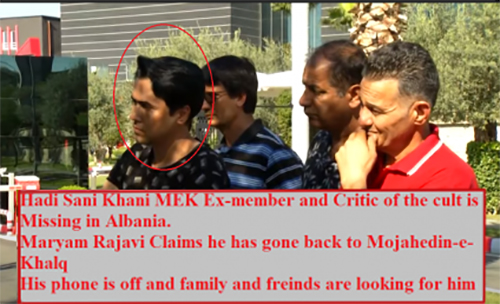
A number of defectors of the Mujahedin Khalq Organization (the MKO/ MEK/ PMOI/ the Cult of Rajavi) took action to denounce the group for kidnapping another former member, Hadi SaniKhani.

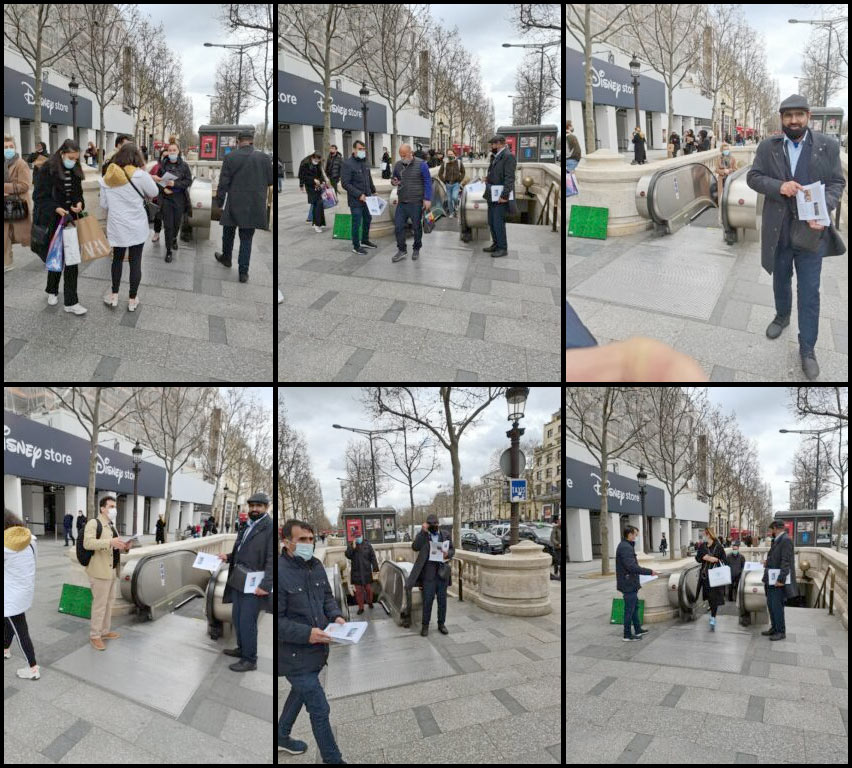
Tens of former members of the MEK distributed flyers and brochures on the case of Sanikhani among citizens of Paris and its suburb. Hadi Sanikhani was recruited by the MEK in Turkey and then smuggled to Iraq to stay in the group’s cult-like system. He escaped from the group after it was relocated in Albania but after a few years he was disappeared. The MEK propaganda websites published some papers allegedly signed by Sanikhani.
Defectors believe that the MEK leaders have probably smuggled Sanikhani to France territory. They warned the French authorities and citizens about the MEK’s unlawful activities in France.
The group’s recent interactions with the United States are divided up into two parts: The first part was during the Trump era and the second part has been started since Biden’s entry into the Oval Office. Since Donald Trump was inaugurated as the 45th President of the United States and with regards to his international policies in cahoots with Israel, MEK assumed that it was the high time that it could achieve its purposes.
To download the video file click here
In the first step, they tried to reduce their violent acts as they expected that the Iranian government overthrows during this period and they can take power in Iran. As mentioned earlier, violence is an inseparable part of this organization and taking that from them would lead to an internal crisis.
The recent disappearance of former MEK member Hadi Sani Khani from Albania is not a new phenomenon as this Special Briefing shows. Ten years ago, Ambassador Daniel Fried, US Special Advisor for Camp Ashraf in Iraq, acknowledged that Camp Ashraf had been “a kind of independent, self-governed, autonomous, extraterritorial facility… for many years”.

This state has been replicated in Albania in Camp Ashraf 3 in Manez. He acknowledged that residents of the camp had not always got there voluntarily, referring to the RAND Corporation report and that of Human Rights Watch, and that potential threats to the residents may be internal rather than external.
Since arriving in Albania, several MEK members have been killed or gone missing from the extraterritorial facility there.
——–
American Special Advisor, Daniel Fried: Take a look at RAND and HRW reports on Mojahedin Khalq, MKO, MEK, Rajavi cult
American State Department, December 20 2011

MR. VENTRELL: Okay. So we’ll go ahead and get started. Everybody, this is Ambassador Fried. This session is on the record, unless otherwise indicated. We do have the director of our Iraq office here to go into some further detail if necessary. But as we start, this is all on the record, unless otherwise indicated.
So Ambassador Fried, please go ahead.
AMBASSADOR FRIED: I’ll start out with some prepared remarks and then take your questions if that’s all right. Oh, and forgive me if I speak a little slowly. This is the result of Novocain and the dentist this morning.
The U.S. seeks a safe, secure, humane resolution of the impasse at Camp Ashraf. Our interest is humanitarian and independent of our views of the MEK’s past record. Thanks to intense efforts by Ambassador Martin Kobler, the head of the UN Mission in Iraq, a reasonable path forward for a safe and secure relocation from Ashraf to Camp Liberty is at hand. On Christmas Day, Kobler signed with the Government of Iraq an MOU that provides details of the transfer and commitments from the Iraqi Government for the safety and security of the residents of Camp Ashraf.
The residents of Camp Ashraf will be moved from Camp Ashraf to former Camp Liberty, which used to be a U.S. military facility and is located near the Baghdad Airport. UNHCR is – will begin immediately to process these people for refugee status. At the same time, those wishing to return voluntarily to Iran as, by the way, several hundred from Ashraf have already done, will be able to do so.
The UN will conduct 24/7 monitoring at Camp Liberty – or former Camp Liberty. In addition, Embassy Baghdad will visit former Camp Liberty on a frequent basis to provide robust observation. The Government of Iraq has agreed in this MOU to the safety and security of Camp Liberty and those there and not to forcibly repatriate any resident of Camp Ashraf/former Camp Liberty to Iran. The Government of Iraq accepted many of Ambassador Kobler’s suggestions, and the plan agreed now reflects major progress since the discussions began. Secretary Clinton, the EU, UN Secretary General Ban Ki-moon have all publicly welcomed the signing of the MOU and have urged that it be implemented in good faith by all sides.
This is Iraq we’re talking about, however. We must be realistic about the difficulties. We’re also acutely aware of the mistrust and even animosity between the MEK and many Iraqis, given the MEK’s history in Iraq. We’re concerned by the recent series of rocket attacks on Ashraf and we condemn them. While these have not caused injuries or damaged property, they heighten and underscore the risks in this situation. U.S. facilities in the area have also been under attack recently.
The UN has expressed its concerns about these attacks to the Iraqi Government. We are doing so as well. Nevertheless and for – perhaps especially because of these attacks, it’s important to move ahead with the MOU. We welcome the willingness expressed yesterday by the MEK to cooperate with implementation of the MOU, specifically their announcement that they are prepared to move the first 400 persons to Camp – to former Camp Liberty. That move is being prepared now.
The UN is putting its assets in place for monitoring and refugee processing. It’s up to the Iraqi Government to prepare Camp Liberty, to receive the first residents of Ashraf, and this is likely to take several more days at least. It’s important that this first move be followed by other moves from Ashraf to former Camp Liberty. Ashraf is relatively isolated and, frankly, less secure than Liberty will be with its UN monitoring and a frequent U.S. presence. We also hope the day-to-day issues of camp management can be worked out on the ground as, hopefully, confidence grows.
The good news is that we are finally entering a phase of implementing an agreement that’s been painfully negotiated and is understood by all sides. But implementation will take sustained cooperation and patience by all. The U.S. will remain closely engaged in all stages of this process.
So with that, let me take your questions.
QUESTION: So how many people in all are we talking about moving? You said a few hundred have gone back to Iran.
AMBASSADOR FRIED: The MEK says there are about 3,200 people at Camp Ashraf. Years ago, when the – in the early phases of the Iraq conflict, we identified about that number of people, but we don’t know how many people are there now. We don’t know how many have left.
QUESTION: Okay. But several hundred, you said, have gone back to Iran?
AMBASSADOR FRIED: We – yes. We believe several hundred have gone back to Iran voluntarily over the years, not recently. Recently, a number of people at Camp Ashraf have gone back to European countries where they have either citizenship or long-term residency. This has been relatively small in numbers, but it’s picked up in recent weeks.
QUESTION: And do you get the sense that some of these people that will be moving over to Liberty are going to want to move on further or that could be their —
AMBASSADOR FRIED: Well, they all want to move out of Iraq. That seems to be – well, let me back up by saying we don’t know actually what the residents of Camp Ashraf want. We know what their leaders say they want. And what they say they want is for them to leave Iraq in safety and security. There is some number – and estimates vary very widely – of how many will actually want to go back to Iran.
Our view is that if residents of Camp Ashraf want to go back to Iran, this is their right, but it has to be really voluntary and not, quote, “voluntary.” That’s why I mention that some hundreds have gone back already. According to international organizations, there is no evidence that they have been mistreated by the Iranians, but we can’t verify that independently for ourselves.
QUESTION: Have they – have the Camp Ashraf group – have they given you any sort of timeline that – you said the first 400 are going to be ready to move. When do you expect them actually to move? When is the camp going to be able to accept them? And do you have a sense that there’s going to be a clear follow-on from that, that they’re going to keep on moving more and more people? Or is this first 400 sort of a test group?
AMBASSADOR FRIED: In the last 48 hours, we have been heartened by the increased willingness of the leaders of Camp Ashraf and the MEK leadership in Paris to participate in this process. We believe that the first 400 are ready to move soon. The – as I said, former Camp Liberty has to be set up, the infrastructure has to be put in place, and this will – it’ll take, we think, at least several days for this to be done. But under the circumstances, we think that the 400 should move as soon as possible, and this should be followed up by more moves.
There are issues of how the new facility will run. Some of these issues were addressed in the MOU. But in reality, they can be worked out on the ground. It’s important now that people start leaving Camp Ashraf, which is really not a secure place, and move to a place where they can be processed by the UNHCR. So we very much hope that as many people will move out as fast as can be accommodated. The first 400 is a good start; it needs to be followed up.
QUESTION: Well, just on the resettlement issue. I understand in the past there was some demands on the part of the Camp Ashraf or MEK that they be done in groups, that they want (inaudible) all go together. What can you – just walk us through what the current understanding is of how and where they might go?
AMBASSADOR FRIED: You are correct that the MEK in the past made many demands, and it wasn’t until recent weeks that it started working with Ambassador Kobler in a serious way. We are very glad that they decided to do so. Late is far better than never, and it’s never too late to do the right thing. So they have done the right thing by working with Ambassador Kobler.
Specific to your question, the UNHCR does not do group refugee designations. They’ve made it clear that they are prepared look at them as individuals and to begin immediately to process them. We’ve also encouraged the people at Camp Ashraf to send in this – in the early group, in the group of 400 and other early groups, those with the strongest ties to the outside world – that is citizens of European countries, citizens of the United States, if there are more still there. We know of only two left there, but we – there could be more. If they send out those with the strongest ties, those will be the easiest to move out of Iraq. And it’s important to show the Iraqi Government and Iraqis and the people of Camp Ashraf this process can work all the way, meaning from Ashraf to former Camp Liberty and out of Iraq safely.
QUESTION: But isn’t there some risk in that, that if you’re starting with the easiest cases then the hard cases are just going to sit there, right?
AMBASSADOR FRIED: Well, the hard cases aren’t going to get any easier with – easier if you move them up front. Move – our view is move those who can most easily move. There are – in terms of numbers, there are a lot of unknowns. But if you start with a topline of 3,200 people, there is – you have to subtract the number of people who may have left. We don’t have it accounted for, so it’s 32 minus X. Then it is minus those will really want to go back to Iran, and there’ll be arrangements in place for them to do so. Then you take away the number of people with citizenship or strong compelling ties to foreign countries. Then you – what you have left is the group which will be interviewed individually for refugee status by the UNHCR. So hopefully those groups subtracted from the topline number will be as big as possible, but we just don’t know.
QUESTION: Is there a risk that you’re just moving – even if it’s Liberty as a more secure place, you’re just moving the problem a few miles?
AMBASSADOR FRIED: Well, there is no way that Ashraf was going to be the venue for the UNHCR interviews. And for reasons having to do with history and the history of the MEK in Iraq, there was no way that the Government of Iraq was going to allow a Camp Ashraf to exist as it was. So for those reasons, this move is critical to start the process in earnest.
QUESTION: Why do you think the MEK has changed its tune? Have you offered them anything? Like, will it be easier for them to get off the terrorism list if they cooperate?
AMBASSADOR FRIED: We have not offered them anything, but it is, I think – and I can’t read their minds, but I think that it became very clear that the United States was (A) concerned with their welfare and willing to put substantial efforts into this process, and (B) quite serious that we could do nothing if they were going to stand pat with maximalist, unachievable positions.
So I think they realized that they had a reasonable offer made by one of the strongest UN officials I’ve ever worked with, Ambassador Kobler. They had the full engagement of the U.S. Embassy in Ambassador Jeffrey. They had the strong interest of Secretary Clinton and other senior people in the U.S. Government. And I think they realized that now was the time to deal seriously.
QUESTION: Does the designation affect their migration status at all, their eligibility to go to any other country, let alone the U.S.?
AMBASSADOR FRIED: One of the enduring urban legends of this process is that the MEK’s current status as a foreign terrorist organization, so listed by the American Government, is in itself a great impediment to resettlement and that removing them from that list would suddenly make many more eligible that are not now eligible. That apparently, as it has been explained to me by those very familiar with American immigration laws, is not true.
The FTO designation process is quite independent from my office and what we’re doing. I haven’t participated in this, in the paperwork. We will – the United States will look at people at Camp Ashraf or future Camp – those who will be at former Camp Liberty on a case-by-case basis. The status of the MEK as a foreign terrorist organization is not, by itself, disqualifying to any particular individual. And removal of the MEK from that list, if it were to happen in the future, would not necessarily make eligible someone who is now statutorily ineligible.
QUESTION: So you can be a member of a foreign terrorist organization and not an American citizen and be given political refugee status in the United States?
AMBASSADOR FRIED: That isn’t what I said.
QUESTION: Right. But I’m asking —
AMBASSADOR FRIED: What I said was it is not – we are going to look at these people on an individual basis. They may have arrived at Camp Ashraf under all sorts of circumstances.
QUESTION: Okay.
AMBASSADOR FRIED: The reason I’m hesitating and being very careful is because interpretation of our immigration laws is not my business at all, and the Department of Homeland Security has, let’s say, a very great deal to say on this subject. But I’ve – in my conversations with them, it’s clear that they’re prepared to look at individuals, but against, obviously, our immigration laws.
QUESTION: Okay.
QUESTION: They’re going to look at an individual and then say, “No,” right?
AMBASSADOR FRIED: I’m not going to pre-judge how they look at individuals. I will say that people may have found themselves in Ashraf on a variety of circumstances.
QUESTION: Unwillingly, perhaps?
AMBASSADOR FRIED: I don’t want to characterize it that way or any way, but just say what I said.
QUESTION: Okay. Now the UNHCR – I understand when they do their interviews, they have to be private. So they won’t have like a MEK superior watching over them and hearing what they say. But this determination of which ones want to return to Iran – is that done somehow through a private interview process? Because then otherwise you might get the groupthink and the “don’t say you want to go back to Iran” and the numbers would be far smaller than you’d expect maybe.
AMBASSADOR FRIED: Without getting into the details of how individuals will be processed by international organizations, it’s not the U.S. doing it on the ground, I should point out. I would say that the UN and other international organizations are very well aware of the potential problem of, as you said, groupthink or group pressure, and they’re very well aware of the many reports about the atmosphere at Camp Ashraf and the character of that place. And I really shouldn’t say any more than that, but —
QUESTION: So they would be doing it, and – UN and international organizations would handle all of the —
AMBASSADOR FRIED: Well, it’s —
QUESTION: Even the part related to the Iran question, not —
AMBASSADOR FRIED: It’s not the United States doing it.
QUESTION: No, I understand, but —
AMBASSADOR FRIED: Everyone is aware of the problem you identified. I should say also that the MOU does contain an Iraqi commitment not to forcibly repatriate anyone to Iran.
QUESTION: Dan, have you seen these latest statements from the MEK in Paris? There was one this morning that says that they have information that the IRGC is going to launch some new rocket attacks tonight. Whether you’ve seen it or not, the other thing they say is that they’re asking for U.S. and UN monitors at the – at Camp Ashraf until it’s been emptied. Is that something from – at least from the U.S. side, is that something that you guys would be willing to consider, sending people to observe?
AMBASSADOR FRIED: The UN has said that it will monitor the former Camp Liberty. Not Ashraf; that’s not your question. But they’ll be at Camp Liberty on a 24/7 basis. The United States is prepared to mount a very robust monitoring – or I should say observation – a robust observation operation at the former Camp Liberty. It’s not practical, for a number of logistic and security arrangements, for us to be out with anything like that intensity at Camp Ashraf, which is one of the reasons people need to think seriously about moving fast.
QUESTION: Why? Why is it not practical?
AMBASSADOR FRIED: Well, it’s a lot farther away, for one thing.
QUESTION: Right.
AMBASSADOR FRIED: And the move – it is harder to move people back and forth. I don’t want to say much more because that involves the logistics of these kinds of things, but we’re going to be at Camp Liberty a lot – at former Camp Liberty a lot more than we are at Ashraf.
QUESTION: Wait, who – I mean, so in other words, you’re not – that’s not in the cards, this latest request for —
AMBASSADOR FRIED: That’s not in the cards. That’s not – that’s right. That’s not in the cards.
QUESTION: And who runs Liberty now? Is it the Iraqi army or —
AMBASSADOR FRIED: It’s an Iraqi – that’s right. We turned over Camp Liberty to the Iraqi military. They’re there. There have been some – a lot of discussions about the security arrangements in future Camp Liberty, and Ambassador Kobler has had these in some detail with his – with his Iraqi counterparts. It will be an Iraqi facility. It’s not going to be a kind of independent, self-governed, autonomous, extraterritorial facility, which is what Camp Ashraf has been for many years.
And the – Ambassador Kobler has had extensive and detailed discussions with both the people at Camp Ashraf – well, the leaders at Camp Ashraf and with – and in Paris. So the MEK knows very well what he is – what the circumstances will be and what the arrangements are.
QUESTION: Are these two Americans who remain?
AMBASSADOR FRIED: We know of two American citizens that are still at Camp Ashraf.
QUESTION: Are they high-level or more of the —
AMBASSADOR FRIED: I – because of – because they are American citizens, Privacy Policy and Act means I can’t talk more about it.
QUESTION: Okay. If they were to return, would they face possible prosecution?
AMBASSADOR FRIED: I can’t talk about any of that. Now there are some at Camp Ashraf – some of the leaders say there are more American citizens there, that there are more permanent residents. We know of just two that remain.
QUESTION: Okay.
QUESTION: Have others come here?
AMBASSADOR FRIED: Yes. Recently, two have come here from – American citizens have come here from Camp Ashraf. And the – I think I can say that the Iraqi Government facilitated that, and it was – when they finally left, it was very smooth.
QUESTION: Are these Iranian-Americans or Americans of Iranian descent?
AMBASSADOR FRIED: I believe they are, but I’m not sure.
QUESTION: As far as you know, there isn’t anyone who’s a non-Iranian in Camp Ashraf, are – I’m just curious. You said there are – some people might have gotten there by very – in different ways.
AMBASSADOR FRIED: Different means, that’s right.
QUESTION: Can you —
AMBASSADOR FRIED: I just don’t know. I don’t think so. I have not heard reports. But I’m not trying to prove a negative. I don’t think so, but I don’t know.
QUESTION: And when you talk about it, can you just say, I mean, just for example, what kind of means would one have gotten there other than voluntarily going in?
AMBASSADOR FRIED: Sorry?
QUESTION: Well, I mean, like the North Koreans, are they running around kidnapping people and bringing them to Camp Ashraf? How do you get there involuntarily? How would one get there?
AMBASSADOR FRIED: There – well, let me refer you to some of the outside studies that have been written – the Rand Corporation report, for one. Take a look at that, or Human Rights Watch. They’ve described what they think are some of the problems. The MEK denies it. Right now, our concern is humanitarian and getting the people out of Ashraf over to Liberty, and then we’ll deal with the next set of really tough problems, which is repatriation/resettlement of these folks.
QUESTION: Some of those other reports that you mentioned have also discussed potential threats to the residents of Camp Ashraf may be internal rather than external. Without going into what your assessment is of where the threats are, is it the U.S. Government sort of understanding or feeling now that the immediate threats that they may have been facing to life and limb in the camp have decreased significantly? Are they not as at-risk as they were prior to this MOU being signed?
AMBASSADOR FRIED: Well, certainly the developments of the – the good developments of the past several days – that is, the signing of the MOU and the MEK’s expressed willingness to work with Ambassador Kobler on the basis of the MOU and move 400 people out – have the effect of lowering the temperature and putting us on an implementation track rather than a negotiation and imminent disaster track.
Now that’s better, right? That’s a better place to be, but implementation is not easy. It’s fraught with the problems we can imagine and probably some we can’t. So no one who’s working on this issue is putting their feet up and saying, well, job is now done, we can just – it’s just on autopilot. Far from it. It will take a lot of work, a lot of work.
QUESTION: Thanks.
QUESTION: Thank you.
—
Ambassador Daniel Fried on MEK Mujahedin e Khalq Special Briefing
Ambassador Daniel Fried, Special Advisor for Camp Ashraf
Washington, DC, December 29, 2011
Link to RAND report
Link to HRW report
FBI recently disclosed report reveals Mojahedin Khalq (MKO, MEK, Rajavi cult) continued terror campaign years after they claim to renounce terrorism
The Mojahedin Khalq Organization is a group from which ISIL and suicide attacks have emerged.
MEK is the first group to launch a suicide operation and calling themselves role models for terrorist groups, claiming that members of the organization sacrificed their lives for the organization without any expectations, and the leadership of this group sacrifices the lives of its members for their own desires.
Suicide operations are the least done by the members of the group, and in 1971, Ahmad Rezaei, one of the leaders of the organization, started the first suicide operation, during which 30 members of the organization were asked to sacrifice their lives and do this violent manner and end their lives.
MEK continued their bloody operations even after the revolution and assassinated the revolutionary figures of the Islamic Republic of Iran, but they wasted their lives in a dark and endless way.
MEK claimed human rights, but the lives of the members of the organization are too insignificant to them that they not only accepted responsibility for their suicide operations but also threatened to do so again.
Saleh Rajavi, Massoud Rajavi’s brother, says that: “when thousands of people are willing to sacrifice their lives for the organization and its goals, then let them call us terrorists, and how can thousands of people who sacrifice for the freedom of their people be called terrorists?”
Yes, when members are forced to obey the orders of the organization without any authority and by brainwashing, they are not able to make decisions. To the extent that they were given cyanide tablets so that they would not be arrested alive in operations so as not to disclose information about the organization.
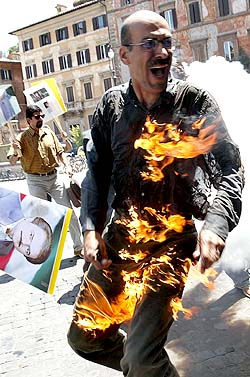
In 2003, when Maryam Rajavi was arrested in France, a large number of people protested against her arrest, declaring that they were burning themselves, the Parisian newspaper wrote that: “Before and after the self-immolation, several reporters were contacted on their cell phones, and the foreign relation spokesperson announced them the name of the person who wanted to set himself on fire.”
Interestingly, after the self-immolation, one of the Mojahedin offers the reporter a better photo of the self-immolation, and the Mojahedin filmed and photographed these scenes and posted them on their site, but after a while, they removed them from the site page due to bad feedback.
The organization uses different names to impress itself in the public mind by deception, and this is the imposition of a lie on its audience, and the individual suffers from multiplicity in the mind.
MEK went so far that due to their unpopularity among the Iranian people and the opposition groups, announce themselves as representing the majority of the people to the point that they hired a number of foreigners to be presented at their annual conference and gave them the flag of MEK to show that their number of supporters is more than the reality.
Even regarding the self-immolation of individuals, two members of the organization, Mahmoud Alemi, and Hossein Amini Gholipour, encouraged individuals to carry out self-immolation operations.
The interesting thing is that out of the 10 people who set themselves on fire, three of them were members of the political branch not from the military branch that would be a definition of being a soldier that feels like it is his duty to burn himself.
In 1984, France deported a number of members to Gabon, where they went on a 40-day hunger strike until the French government had to return them.
What is very prominent among the MEK is the spirit of sectarianism, which is very outdated, and the Mojahedin even decided to carry out suicide operations because they do not care about the lives of the people and seek to do things that will make a noise in the world, they even decided to carry out suicide operations in Karbala and even trained the women of Camp Ashraf in Iraq to carry out suicide operations there.
A 2009 report stated that the MEK praised suicide and always carried cyanide tablets with a leather cover around their necks, and swallowed a pill immediately if caught on missions. Also Rajavi called all members of the organization living martyrs, and among all the actions they took, self-immolation was the most common type of suicide and self-immolation became a tool, and even when members of the organization were prevented from leaving, they set themselves on fire, and the cause of death of disobedient members who had been killed under torture was declared a suicide.
All this goes back to the tortures and brainwashing that were inflicted on members, otherwise who is willing to sacrifice his life, which is his most important and valuable asset, to achieve the worthless human desires of a man introduces himself as the leader of the group and a claimant of human rights.
One of the tortures was that members of the organization were locked in solitary confinement and given a leaflet declaring their support for Massoud Rajavi as the leader of the group, and the individual had to repeat these sentences to himself to never forget it. Can a cult that violated every kind of human rights call itself a democratic group?
Jack Turner, geopolitica.ru
President Biden’s Ex adviser on Middle East affairs; Mr. Daniel Benaim offers a suggestion how US can mend its ties to Iran. A possible way is to transfer the Iranian Mujahedin sheltered in Albania to Ethiopia or somewhere on the shores of the Red Sea.
It is expected to witness drastic changes in US foreign policy after the inauguration of Joe Biden as President. He will strive to mend relations damaged by President Trump with Europe, Iran and China.
Daniel Benaim, who is expected to occupy an important position in Biden’s administration in his interview to “Jacobin Mag” stresses the fact that US abandonment of the nuclear deal with Iran(JCPOA) was a painful strike to Iran.
According to him strategic concessions should be offered to Iran, in order to lure it back to the negotiating table. Such concessions could include a reduction of the support to MEK (Mujahedin-e Khalq) sheltered in Albania.
Mr. Benaim suggests that a way out would be to transfer them to Ethiopia or somewhere on the shores of the Red Sea.
He declared: “My friend and I share the suggestion that Iran could welcome a reduction in US support to MEK.
Albanian officials in bilateral meetings with American officials have declared that they are concerned over illegal activities of MEK such as trafficking of human beings, drugs or gun running.
It is not necessary to shelter Muajhedin-e Khalq in Albania and close to EU borders for a long time and we can study the possibility of transferring them to Ethiopia or somewhere on the shores of the Red Sea.”
From 2013 being under American pressure, Albania has sheltered more than 4000 members of MEK, an opposition group to the current Iranian regime.
Gazeta Impakt – Translated by Nejat Society
Letter from “Mothers, the Forgotten Victims” to the Minister of Interior of the Albanian Government
Mr. SANDER LLESHAJ, Albanian Minister of Interiors
Greetings and best regards,
Contradictory reports from Albania indicate that somehow the life of Mr. Ehsan Bidi, a former member of the Mojahedin-e Khalq Organization (MEK, MKO, Rajavi Cult), is in danger.
As you know, Maryam Rajavi has been deported from France and also has no right to enter the European Union. Attempts to obtain entry visas to the United States and the United Kingdom have so far been unsuccessful. She blames the former members, who have revealed the truth about the cult, and intends to take revenge on them.
We know that the internal situation of the Rajavi Cult is very bad and a large number of members want to separate, and the officials of the organization are trying to make the situation outside the MEK camp in Albania unsafe so that no one dares to leave.
In the past, Maryam Rajavi had conspired against Mr. Ehsan Bidi many times and tried to silence him, but she did not succeed. She has not given up her efforts against Mr. Bidi and continues her conspiracies, including giving false information to the police. Apparently, Mr. Ehsan Bidi has been transferred to an unknown location by the police.
On behalf of the suffering mothers of MEK members in Albania, I must inform you that in the current situation, we hold the Albanian government and the Albanian State Police responsible for safeguarding the security of Mr. Bidi and other former members of the Rajavi Cult in that country.
Soraya Abdollahi,
Mothers, the forgotten victims
cc:
General Director of Albanian State Police (ASP) Ardi Veliu
European and International organizations and the media
Different concepts and theories from a social and psychological perspective can explain the situation of the Mojahedin Khalq, but it seems that to understand the social world of this group, in the first place, it is necessary to focus on recognition of two complementary elements, namely “the leadership” and “members” of this group.
In fact, these two are inseparable elements, which feed on each other, are the key to answering the question of how in a modern era, according to Marshall Berman, everything that is hard and solid can smoke and blow into the air and a new type of slavery take shape in Europe? In this part, I will first explain the concepts related to the discussion, because to analyze any action of this group, we must first know who we are facing.
To download the video click here
There is a common characteristic between the followers and the leader in this group, and this characteristic is the existence of an”authoritarian personality”in both of them (although there is a difference between the authoritarian personality of the leader and the authoritarian personality of the follower, which I will discuss later).
First, what is the characteristic of an authoritarian personality? And what are the common points of these two (leader and follower of Mojahedin Khalq)?
This type of personality, is an immature person whose important characteristic feature is the inability to rely on himself, dependent and inability to tolerate freedom. Humans learn two important skills during maturity, lovemaking and wisdom, which the authoritarian personality lacks. In fact, love means feeling that a person has with the world while maintaining the independence and integrity of one’s identity, or in other words, love means knowing the world as an emotional and passionate experience.
Wisdom is also understanding the world and trying to reach the essence and principle of phenomena. An authoritarian character has neither love nor wisdom, so he remains immature and extremely lonely. Note that the meaning of loneliness in this situation explains the subsequent actions of the authoritarian personality.
This situation leads him to desperately need a bond that does not require love and wisdom. He destroys his identity, he must melt into another person; because he cannot stand loneliness. These are the features that are common between Massoud Rajavi and his followers. Both incapable of making love and reasoning, they melt into the other half and feel lonely without each other to the point of madness. This situation reflects the hysterical states of the members of this group in many cases, such as the strange behavior like self-immolation of these people or suicide attempts. So that even people who are separated from this group are confused for a long time and cannot make decisions.
Now the question may arise for the reader that the type of action of the leader is not different from the followers?
The answer is yes, and this is exactly where we divide the authoritarian personality into two categories:”active authoritarian personality”such as Massoud Rajavi and”passive authoritarian personality”such as members of the group.
We will first understand the situation of the members of this group, who were categorized as”passive authoritarian personalities”. These people are self-harm, under control and eager to be a small part of a”big”person, a”big”organization, or a”big”idea, Whether this is greatness be real or it only be in the minds and illusions of these people, what matters is that this person feels strong and great by feeling that he is part of this greatness, the paradox is that such a person by shrinking and humiliating himself, can actually become part of this delusional greatness. This is the point that the leadership of the organization (Massoud Rajavi) repeatedly mentions in different meetings that the members of the group must be connected to a point outside of themselves in order to release their energies and reach unity, and only this is the path to reach the peak of human perfection.
This part may sound strange to a reader unfamiliar with the ideology of the MKO, but one of the techniques used in this group, called self-criticism or self-criticism sessions, has the same function. At first, the forces of this group”threatening and insulting each other”, humiliating themselves and attributed the most vile insults and misdeeds to themselves, then when all the identity of the members were destroyed, according to the group’s leadership, that member has been cleansed and purified, because he has put all his sins on the shoulders of the leader!!! And now that he is clean, or rather, he has no identity left, he can melt into leadership.
The next step is that such a person desperately wants orders and accepts orders wholeheartedly, or as this group calls this mental state, an organized member! But the fact is that such a person is so eager to accept orders because he does not have to decide and be responsible, avoiding his freedom as a human being, he devotedly seeks to give meaning to his destroyed existence. This humiliated character, who is terrified and feels helpless and lonely, seeks a leader to command him and control this feeling in him. The passive authoritarian character, who is”under control”and dominated by the leader, fears, and this fear causes him to take refuge to his self-made idol and calm down.
A crowd of authoritarian figures gathered around an idol forms a”mass”that explains another scenario in this group. When they are inside a population, they acquire new characteristics that are different from the characteristics of each individual that makes up that population. In fact, their self-conscious personality disappears and they seem to find a common spirit that guides the members’ feelings, thoughts and behaviors. This is the point at which the intellectual abilities and personality of individuals fade into the general spirit of the masses, and being in the crowd gives them a sense of invincible power. This situation can explain the actions of the members of the Mojahedin Khalq Group in situations where they are especially asked to sing slogans and songs with great enthusiasm in the meetings, and of course there are leaders to watch out for people who does not participate in this mass show with passion and enthusiastic.
Those who are familiar with the ideology of this group know that”gathering”is one of the situations for which the members of the organization have been harmed many times for that, and Rajavi and his gang wouldn’t tolerate any resistance in this mass to the leadership of the group. Because distancing oneself from the mass that is in the unconscious state and is only willing to do anything to kill itself in terms of indoctrination and contagion of other members, if it approaches the conscious state which is the domination of rationality, it realizes that all the members who shout the leader’s name with all their might are automatic beings who have lost their willpower. This is exactly the situation that many members of the Mojahedin Khalq Group have written in their biographies that they did not know what they were doing in that situation! It was like that they are not more themselves who were shouting, or even when they were about to commit suicide, it was as if someone else was leading them.
Now it is time to understand the status of leadership or the”active authoritarian personality.”This character, who is harming others, is very frightened and lonely, even though he looks like a confident and powerful person in the eyes of his followers; because he only feels empowered when he swallows others. He is heavily dependent on his followers, although his helplessness is manifested when he has lost power or is unable to swallow others. It is good to pay attention to the very brutal reactions that Rajavi and his associates have to members who make the slightest criticism of the group or the leadership. References to documents and individuals who have previously had experience in this group show that the slightest mercy did not exist even to those very close to Rajavi, and the slightest disagreement and critics dealt with severely punishment. This situation clearly shows how incompetent and lonely the leadership of this group is; because any kind of opposition frightens him greatly. He feels empowered and overcomes his deep loneliness by humiliating and enslaving the members of the group and seeing that the members of the group endure all the suffering of slavery without any resistance or disobedience.
With the explanation of these items, it is now clear why these two are the main parts of the Mojahedin Khalq Group and do not last without each other!
To understand this phenomenon more deeply, I ask a question that may have occupied the minds of many readers: If we accept these explanations, then what is the role of many leaders who have liberated and saved their society? What is the role of many patriots and martyrs who have sacrificed their whole existence for their nation? How can a sick authoritarian figure be distinguished from a true leader? What is the difference between real martyrs and national heroes and brainwashed masses? To answer this question, I return to the beginning of the discussion, where we defined the main characteristic of an authoritarian personality as his inability to make love and reason; what do we see in examining the real leader and the true patriot and the relationship between the leader and followers? The element of wisdom and the element of love. First, in this situation, followers are allowed to think, ponder, choose, critique, and decide freely; so they have reasoned, and if the forces stay with their leader, they will achieve their goals with love.
Compare this situation with the type of relationship Massoud Rajavi has with his followers; Those who for any other reason cannot or do not want to continue with this group, would be tortured, or killed, or if they can survive, they should suffer slanders, lies and conspiracies (as an example MKO attacks on critical journalists). To understand the difference between a true leader, a true patriot, and a thief of emotions, the only indicator that provides love is the one that brings freedom and independence to its people, not a sick man that Fearing for his loneliness, denies his freedom and his followers.
Finally, I call on all liberal and sociological institutions in Europe and the United States that are pursuing humanitarian goals to take a closer look at the situation of these individuals by being at the camp of Mojahedin Khalq members in Albania and consider the dimensions of this issue by further scientifically investigations.
By Alireza Niknam, geopolitica.ru